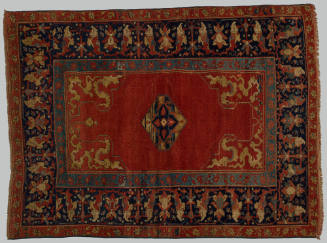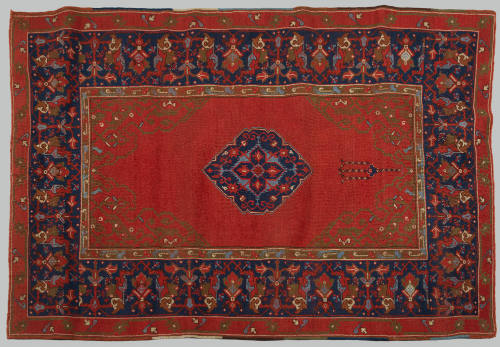
Carpet
Date20th century
OriginUnknown
MediumWool pile, orange-red wool warps, red wool wefts.
Dimensions5'10" X 4'2"
Credit LineMuseum Purchase
Object number1957-138
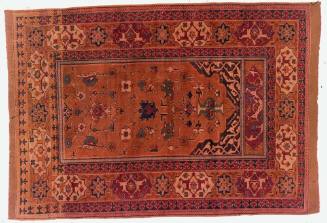
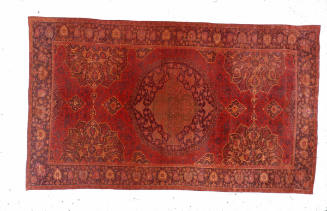
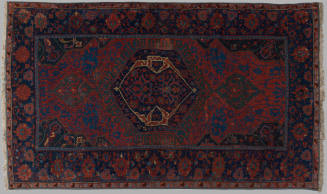
DescriptionCarpet: Ghiordes knot; approximately 72 knots per square inch; 2 shoots red wool weft after each row of knots. Colors: Ground; field-red, centermedallion- dark blue, border-dark blue, inner guard band- brown, outer guard band- red; Pattern; white, light blue, dark blue, green, orange, red, dark green. The field of the rug has a double niche, one at each end. The four spandrels show interlaced arabesques with half-palmettes. In the center of the field there is a lobed oval medallion with arabesques and floral scrolls bearing stylized palmettes. The border has a pattern of floral scrolls with lotus palmettes and carnations, interlaced with an arabesque scroll bearing large composite half-palmettes. The outer guard band has a wavy floral scroll with angular palmettes and leaves. The inner guard band has a geometrical scroll with leaves and spirals.Construction History
20th century: Initial constructionLabel TextThis carpet has been determined by specialists to be an "obvious forgery," perhaps a direct copy of an 18th century Turkish prayer carpet also in the collection (1957-128). The condition is believed to be too "incredible for an old rug," while the wear is too evenly distributed; the color, especially throughout the foundation, are similarly uncharacterstic. Analysis under a microscope even revealed that the rug was mended with that same material that it was woven with.
In the 19th and 20th centuries, many carpets modeled on (and sold as) desirable 16th, 17th, and 18th century Anatolian types were produced for a contemporary audience. Often woven in Eastern Europe, these carpet "copies" passed as an authentic, and even ended up in many European and American museum collections.Inscription(s)None foundMark(s)None foundProvenancePrior to 1957, Beshir Galleries (New York, NY); 1957-present, purchased by The Colonial Williamsburg Foundation (Williamsburg, VA)
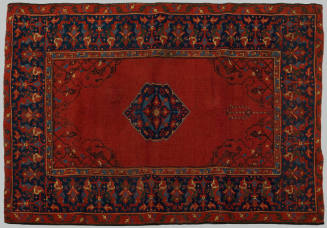
18th century, possibly
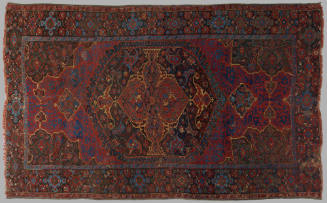
18th c.
20th century (probably)
18th century
17th century
17th century (probably)
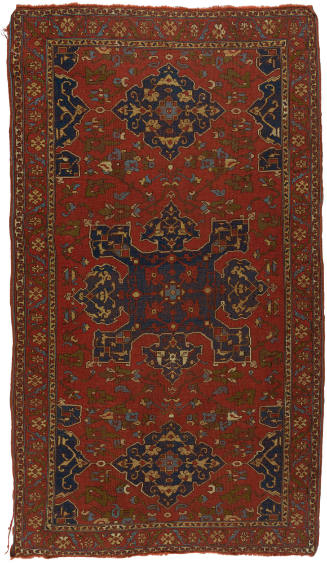
Probably 19th or 20th c.
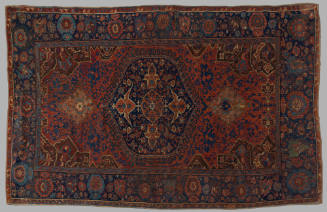
17th or 18th c.
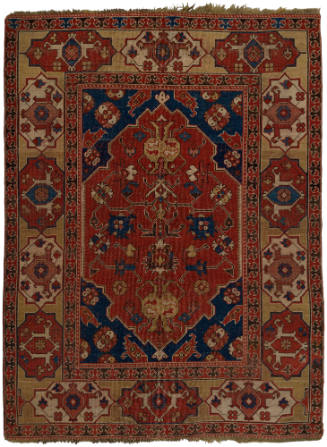
17th or 18th century
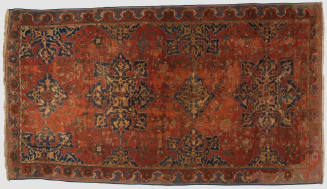
17th century
18th or 19th century