
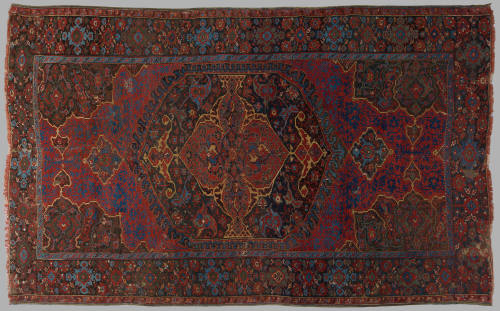
Carpet
Date18th century
OriginAsia, Turkey, Ushak
MediumWool pile, red cotton and wool warps, red wool wefts.
Dimensions92" X 144"
Credit LineMuseum Purchase
Object number1959-109
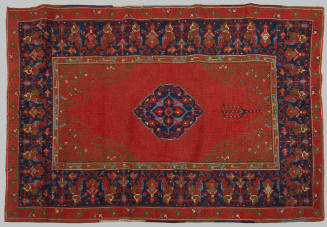
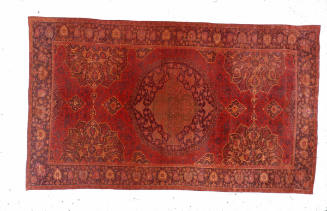
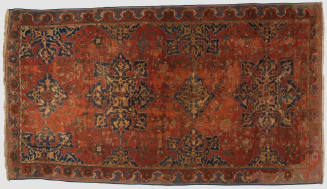
DescriptionCarpet: Ghiordes knot; approximately 63 knots per square inch; 2 shoots red wool wefts after each row of knots. Colors: Ground: field-red, central medallion-blue and green, inside medallion- red, border- dark blue, outer guard band- red, inner guard band-light blue; Pattern: white, yellow, light blue, dark blue, red, green, dark brown. In the center of the field is a pointed oval medallion containing floral scrolls interlacing with arabesques whose half-palmettes form a quatrefoil compartment. At each end of the central medallion is a lobed pendant attached with an arabesque design. In each corner of the field are sections of medallions. The rest of the field is covered with angular floral scrolls. The border contains a pattern of floral scrolls with palmettes surrounding a series of quartrefoiled medallions and rosettes. The inner guard band has a series of angular S-motives. The outer guard band has a geometrical scroll with spiral motives.Construction History
18th Century: Initial construction
1959: Repaired and lined (with purchase) by Beshir Galleries (New York, NY)
May 1980: Cleaned by Yonan Rug Company Inc. (Richmond, VA)
Apr. - Aug. 2009: Linen backing removed, areas strenghthened and mended, vaccumed front and back (for loan and exhibition)Label TextWith its intricate center medallion and arabesque motifs, this carpet serves as an example of the Turkish "Ushak medallion" design. Imported "Turkey carpets," (as they were known in Europe and America in the early modern period), reached popularity among the upper echelons of society as symbols of status and class. Oriental carpets, because of their high value, were most often placed on tables or beds rather than floors until the mid-18th century.Inscription(s)NoneMark(s)NoneProvenancePrior to 1959, Beshir Galleries (New York, NY); 1959-present, purchased by The Colonial Williamsburg Foundation (Williamsburg, VA)
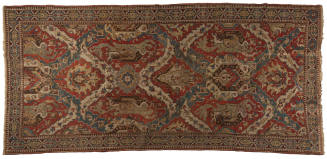
18th century
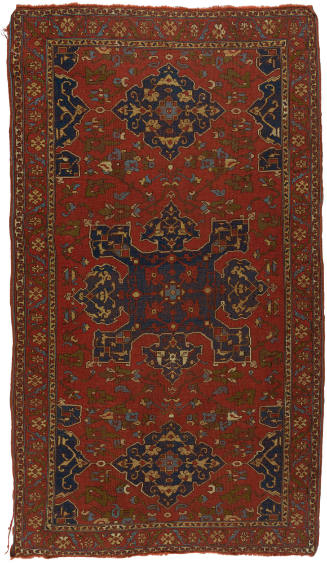
19th-20th century (probably)
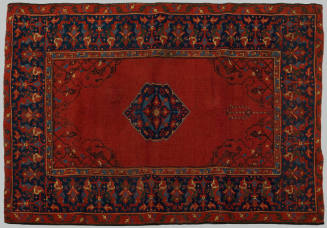
18th century (possibly)
20th century
17th century
20th century (probably)
18th-19th century
18th century
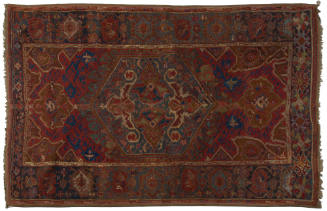
18th century (possibly)
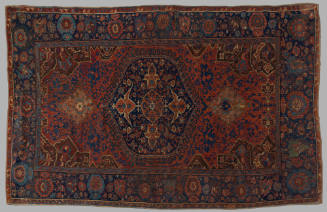
17th-18th century
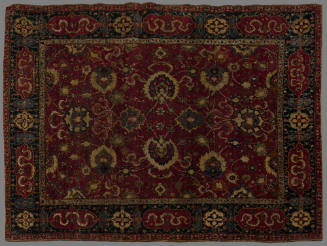
17th century (probably)
17th century