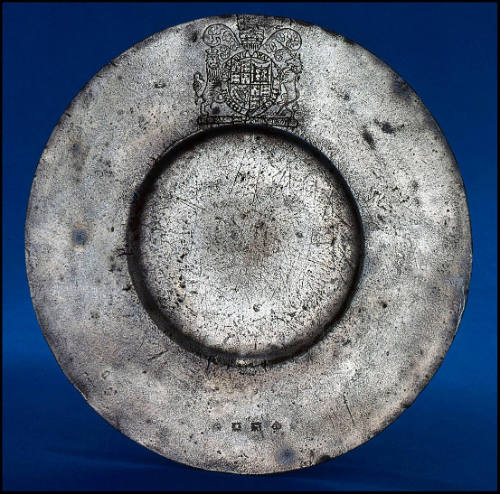
Plate
Date1660-1680
Maker
James Taudin I
OriginEngland, London
MediumPewter
DimensionsDiam: 10 1/8"; W (rim): 2 7/16"
Credit LineMuseum Purchase
Object number1976-362
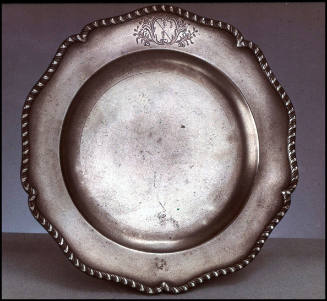
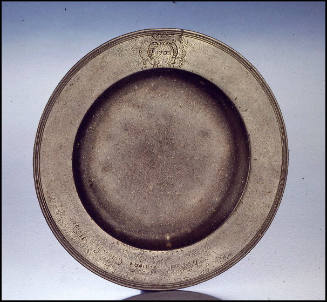
Label TextThis splendid plate is the only recorded English pewter plate from the seventeenth century that is engraved with the royal arms. It may have been occasioned by the remarkable relationship between James Taudin, the maker, and King Charles II. Since his arrival from France in the 1650s, members of the Pewterers' Company harassed Taudin, trying to discourage him from practicing his trade. They forcibly entered his house to damage and seize over 1,800 pounds of pewter. Taudin petitioned Cromwell, and the Pewterers' Company was forced to accept him as a member. When he was further harassed, an angry Charles II sent a blunt letter to the Company, dated November 7, 1668. The King wrote, in part, "We expect you will look on the said James Taudin as Our Servant and that he shall not have any occasion given him from you or any of you to complain at any time of him being so admitted into your Corporation or to seek relief from Us against any hard usages he may receive from you. We shall not doubt your Compliance." Ronald Homer has suggested that the King's reference to Taudin as "Our Servant" indicates that he made pewter "by appointment" to the King.
This was not an otherwise unknown distinction, for he cites William Hurstwaight having been referred to as "pewterer to the king" in 1526, and James Durand, a successor to Taudin, as "Pewterer to his Majesty" in 1763.
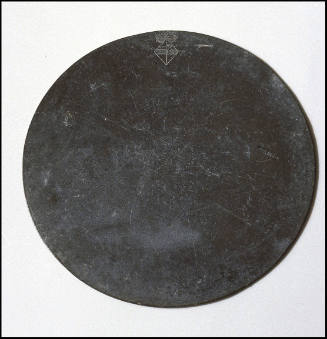
Inscription(s)English royal arms engraved on face of rim opposite pseudo hallmarks. Owner's initials "HW" engraved on underside of well.Mark(s)Maker's touch a rose within a shield with palm fronds to the sides and crossing below with "E:SONNANT" and "I:TAUDIN" within curved reserves with intervening scrolls and bosses above, all within an oval on underside of rim (London Touch Plate I, 16; Cotterell 4650). Pseudo hallmarks (1) "I [?] RT" with mullet above and below within a lozenge, (2) unicorn passant within a serrated rectangle, (3) leopard's head within a serrated rectangle, and (4) indistinct, on face of rim.ProvenanceIsher, Cheltenham, Gloucestershire (sold after his death by Bruton Knowles & Co. in 1976); purchased from Jellinek & Sampson Antiques, London.