
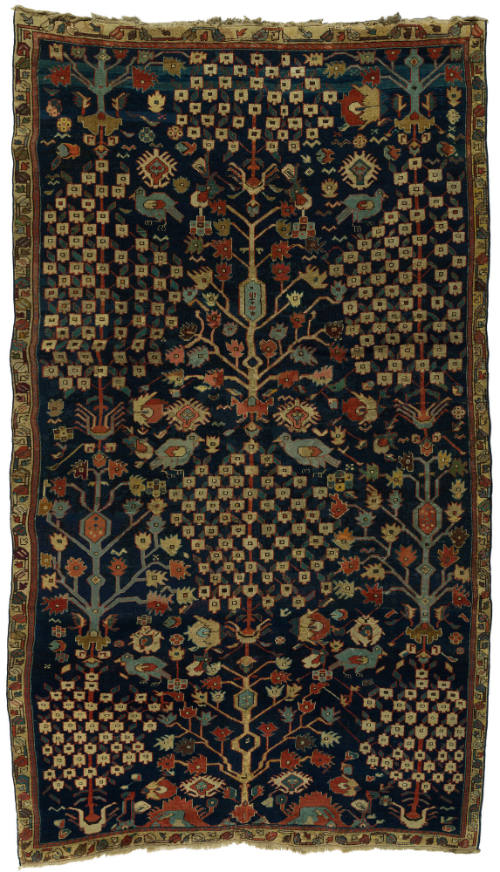
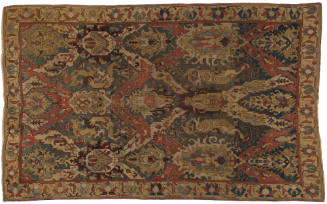
Carpet, tree pattern
Date18th-19th century
OriginAsia, Persia
MediumWool pile, natural cotton warps and wefts.
Dimensions5'6" x 10' 5".
Credit LineMuseum Purchase
Object number1957-175
DescriptionTree pattern carpet. Ghiordes knot: about 90 knots per square inch: two shoots of natural cotton wefts after each row of knots. Colors: ground: fiedld-dark blue; border-creamy yellow; inner guard band-red; Pattern: white, yellow, orange, brick-red, salmon-red, light-blue, dark-blue, black-brown. The field has several rows of stylized trees bearing palmettes on bell-shaped blossoms. Between trees there are two stylized birds.Construction History
18th or 19th century: Initial construction
1957: Holes and edges repaired, lined; by Beshir Galleries (New York, NY)
Nov. 1970: Handcleaned, selvedges overcast, mended, and lining removed; by Beshir Galleries (New York, NY)
Dec. 17, 1984: Backed with cotton, Velcro/muslin strip attached to top edge, Velcro dots stitched along vertical edges; for exhibition
Apr. 9, 1985: Second velcro/muslin strip added to back; for hanging support during exhibition
July 1, 1985: Row of basting stitches removed from back; to decrease buckling during exhibitionLabel TextPersian carpets, though less prevalent than popular "Turkey" carpets, were still among the Oriental textiles brought to America in the 18th and 19th centuries. A 1773 South Carolina Gazette advertisement for Captain Maitland's "well-assorted cargo of goods" imported from London includes a "...variety of very handsome Persia, Wilton, Brussels, and Scotch carpets, and carpeting, some are for pews, bedsides and tables...' These types of merchant advertisements were common, listing Persian carpets alongside an "assortment" of luxury and exotic items for sale in America.
This Persian carpet is especially striking because of its intricate "flowering tree" motif, interlaced with detailed birds and shrubs; it has been identified as a "late descendant" of earlier carpets of this design.Inscription(s)None foundMark(s)None foundProvenancePrior to 1957, Beshir Galleries (New York, NY); 1957-present, purchased by The Colonial Williamsburg Foundation (Williamsburg, VA)
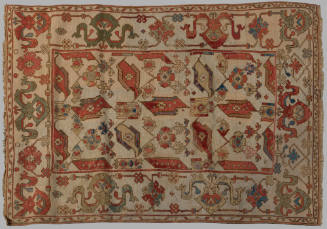
Probably 17th century (original parts)
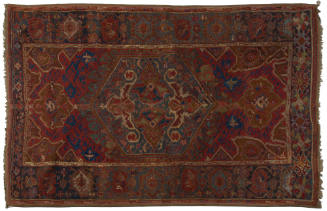
18th century (possibly)
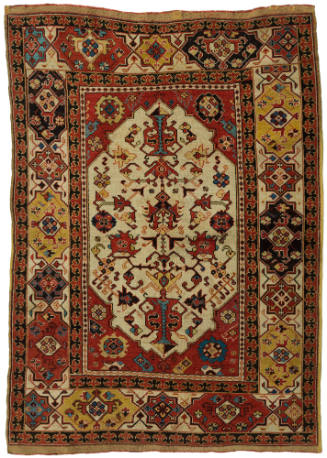
19th century (possibly)
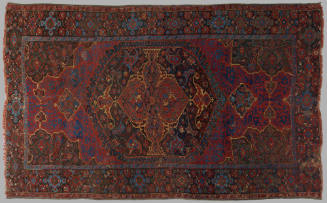
18th century
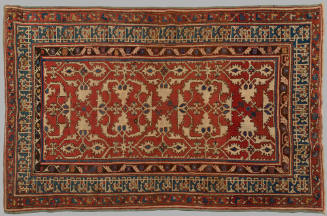
17th century (or later)
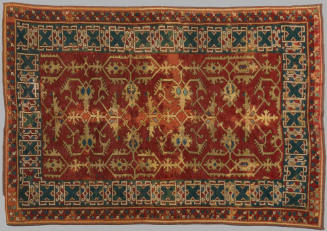
Probably late 17th century
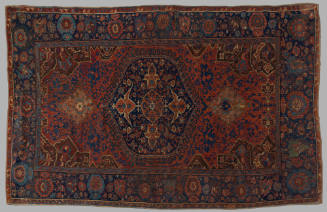
17th-18th century
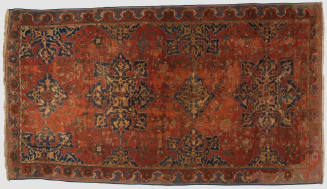
17th century
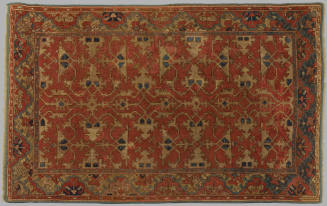
17th-18th century
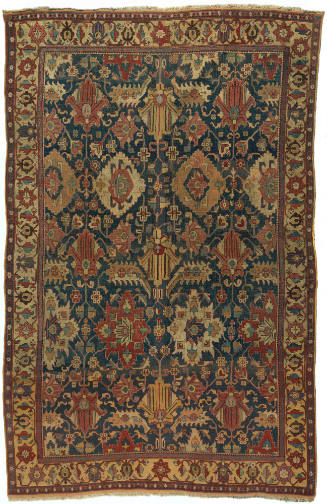
18th century
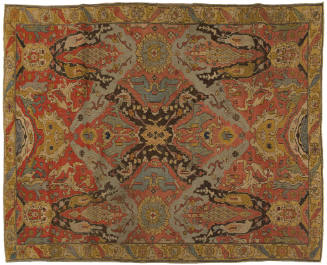
1700-1730