
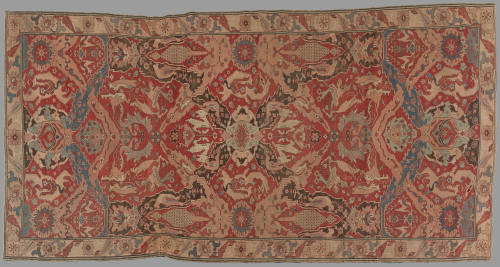
Carpet, 20th Century Forgery
Dateca. 1930
Artist/Maker
Tuduk
MediumWool pile, olive-drab wool warps and wefts
Dimensions13' 5" X 6' 9"
Credit LineMuseum Purchase
Object number1957-35
DescriptionThe field of this rug is carefully made, an exact mirror repeat centered with a lozenge- shaped medallion formed by long serrated leaves. Other long serrated leaves, bearing floral tracery, are joined together with large and small cartouches and criss-crossed to form geometric devices at end of the field. Scattered throughout the field are such figures as stylized birds, dragons, cypress trees, rosettes and palmettes, all symmetrically arranged. The border is a pleasing design of alternating rosettes and palmettes separated by angular pointed light and dark leaves. Guard bands are simple lines of color. Ghiordes Knot; about 56 knots per square inch; 2 shoots olive wool wefts after each row of knots. Colors: Ground: field - brick red (madder red); border - muddy tan; guard bands - light blue; Pattern: tan, light brown, henna, ivory, light blue, medium blue, dark blue, black.Construction History
Ca. 1930: Initial construction, possibly by Teodor Tuduc
1957: Lined and repaired by Karekin Beshir (New York, NY)Label TextThough this carpet is now widely accepted as a 20th century forgery, it originally passed as an antique Caucasian Kuba when purchased by Colonial Williamsburg (via a reputable dealer) in 1957. In 1964, expert Charles Grant Ellis identified it as the work of Teodor Tuduc, a notorious Oriental carpet forger who operated out of Eastern Europe between 1900 and 1935. Probably copied from photographs or fragments of 17th-century examples, certain inauthentic features of this carpet signify imitation, including the odd color palette, the mirror-repeat design, and the "mask-like" motifs. Further, this carpet appears to have been worn artifically, whether chemically or manually.
Forged carpets are notably distinct from reproductions, as forgeries are made to decieve through their deliberate workmanship. Many fakes have been discovered in museum collections, and perhaps many are still going unnoticed today. These carpets, the results of an industry that had widespread influence, can speak to the 20th century value and demand of Oriental carpets.
Inscription(s)None foundMark(s)None foundProvenancePrior to 1957, Beshir Galleries (New York, NY); 1957-present, purchased by the Colonial Williamsburg Foundation (Williamsburg, VA)
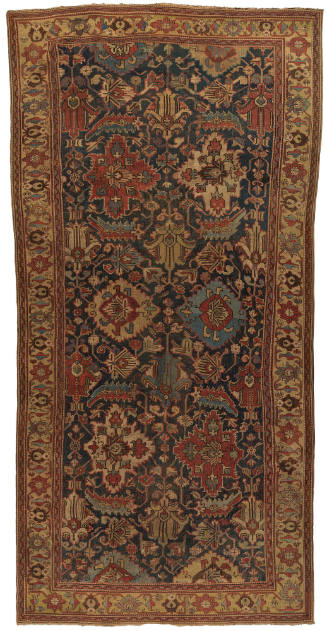
18th century
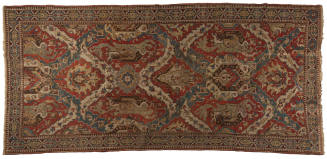
18th century
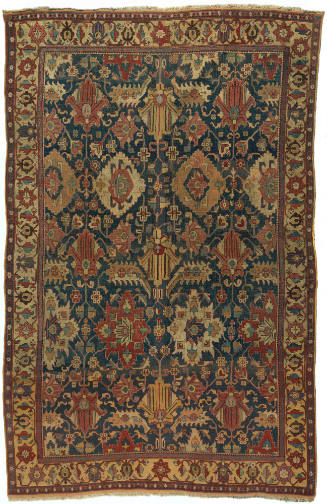
18th century
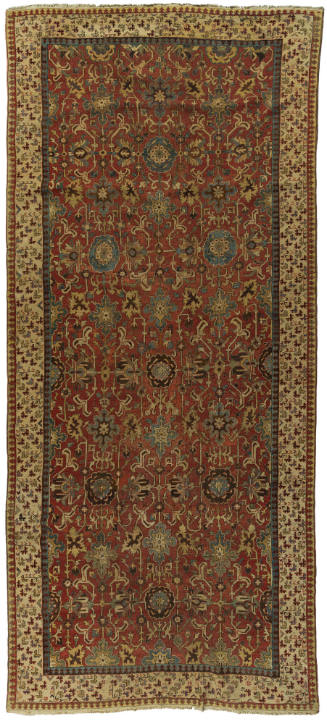
18th century (?)

Late 19th or early 20th century
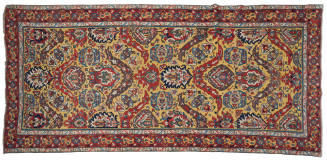
19th-20th century
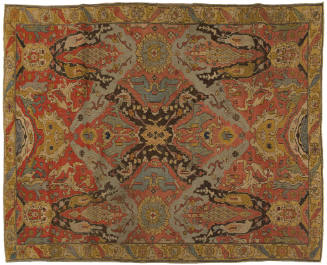
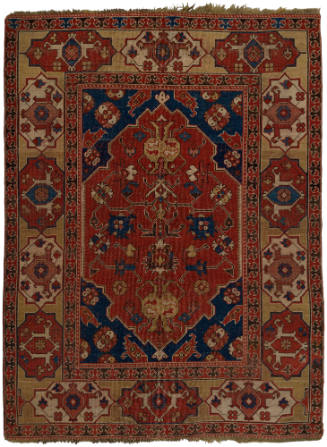
17th-18th century
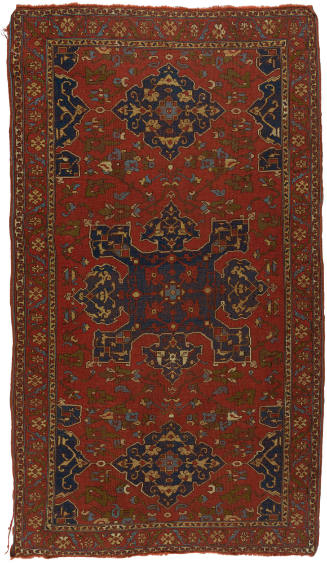
19th-20th century (probably)
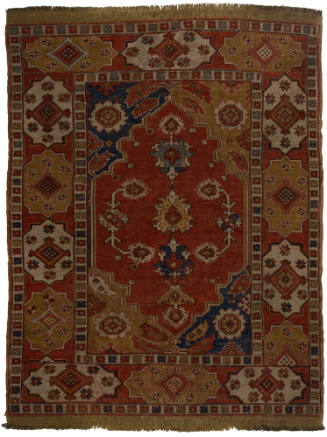
Possibly 18th century (may be earlier or later)
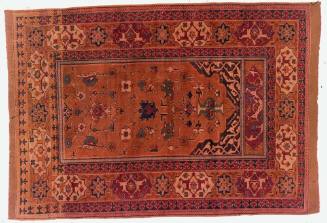
20th century (probably)
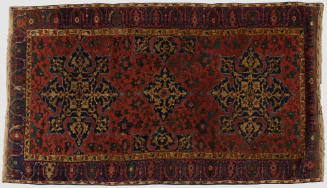
17th century