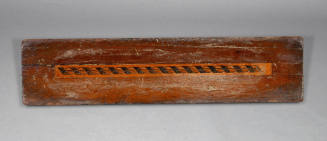
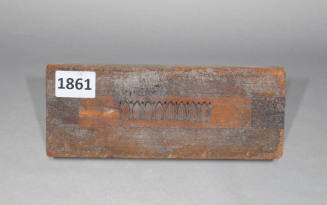
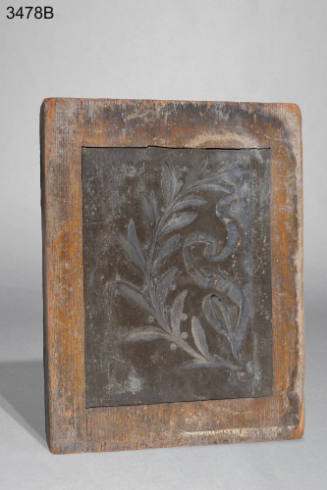
Composition Mould
OriginEngland or America
MediumBoxwood
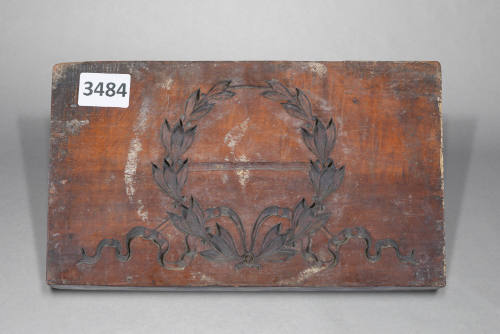
DimensionsMotif: 9 3/4" (W) x 5 1/2" (H) x 3/16" (D) at outer edges of top ribbon. Base: 11 1/2" (L) x 6 5/8" (W) x 1 7/8" (T).
Credit LineGift of Mr. & Mrs. Elias Nassim
Object numberAF-X2023.3484
DescriptionIt is a boxwood carving depicting a laurel wreath topped with a ribbon knot and extensions of crimped ribbon on each side of the knot. The two arcs of laurel stem are separated by a straight line intended to support the carving when the impressed material when removed from the carved block. The two stems of laurel have six pairs of leaf clusters (three leaves in each cluster). There are 5 sets of two berries separating the leaf clusters. Two swags of crimped ribbon extend down below the bottom of the knot. At the base of the carving is a carved stem continuation connecting the stems for support (like the one in the middle). There are two straight support lines carved from the laurel stem to the upper ribbons.Label TextThis antique composition mould represents a trade that was practiced in Virginia during the Revolutionary period and into the 19th century. It depicts a common design found in upper class homes and public buildings. Composition was a substitute for more laboriously produced ornamental plaster and carved wood and stone. It is thought that the Adam brothers (Robert Adam 1728-1792) and John Adam (1721-1792)) played a major role in the initial manufacture of composition ornament on a grand scale. The Adam style demanded a large amount of delicate low-relief ornament. These moulds are for the production of such ornament in plaster, or in composition, usually a combination of whiting, glue, rosin and oil. The finished ornament was used on furniture and other objects as well as in the decoration of rooms.
Second half of 18th century
1690-1720
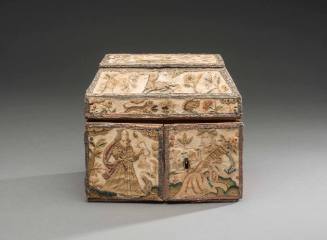
1650-1675