
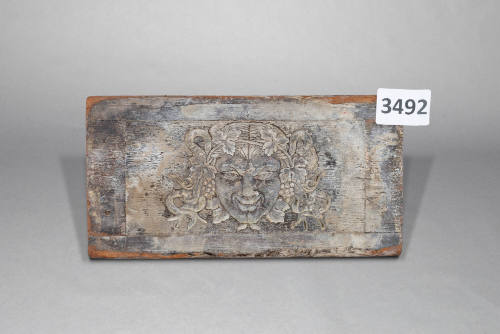
Composition Mould
OriginEngland or America
MediumResin; Wood
DimensionsImpression = 4 5/8" (W) x 3" (H) x 1/2" (D) at the tip of the nose. Inset: 6 3/4" (L) x 3" (W) x 9/16" (T). Base: 8 7/8" (L) x 4 1/2" (W) x 2" (T).
Credit LineGift of Mr. & Mrs. Elias Nassim
Object numberAF-X2023.3492
DescriptionIt is a resin mould inset into a wood base with plugs on both ends of the inset. It is the forward-facing head of a god of wine (mythological). The face is surrounded by entwined clusters of grapes and grape leaves with the stem above the brow as a band holding the hair back from the face. There are crimped ribbons descending from the grape clusters and from each side of the upper headband down the length of his face. The face is oval with a widow’s peak of hair pointing down to the nose. The eyes are slanted up and squinted. The nose has flared nostrils above a grinning mouth with teeth showing. There is a cleft chin with a goatee below.Label TextThis antique composition mould represents a trade that was practiced in Virginia during the Revolutionary period and into the 19th century. It depicts a common design found in upper class homes and public buildings. Composition was a substitute for more laboriously produced ornamental plaster and carved wood and stone. It is thought that the Adam brothers (Robert Adam 1728-1792) and John Adam (1721-1792)) played a major role in the initial manufacture of composition ornament on a grand scale. The Adam style demanded a large amount of delicate low-relief ornament. These moulds are for the production of such ornament in plaster, or in composition, usually a combination of whiting, glue, rosin and oil. The finished ornament was used on furniture and other objects as well as in the decoration of rooms.
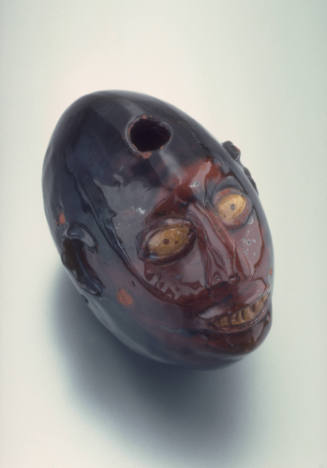
1850-1875
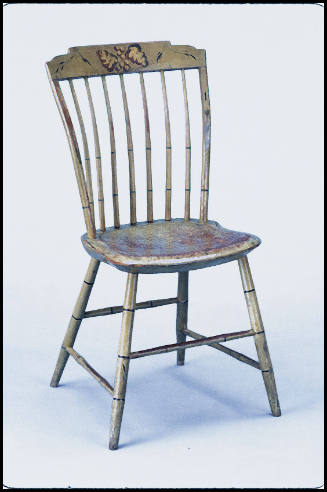
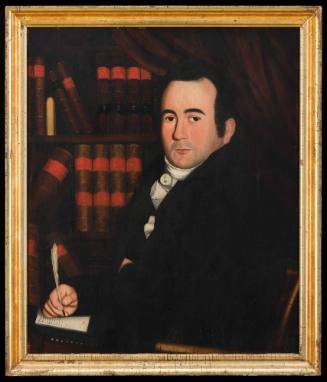
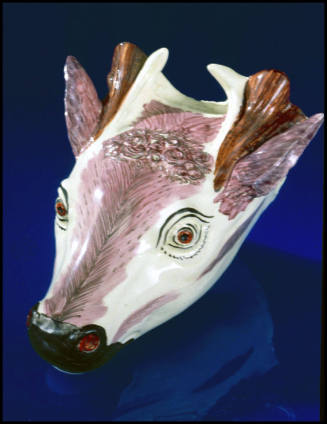
ca. 1800
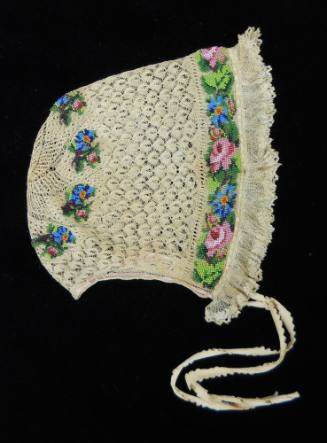
1830-1860
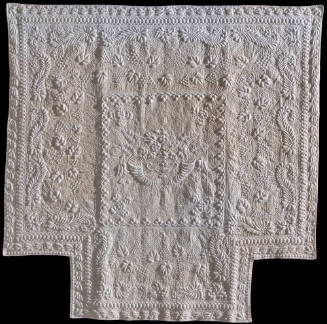
1830-1850
Early 19th century
1805-1810
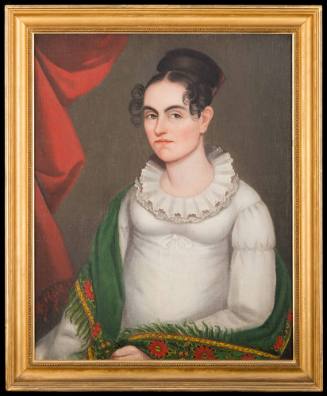
Ammi Phillips
1820-1825 (probably)