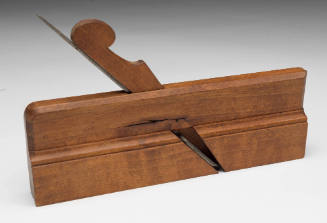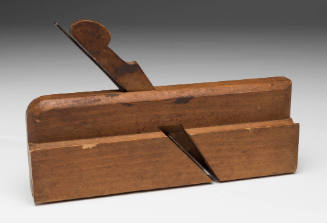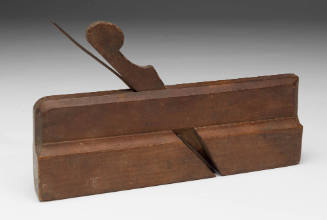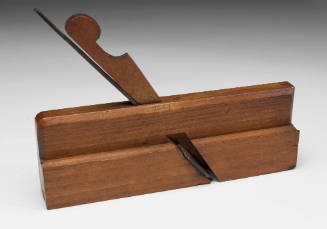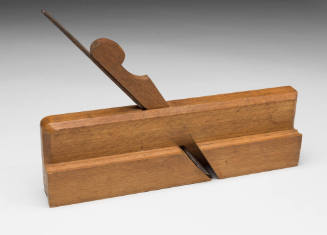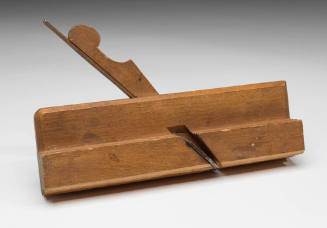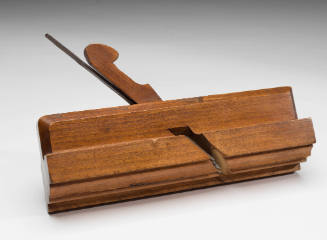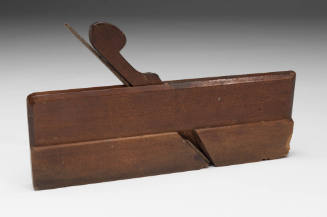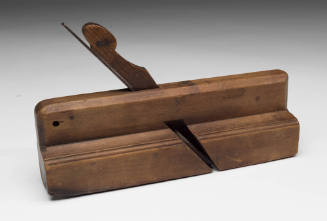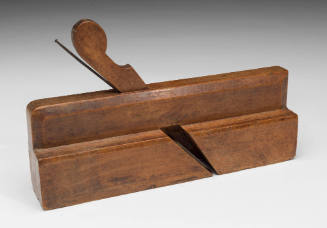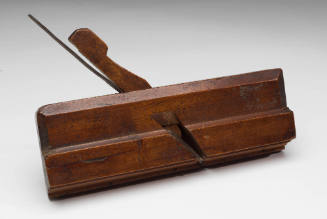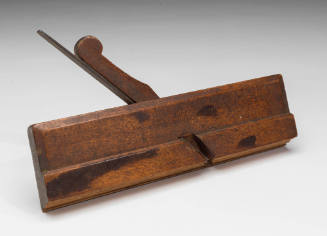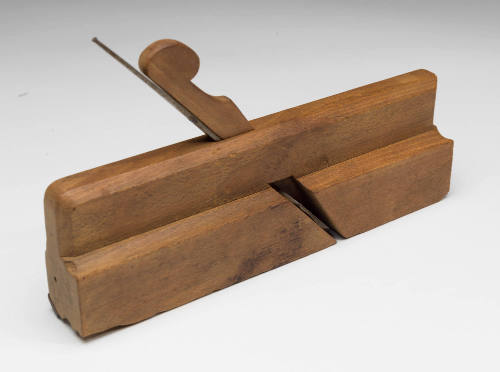
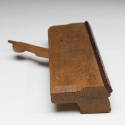
Complex Molding Plane
Dateca. 1785-1800
Maker
Henry Clock
1749 - 1818
MediumBeech, walnut, iron, and steel
DimensionsLength: 10"; Thickness; 1 1/2"
Credit LineGift of Thomas Elliott
Object number2024-268
DescriptionComplex molding plane with a molded shoulder and flat chamfers that end with a line and a gouge cut. Replaced walnut fence help by screws.Label TextHenry Clock (sometimes Klock) was born into a family of German decent in New York's Mohawk River Valley. His grandfather, Johann Henrich Klock, arrived from Hesse-Kassel in 1710, and was engaged in the "Indian trade." Henry's father built the stone Fort Klock, a fur-trading post, which doubled as a refuge for the local settlers in case of an attack. During the Revolutionary War, Henry Clock served in the 2nd Regiment of the Tryon County Militia, commanded by Col. Jacob Klock, his kinsman.In the years after the Revolution, Clock turned to farming as his primary occupation. The only hint of any woodworking activities on his part comes in the mid-1790s, when he served as one of the Directors erecting an octagonal church in Little Falls, NY.
Possibly dating from the time of the Octagon Church's construction, this plane was made with an imported English iron marked G. BISHOP, " then working in Sheffield. This plane was found in Colorado in the early 1990s with seven others, all marked by Clock.Mark(s)H:CLOCK in relief within a serrated rectangle, is struck into the toe (Elliott, GAWP 5th ed., p.76). G. BISHOP in incuse, is struck into the tang of the iron.ProvenanceSeptember 1992, purchased by Thomas Elliott (Westbrook, CT); 2024, given to The Colonial Williamsburg Foundation (Williamsburg, VA)