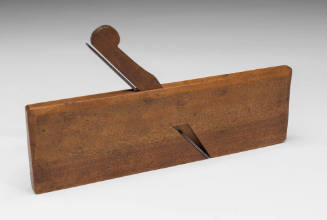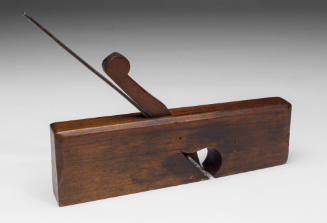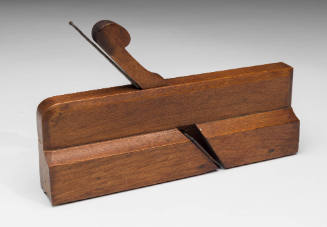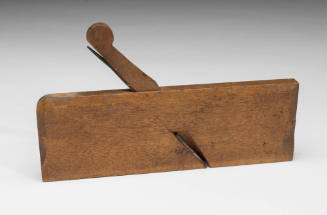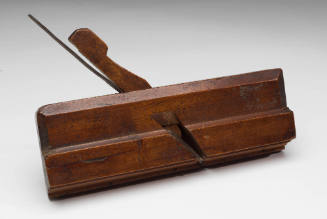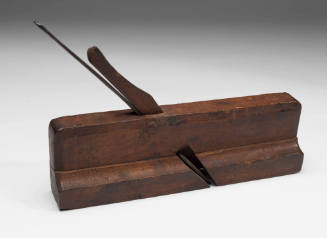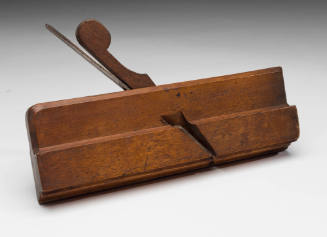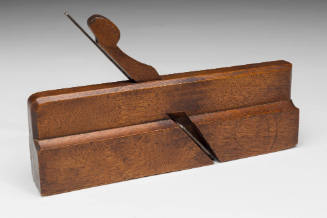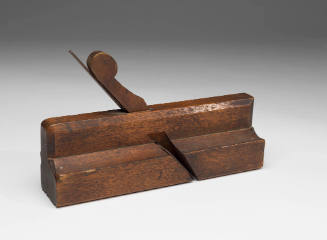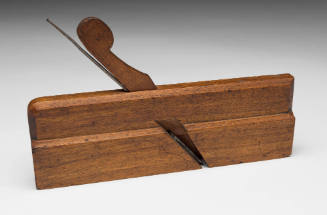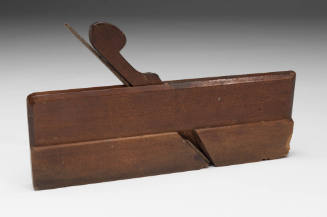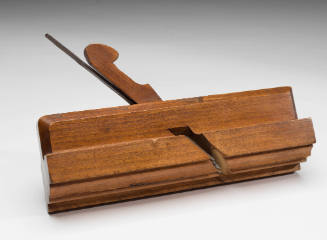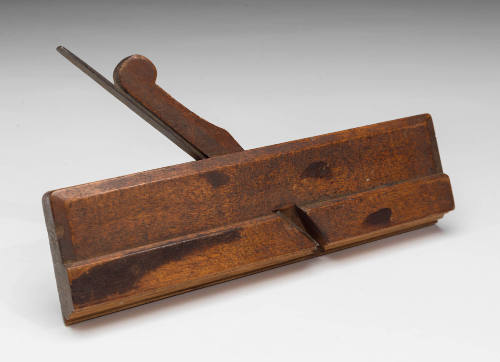
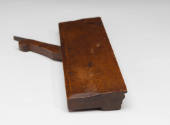
Small Complex Molding Plane
Dateca. 1760-1780
Maker
Able Spicer
1736 - 1784
MediumBirch, iron, and steel
DimensionsLength: 9 5/8"; thickness: 15/16"
Credit LineGift of Thomas Elliott
Object number2024-316
DescriptionSmall complex molding plane with flat chamfers that end with a slopped line with a long, tapered return, and a molded shoulder.Label TextOne of the earliest documented planemakers in Connecticut, Able Spicer was a cabinetmaker, whose estate inventory included 8 planes, 23 gouges and chisels, a turning wheel, a glue pot, and a "phenearing" (veneering) saw. Also listed was "one stamp," which may be the name punch he used to mark his woodworking planes.Plane making ran in his family, as his older brother Oliver also engaged in the trade. The brothers are two of perhaps five or six plane making Spicers operating out of eastern Connecticut between the middle of the 18th century and about 1820.
Styled Captain Able Spicer, he served in the French and Indian War and was at Crown Point, the longstanding seat of France in the Champlain Valley of New York, taken by the British and Americans in 1759. A member of the 5th, and later the 4th Connecticut Regiment, he spent some time in the hospital there in 1760.
During the Revolutionary War, Spicer led his men to the Siege of Boston after the Lexington Alarm, and fought in the Battle of Bunker Hill on June 17, 1775. In late 1775, he was listed as a Captain in the 5th Connecticut Regiment, but by October of 1776, Spicer is serving in the Connecticut State Regiment and in camp at Harlem Heights in Manhattan. Shortly thereafter, he is recorded with his unit at White Plains, showing he saw action in the New York Campaign of 1776. Spicer left the regular service to return home, but continued to serve as Captain in the local militia. He died in the spring of 1784, at the age of only forty eight.Mark(s)The toe of the plane marked with AxSPICER in relief within a conforming rectangle (Elliott, AWP, p.353, imprint A).ProvenanceSeptember 1993, purchased by Thomas Elliott (Westbrook, CT); 2024, given to The Colonial Williamsburg Foundation (Williamsburg, VA)