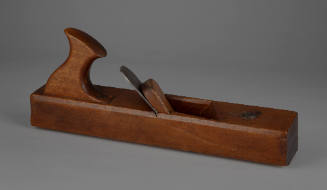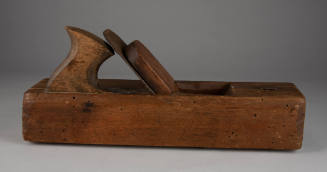
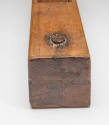
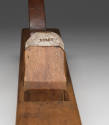
Jointer Plane
Dateca. 1790-1810
Maker
John Lindenberger
1754 - 1817
MediumBirch, iron, and steel
DimensionsOverall: 28 1/8 × 3 1/4 × 6 15/16 in (71.5 × 8.2 × 17.7cm)
Body: Length: 28 1/8"; Height: 3"; Width: 3 1/4"
Width of cutting edge: 2 1/2"
Body: Length: 28 1/8"; Height: 3"; Width: 3 1/4"
Width of cutting edge: 2 1/2"
Credit LineGift of Thomas Elliott
Object number2024-298
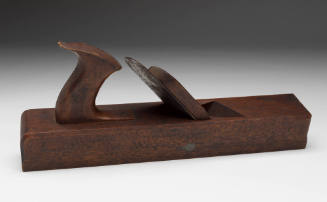
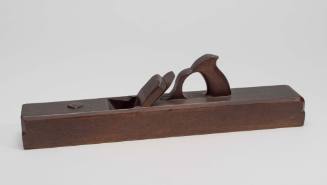
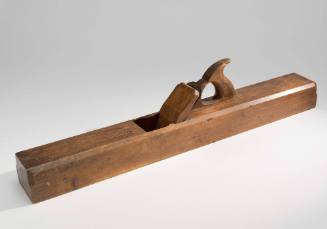
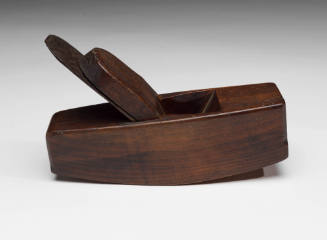
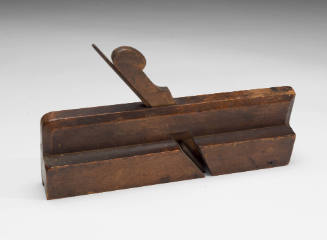
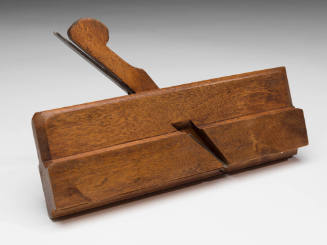
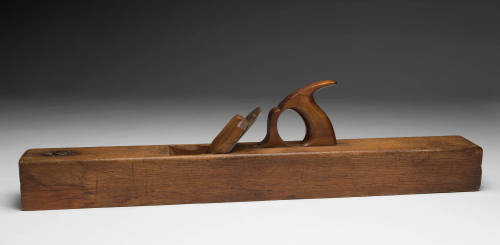
DescriptionJointer plane with a slightly rectangular body, an off-set closed tote, a round-top iron, and a strike-button on the toe. The body is chamfered, with turn-outs at the ends.Label TextJointers, the longest of the bench planes, were used to true-up boards intended to be joined edge-to-edge. They were pushed along the board’s edge in one continuous motion to produce a smooth, level surface.This plane was made by a true American "jack of many trades," John Lindenberger (1754-1817). Born in Baltimore in 1754, John served in the Revolutionary War as an Ensign of the German Regiment and as a 1st. Lieut. of the 4th Continental Artillery. Lindenberger fought at the battles of Brandywine, Germantown, Trenton, and Princeton.
After the war, Lindenberger relocated to Providence, where he had set up shop by 1786. The next year, he advertised that he was "carrying on the planemaking business," in addition to other activities.
Lindenberger was also a blacksmith, toolmaker, architecture instructor, and merchant. When he died in 1817, his inventory included 1500 feel of "Beech and birch stuff," 962 molding plane irons, 391 molding planes, 59 bench planes, two moving filister planes, and three plow planes.Mark(s)The toe of the plane marked with "I:LINDENBERGER" and "PROVIDENCE," in italic relief within rectangles (Elliott, AWP, p.229, imprint A). The iron is struck with "SORBY," incuse.ProvenanceJanuary 2002, purchased by Thomas Elliott (Westbrook, CT); 2024, given to The Colonial Williamsburg Foundation (Williamsburg, VA)