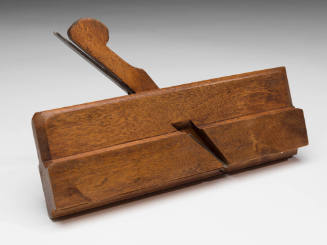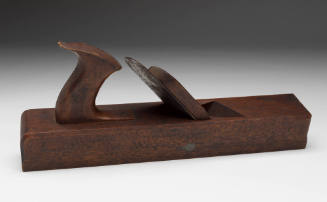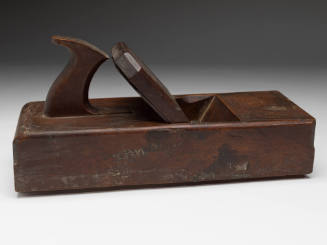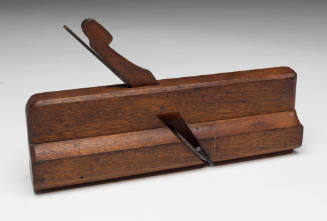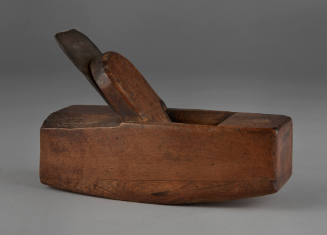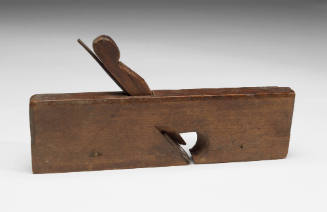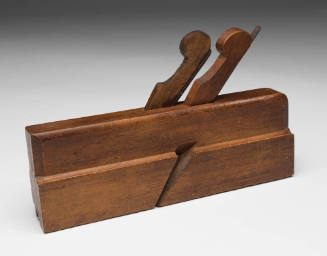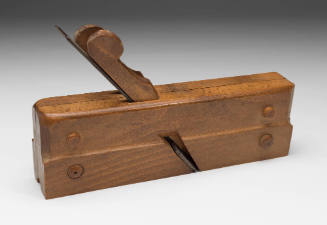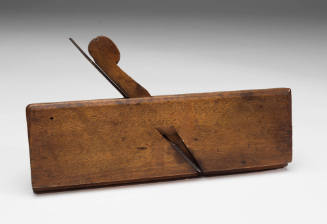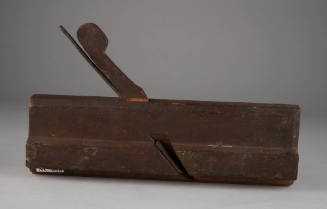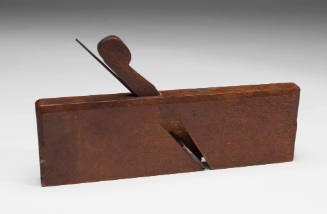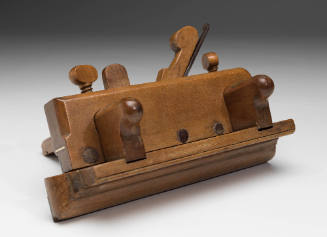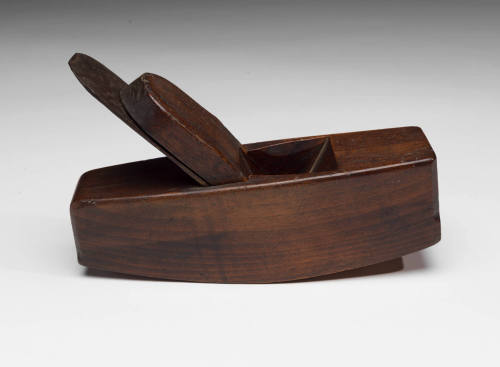
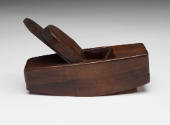
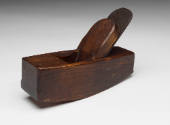
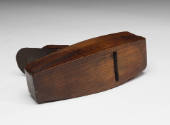
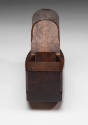
Compass Smoothing Plane
Dateca. 1790-1800
Maker
Joseph Fuller
1746 - 1822
MediumBeech, iron, and steel
DimensionsLength: 8"; width: 2 11/16"
Credit LineGift of Thomas Elliott
Object number2024-276
DescriptionCompass smoothing plane with rounded chamfers on the top rear, and flat chamfers that terminate in turn-outs on the toe and heel sides. Its round top imported British iron is held by a round-top chamfered wedge.Label TextJoseph Fuller followed in the footsteps of Francis Nicholson, his son John, and Cesar Chelor, who founded the American planemaking trade early in the eighteenth century. Though he was only about six years old when Francis died, and it is believed John turned to other ways of making a living in the mid-1760s, Chelor and Fuller were contemporaries. Only twenty-something miles apart along the same highway into Boston, the two planemaking specialists may have even been friends. Fuller's earliest located advertisement ran in the January 9, 1773 issue of the Providence Gazette. Above the copy, the headline reads JOINERS TOOLS Made and Sold by JOSEPH FULLER. Staying put during the Revolution, Fuller served his hometown as Ensign and Captain in the 4th. Company of the Providence County Militia.
In 1784, with Chelor's death, the epicenter of the trade in this part of New England moved south to Providence, and was to be dominated by Joseph Fuller, now acknowledged as one of the most important early American tool makers. As a prolific manufacturer who made thousands of planes spanning at least five decades, Fuller's products helped drive the ever-evolving form of newly-made tools.
Today, Joseph Fuller's planes are amongst the most commonly encountered American planes of the era, spanning the gamut from small compass planes up to large jointers, and everything in between.Mark(s)JO,FULLER← above IN above PROVIDENCE in relief within serrated rectangles, is struck into the toe (Elliott, GAWP 5th ed., p.140, imprint D1). Iron is marked WELDON in incuse, and CAST STEEL, now struck-through.ProvenanceMarch 1991, purchased by Thomas Elliott (Westbrook, CT); 2024, given to The Colonial Williamsburg Foundation (Williamsburg, VA)