Dish
Date1820-1840
MediumLead-glazed earthenware (slipware)
Dimensions5 1/8" x 5 1/8" x 1" (13.0 cm. x 13.9 cm. x 2.5 cm.)
Credit LineMuseum Purchase
Object number1976.900.4
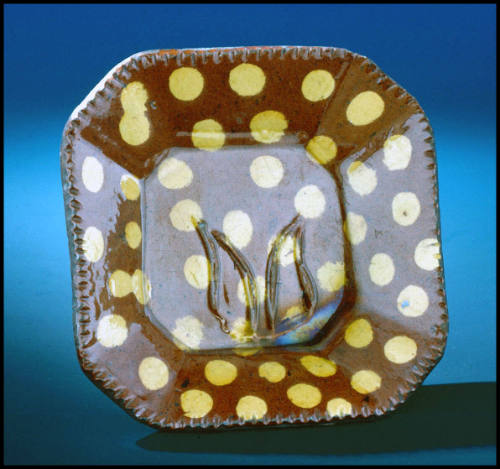
DescriptionMolded, 8-sided redware dish covered with clear lead glaze and decorated with all-over pattern of yellow dots (white slip appearing yellow from tint of lead glaze). Molded raised tulip design at bottom center of dish. Coggle-crimped outer edges of dish. The shape is not octangular with 8 sides of even length; there are four long sides, almost forming a square, with four short connecting "sides."Label TextThe relative size or importance of a given piece of pottery had little bearing on whether or how a potter might decorate it. This small, but complex octagonal dish with a raised tulip flower at the center was formed by pressing clay over a mold which had the tulip motif carved into it. Prior to this, slip was dripped onto the surface and the rim was coggled. The dots may have been inspired by dotted slipware made at Staffordshire or elsewhere in the English Midlands during the seventeenth and eighteenth centuries. American pottery bearing tulip flowers is usually associated with Germanic folk art traditions, but the motif was also commonly used by English potters. The combination of a tulip flower and dot decoration on this dish possibly identifies the work of an Anglo-American potter, rather than one trained in the German tradition.ProvenanceJim & Nancy Glazer, Philadelphia, Penn.