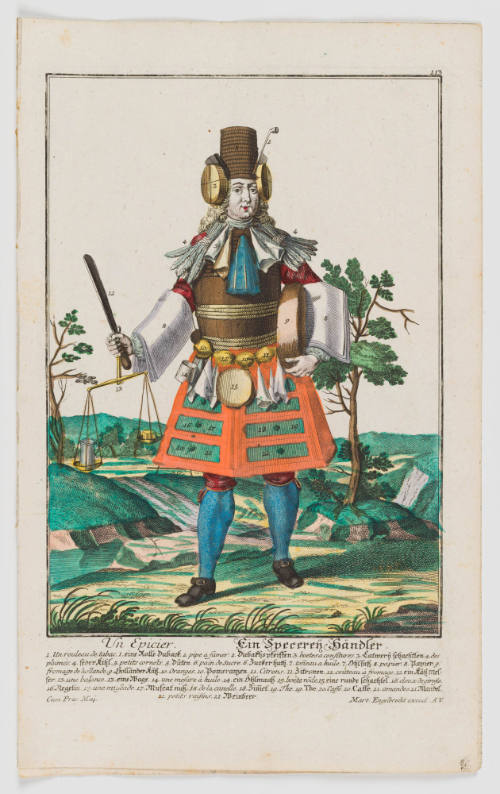
Un Epicier (grocer)
Dateca. 1720
Artist/Maker
Martin Engelbrecht
OriginEurope, Germany
MediumLine engraving and etching on laid paper with hand coloring
DimensionsOther: 14 × 8 1/2 in (35.56 × 21.59cm)
Platemark: 12 × 7 1/2 in (30.48 × 19.05cm)
Platemark: 12 × 7 1/2 in (30.48 × 19.05cm)
Credit LineMuseum Purchase
Object number1955-150,25A
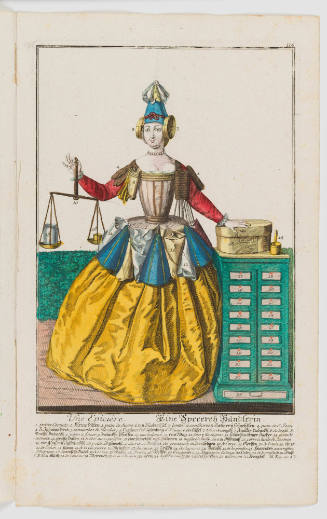
DescriptionUpper right corner reads, "113"The lower margin reads, "Un Epicier. Ein Speceren handler./ 1. un rouleau de tabac. 1. eine Rolle Duback. 2. pipe a fumer 2. Dubakhspfeiffen. 3. boetes a confitures 3. Latmern schachtlen 4. des/ plumes 4. Feder Kihl. 5. petits cornets 5. Dűten. 6. pain de sucre 6. Zuckerhuth 7. toneau a huile 7. Ohlfak. 8. papier 8. papier. 9./ fromage de hollande. 9. Hollӓnder Kӓse. 10. oranges. 10. Bomerangen. 11. citrons. 11. Zitronen. 12. couteau a fromage 12. Kӓse Mes/ ser. 13. une balance 13. eine Wage. 14. une mesure a huile. 14. ein Ohlmaak. 15. boete rode 15. eine runde schachtel. 16. cloux de girofle./ 16. Negelin. 17. une muscade. 17. muscatnus. 18. de la canelle. 18. Zimet 19. The 19. The. 20. caffe 20. caffe. 21. amandes. 21. Mandel./ 22. petits raisins. 22. Weinbeer./ Cum Priv. Maj. Mart. Engelbrecht excud. A.V."Label TextMartin Engelbrecht’s mid-18th century publication on trades included both a male and female illustration of each trade or profession in creative ways. Though they represent the tools that tradesmen used and the products they produced, they were meant to entertain elite audiences rather than inform about the labor involved in these trades or professions.This print represents an idealized version of a grocer. He carries his products on his person as follows: 1. (on head) un rouleau de tabac (a roll of tobaco); 2. (on head) pipe a fumer (pipe for smoking); 3.(right ear and left ear) boetes a confitures (boxes of preserves); 4. (right and left shoulder) des plumes (plumes); 5. (right and left shoulder) petits cornets (little paper cones); 6. (at neck) pain de sucre (loaf og sugar); 7. (around chest) tomeau a huile (barrel of oil); 8.(over right arm) papier (paper); 9. (under left arm) fromage de hollande (wheel of Dutch cheese);10. (at waist) oranges (oranges); 11. (waist) citrons (lemons); 12. (right hand) couteau a fromage (cheese knife); 13. (right hand) une balance (scale); 14. (waist) une mesure a huile (small measure for oil); 15. (waist) boete rode (box of polish); 16. (in box at waist) cloux de girofle (spikes of cloves); 17. (box at waist) une muscade (nutmeg); 18. (box at waist) de la canelle (pepper); 19. (box at waist) The (tea); 20. (box at waist) caffe (coffee); 21. (box at waist amandes (almonds); 22. (box at waist) petits raisins (little raisins).
This print is from a series of 189 engravings consisting prints featuring depictions of tradesmen in the format known as composite figures, which are human figures made up of objects. Sometimes various accoutrements or tools are cleverly incorporated into recognizable garments or even replace body parts. Each plate represents different trades by trades men and women dressed with associated tools and products. They do not represent actual tradespeople nor are they meant to suggest that women participated in these trades, though in some cases they may have.They were designed by Johann Jacob Stelzner (1706-1780), C.F. Horstman and M. Rosler. They were etched by Martin Engelbrecht ( 1684–1756). The series was published in a compilation known as, From Martin Engelbrecht, "L' Assemblage nouveau des manouvries habilles or Neu-eröffnete Sammlung der mit ihren eigenen Arbeiten und Werkzeugen eingekleideten Künstlern, Handwerkern und Professionen," (Augsburg, Germany, ca. 1730).Mark(s)Cum Priv. Maj. Plate #113ProvenanceBefore 1955, the Old Print Shop (New York, NY); 1955-present, purchased by the Colonial Williamsburg Foundation (Williamsburg, VA).