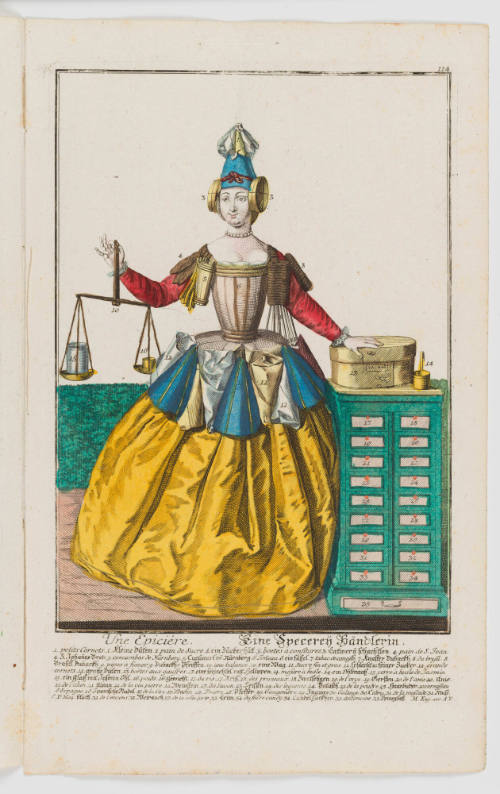
Une Epiciere (female grocer)
Dateca. 1720
Artist/Maker
Martin Engelbrecht
OriginEurope, Germany
MediumLine engraving and etching on laid paper with hand coloring
DimensionsO: 14" X 8 1/2"; plate to marks including title: 12" X 7 1/2"; plate alone: 10 1/2" X 7 1/3"
Credit LineMuseum Purchase
Object number1955-150,25B
DescriptionUpper right corner reads, "114"The lower margin reads, "Une Epiciere. Eine Speceren Hӓndlerin./ 1. petits cornets. 1. Kleine Duten. 2. pain de sucre 2. ein Zuckerhut. 3. boetes a confitures 3. Latmern Schachtlen. 4. pain de S. Jean./ 4. S. Johanes Brod. 5. concombes de Nurnberg 5. Cucűmerl do Nűrnberg. 6. toneau 6. ein fӓsel. 7. tabac de canaste. 7. Knaster Dubackh. 8. du bresil. 8./ Brazsill Dubackh. 9. pipes a fumer 9. Dubackh pferffen. 10. une balance 10. eine Wag. 11. sucre fin et gros. 11.schlechtu: fener Zucter.12. grands/ cornets. 12. groß Duten. 13. boetes aux gaufres. 13. eine schactgtel mit holippen. 14. mesure a huile./ 14. ein Ohlmaak. 15. verre a huile de Jasmin/ 15. ein Glas mit Jasmin Ohl. 16. poids 16. Gewicht. 17. du ris 17. Reis. 18. des pruneaux. 18. Zmetlchgen. 19. de l'orge. 19. Gersten. 20. de l'anis 20. anis./ 21. de l'alun 21. alaun. 22. de la vin pierre 22. Weinstein. 23. du Savon. 23. Seiffen. 24. des legumes 24. batalch 25. de la poudre. 25. haarpuder. 26. vermilleau/ d'Espagne 26. Spainfche Nudel. 27. de la cire 27. Wachs. 28. poivre 28. Pfeffer. 29. Gimgembre 29. Ingwer. 30. Galange 30. Galing. 31. de la muscade. 31. Musc/ knuss. 32. de l'encens. 32. Weirauch. 33. de la colle forte. 33. Leim. 34. du sucre candy. 34. Candelzucther. 35. antimoine. 35. spiesglas./ C.F. Maj. M. Eng. exc. A.V."Label TextMartin Engelbrecht’s mid-18th century publication on trades included both a male and female illustration of each trade or profession in creative ways. Though they represent the tools that tradesmen used and the products they produced, they were meant to entertain elite audiences rather than inform about the labor involved in these trades or professions.This print represents an idealized version of a grocer. She carries the products on her person as follows: 1. (head) petits cornets (small paper cones). 2. (head) pain de sucre (loaf of sugar); 3. (ears) boetes a confitures (boxes of preserves); 4. (right shoulder) pain de S. Jean (leaf of S. Jean); 5. (right shoulder) concombes de Nurnberg (cucumbers of Nurnberg); 6. (chest) toneau (barrell); 7. (left shoulder) tabac de canaste (tobacco canaster); 8. (left shoulder) du bresil (brazil wood); 9. (left back) pipes a fumer (pipes for smoking); 10. (right hand) une balance (a scale); 11. (waist) sucre fin et gros (sugar fine and coarse); 12. (waist) grands cornets (large paper cones); 13. (under left hand) boetes aux gaufres (box of honey combs); 14. ( on table) mesure a huile (measure for oil); 15. (on scale) verre a huile de Jasmin (glass for oil of Jasmin); 16. (on other side of scale) poids (weight); 17-35. (are in a cabinet); 17. du ris (rice); 18. des pruneaux (prunes); 19. de l'orge (barley); 20. de l'anis (anise); 21. de l'alun 9alum); 22. de la vin pierre (wine stones); 23. du Savon (soap); 24. des legumes (vegetables); 25. de la poudre (powder); 26. vermilleau d'Espagne (noodles from Spain); 27. de la cire (beeswax); 28. poivre (pepper); 29. Gimgembre (ginger); 30. Galange (Galingale); 31. de la muscade (nutmeg); 32. de l'encens (incense); 33. de la colle forte (strong paste; 34. du sucre candy (sweets); 35. antimoine (antimony).
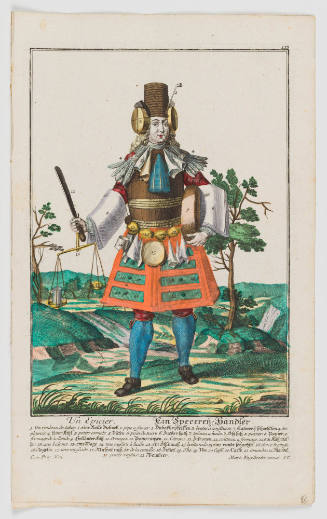
This print is from a series of 189 engravings consisting prints featuring depictions of tradesmen in the format known as composite figures, which are human figures made up of objects. Sometimes various accoutrements or tools are cleverly incorporated into recognizable garments or even replace body parts. Each plate represents different trades by trades men and women dressed with associated tools and products. They do not represent actual tradespeople nor are they meant to suggest that women participated in these trades, though in some cases they may have.They were designed by Johann Jacob Stelzner (1706-1780), C.F. Horstman and M. Rosler. They were etched by Martin Engelbrecht ( 1684–1756). The series was published in a compilation known as, From Martin Engelbrecht, "L' Assemblage nouveau des manouvries habilles or Neu-eröffnete Sammlung der mit ihren eigenen Arbeiten und Werkzeugen eingekleideten Künstlern, Handwerkern und Professionen," (Augsburg, Germany, ca. 1730).Mark(s)C.P. Maj. Plate #114.ProvenanceBefore 1955, the Old Print Shop (New York, NY); 1955-present, purchased by the Colonial Williamsburg Foundation (Williamsburg, VA).