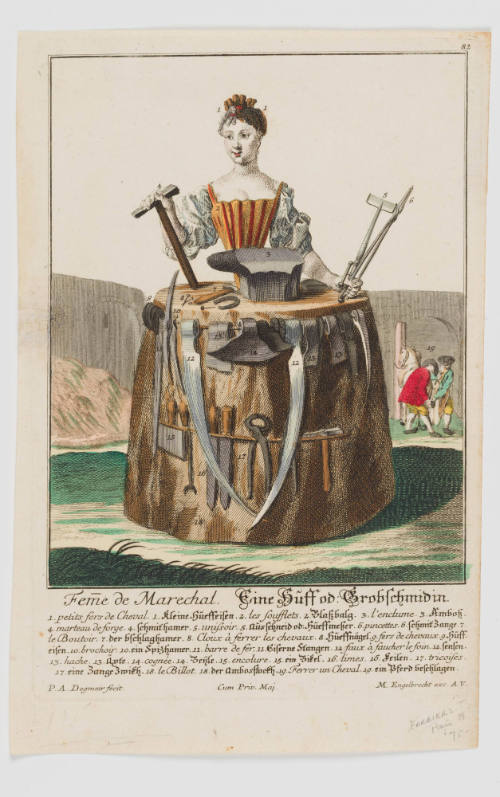
Feme de Marechal (female farrier)
Dateca. 1720
Engraver
Martin Engelbrecht
After work by
P.A. Degmeir
OriginEurope, Germany
MediumLine engraving and etching on laid paper with hand coloring
DimensionsOverall: 14 × 8 1/2 in (35.56 × 21.59cm)
Platemark: 8 × 8 1/4 in (20.32 × 20.95cm)
Platemark: 8 × 8 1/4 in (20.32 × 20.95cm)
Credit LineMuseum Purchase
Object number1955-150,18B
DescriptionUpper right corner reads: "82"Lower margin reads: "Feme de Marechal Eine Hũff od: Grobschmidin/ 1. petits fers de Cheval 2. kleine hũeffeisen. 2. les soufflets 2. Blakbalg. 3. l'enclume 3. Ambok./ 4. marteau de forge. 4. schmifhamer. 5. unissoir. 5. Aũs schneid od: hũeffmeker. 6. pincettes 6. schmit zange. 7./ le Boutoir 7. der bschlaghamer. 8. cloux a ferrer les chevaux. 8. hũeffnagel. 9. fers de chevaux. 9. hũff./ eisen. 10. brochoir. 10. ein Spizhamer. 11. barre de fer 11. Eiferne Stangen. 12. faux a faucher le foin 12. sensen./ 13. hache. 13. Aofe. 14. cognee 14. Bense. 15. encolure. 15. ein Bikel. 16. limes 16. keisen. 17. tricoisses./ 17. eine zange zmikh. 18. le Billot. 18. der Ambosftokh. 19. Ferre un Cheval. 19. ein Bferd beschlagen./ P.A. Degmeir fecit. Cum Priv. Maj. M. Engelbrecht exc. A.V."Label TextMartin Engelbrecht’s mid-18th century publication on trades included both a male and female illustration of each trade or profession in creative ways. Though they represent the tools that tradesmen used and the products they produced, they were meant to entertain elite audiences rather than inform about the labor involved in these trades or professions.This print represents an idealized version of a female blacksmith or farrier. She carries the tools of her trade on her person as follows: 1. (on head) petits fers de Cheval (little shoes for the horse); 2.(on her chest) les soufflets (bellows); 3. (on skirt) l'enclume (forge); 4. (in right hand) marteau de forge (hammer for the forge); 5. (in left hand) unissoir (joiner); 6. (left hand) pincettes (tongs); 7. (on skirt) le Boutoir (farrier's knife); 8. (on skirt) Cloux a ferrer les chevaux (nails for the horse dhoes); 9. (on skirt) fers de chevaux (horse shoes); 10. (on skirts) brochoir (shoing hammer); 11. (on skirt) barre de fer (iron bars); 12. (on skirt) faux a faucher le foin (sythes to mow the hay); 13. (on skirt) hache (hachets); 14. (on skirt) cognee (axes); 15. (on skirt) encolure (horse collar); 16. (on skirt) limes (files); 17. (on skirt) tricoisses (farrier's pincers); 18. skirt) le Billot (stock of anvil); 19. (to rear of figure) Ferre un Cheval (shoing the horse).
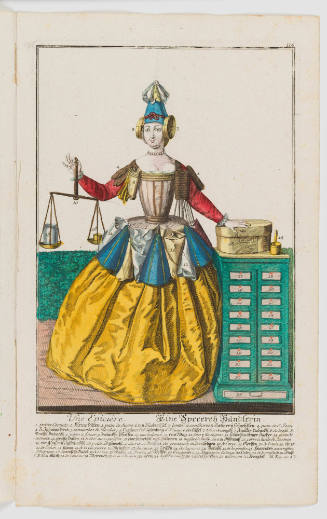
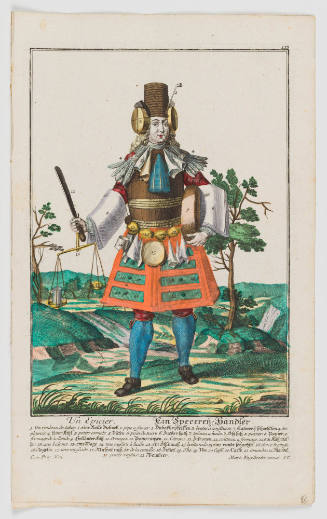
This print is from a series of 189 engravings consisting prints featuring depictions of tradesmen in the format known as composite figures, which are human figures made up of objects. Sometimes various accoutrements or tools are cleverly incorporated into recognizable garments or even replace body parts. Each plate represents different trades by trades men and women dressed with associated tools and products. They do not represent actual tradespeople nor are they meant to suggest that women participated in these trades, though in some cases they may have.They were designed by Johann Jacob Stelzner (1706-1780), C.F. Horstman and M. Rosler. They were etched by Martin Engelbrecht ( 1684–1756). The series was published in a compilation known as, From Martin Engelbrecht, "L' Assemblage nouveau des manouvries habilles or Neu-eröffnete Sammlung der mit ihren eigenen Arbeiten und Werkzeugen eingekleideten Künstlern, Handwerkern und Professionen," (Augsburg, Germany, ca. 1730).Mark(s)Cum Priv. Maj. Plate #82ProvenanceBefore 1955, the Old Print Shop (New York, NY); 1955-present, purchased by the Colonial Williamsburg Foundation (Williamsburg, VA).