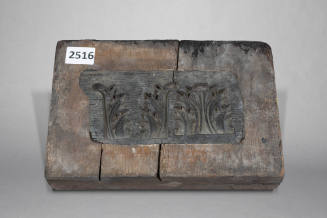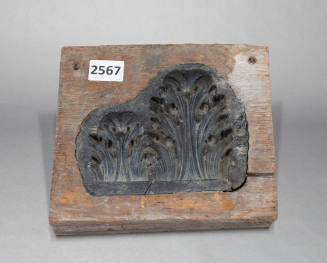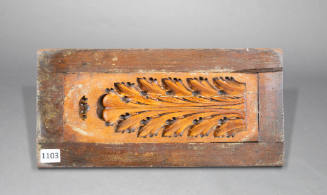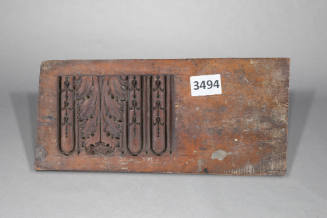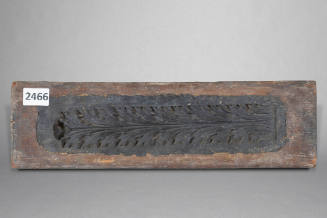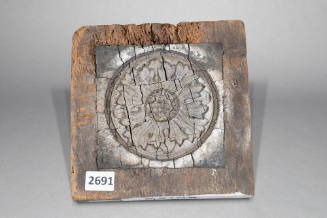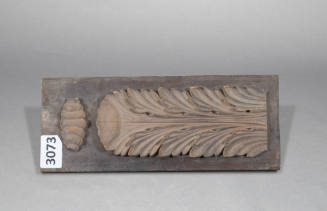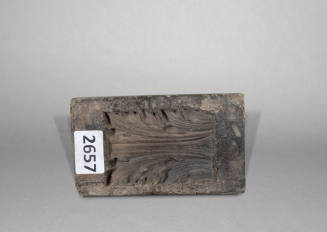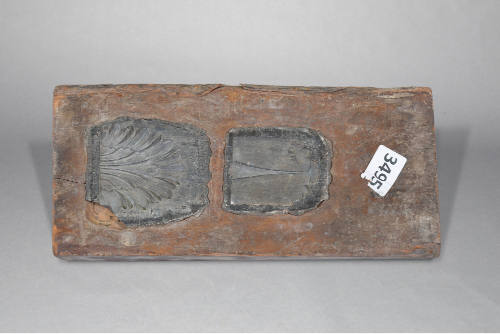
Composition Mould
OriginEngland or America
MediumResin; Boxwood
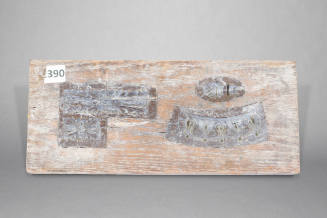
DimensionsImpressions: (A) impression: 2 3/4" (H) x 2 3/16" (W) x 1/16" deep at flat surface and 1/4" deep at the tip; inset: 3 1/2" (L) x 3" (W)(B) 3" (W) x 2 7/8" (L) x 3/16" (deep at the tip). Inset: 4" (L) x 3 5/8" (W). On (B) the lower right corner of the resin is broken. Base: 12 1/2" (L) x 5 7/8" (W) x 2" (T).
Credit LineGift of Mr. & Mrs. Elias Nassim
Object numberAF-X2023.3495
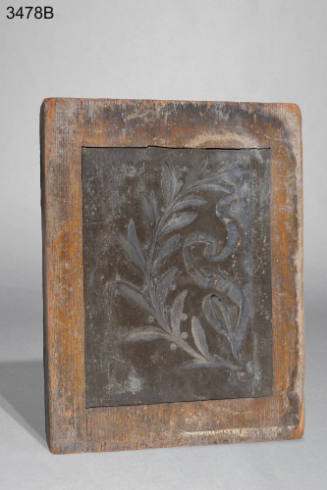
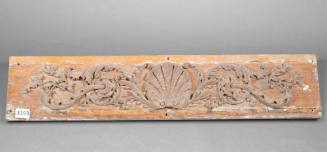
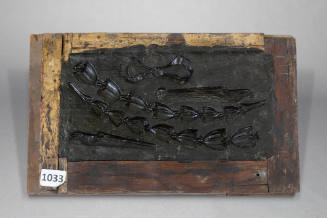
DescriptionIt has two resin moulds inset into the boxwood base: (A) flat acanthus leaf with a wide central stem; (B) multi-segmented acanthus leaf (15 outer segments and 7 inner segments).Label TextThis antique composition mould represents a trade that was practiced in Virginia during the Revolutionary period and into the 19th century. It depicts a common design found in upper class homes and public buildings. Composition was a substitute for more laboriously produced ornamental plaster and carved wood and stone. It is thought that the Adam brothers (Robert Adam 1728-1792) and John Adam (1721-1792)) played a major role in the initial manufacture of composition ornament on a grand scale. The Adam style demanded a large amount of delicate low-relief ornament. These moulds are for the production of such ornament in plaster, or in composition, usually a combination of whiting, glue, rosin and oil. The finished ornament was used on furniture and other objects as well as in the decoration of rooms.