
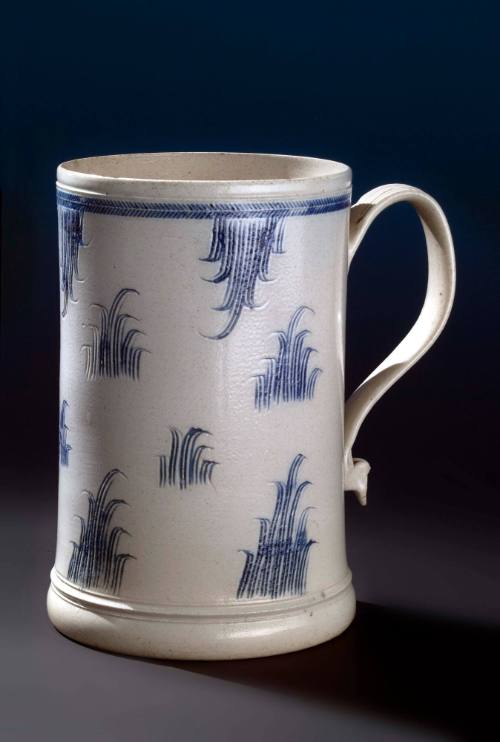


Tankard
Dateca. 1750
OriginEngland, Staffordshire
MediumWhite salt-glazed stoneware
DimensionsOverall: 6 1/2 x 6 x 4 7/16in. (16.5 x 15.2 x 11.3cm)
Credit LineMuseum Purchase
Object number1951-164
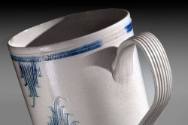
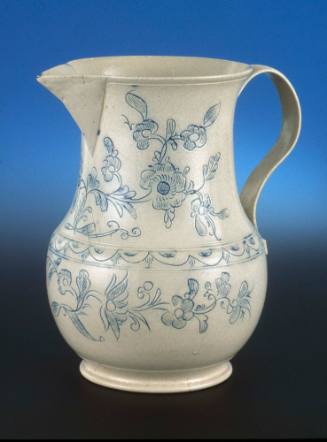
DescriptionMug or tankard of slightly tapered cylindrical shape with heavy turned base (horizontal ribs), plain walls, and narrow turned rib at rim. Below the rim rib is a fine lined horizontal herringbone milled band of 1/4" height. Applied to one side is an extruded loop-shaped handle with 7 narrow rims running along spine; pinched lower terminal. Scratch blue decoration of 3 stylized flames or ferns descending from the herringbone band. The body with similar inverted flames or ferns in varying sizes. These patterns plus herringbone band decorated in deep blue.Label TextThe scratch blue grass pattern on this tankard is a common design found on shards from American archaeological excavations.***By the 1720s, potters began to embellish white stoneware with incised lines colored brown. Known today as “scratch brown,” such wares are rarely found in early America. Scratch blue, however, was extremely popular from the mid 1740s onward. Both variations featured floral
and linear designs and border patterns cut into the still damp clay of unfired wares. These lines were then filled with iron for brown or cobalt
for blue which, when fired, created a pleasing color within the carved motifs. Writing in 1829, the early Staffordshire historian Simeon Shaw described the manufacture of scratch blue as being primarily practiced by women, stating, “The Flowerers now scratched the jugs and tea ware, with a sharp pointed nail, and filled the interstices with ground zaffre [a form of cobalt].”
Scratch blue items were widely offered for sale in colonial newspapers, where they were listed among “white, blue and white, and enamelled
stone ware.” Fragments of straight-sided drinking vessels and pitchers enhanced with scratch blue decoration are frequently recovered
at archaeological sites dating from about 1745 to 1780. Characteristically, specimens are ornamented with patterns of stylized grass or lush floral designs.ProvenancePurchased from D. M. & P. Manheim, New York
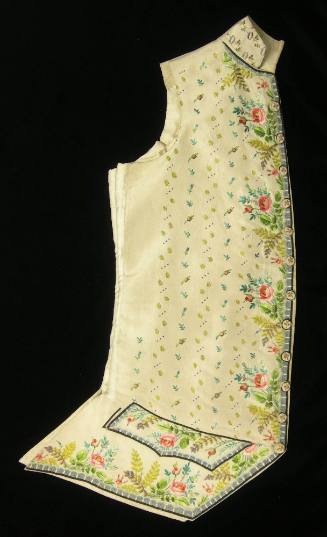
1770-1800
ca. 1745-1770
ca. 1760
1930-1950
December 1774
1770-1800
1800-1900