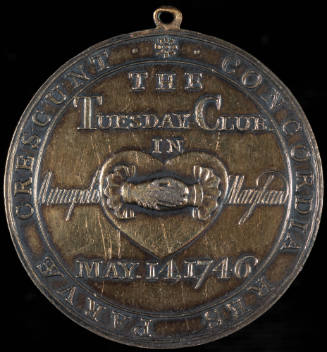
Badge Medal of the Tuesday Club of Annapolis
Date1746-1800
Possibly by
John Kirk
OriginEngland, London
MediumBronze
DimensionsDiameter: 44 mm; Weight: 37.01 grams
Credit LineBequest of Joseph R. Lasser
Object number2011-257
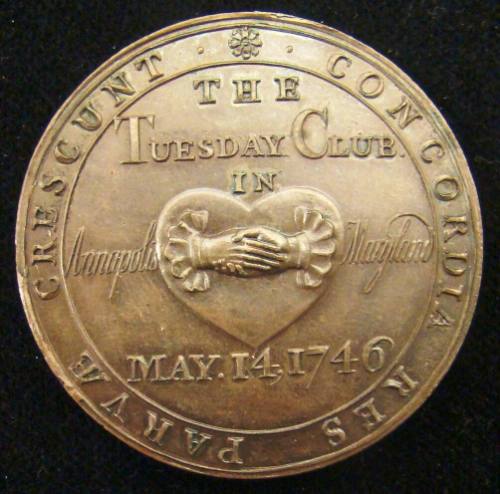
DescriptionOBVERSE: Clasped hands withing a heart in the center, flanked by "Annapolis" and "Maryland" in script, THE TUESDAY CLUB. IN above, and MAY. 14, 1746 below. Surrounding is the legend • CONCORDIA RES PARVAE CRESCUNT •, Latin for "happily joining like-thinking fellows." Immediately below the suspension loop is an eight-petaled flower, and the whole is edged with a linear border.REVERSE: Liberty, represented young nude male, holding a pole and liberty cap, seated next to a brick-based altar inscribed LIBERTAS ET NATALE SOLUM, Latin for "liberty and homeland only." Surrounding is the legend CAROLUS COLE ARMIGER PRAESES, translating to "Charles Cole, Esquire, President." Immediately below the suspension loop is an eight-petaled flower, and the whole is edged with a rope border.Label TextOf the countless hundreds of social clubs which existed in colonial America, none are as well understood or documented as the Tuesday Club, formed in Annapolis, Maryland on May 14, 1745. The brainchild of Dr. Alexander Hamilton (no relation to the famous one), it met every other Tuesday evening, most often at Hamilton's house. Like most such clubs, it was exclusively male and centered around drinking, eating, smoking, and conversing with other prominent men of the northern Chesapeake region.
Laughter, chit-chat, the clinking glasses, singing, and music were the dominant sounds of the Tuesday Club's meetings.
The Club is renowned, owing to the reams of minutes, records, illustrations, and sheet music left behind by Dr. Hamilton, the Club's Secretary. Before his death in 1756, he prepared some 900 manuscript pages for publication under the title of "The History of the Ancient and Honorable Tuesday Club," but his vision remained unfulfilled until late in the 20th century. Available in a number of different formats and publications, Dr. Hamilton's words provide us with an enthralling, hysterically funny, and unparalleled look into the antics of the Club and society life in Annapolis during the mid-18th century.
Each member received a faux-Latin or satirical nickname, rooted in some truth about the person. Dr. Hamilton, a man of many words and a hyperactive pen, was dubbed "Locquatious Scribble." Jonas Green, Maryland's Public Printer and publisher of the Maryland Gazette was an active member, and went by "Jonathan Grog." Liquor merchant Mark Gibson went by "Dumpling Gundiguts," and Thomas Cumming, Quaker merchant and the Club's local agent, was called "Coney Pimp Frontinbrass," to cite a few which may elicit a chuckle from the modern reader.
Over its eleven-year existence, meetings of the Tuesday Club (which they called 'Sederunts') were attended by over 150 people, including "regular" members, all of whom were residents of Annapolis, honorary members, who lived elsewhere but brought something special into the social mix, and invited guests. A few colonial-era celebrities rubbed elbows with the Club, including Benjamin Franklin, nicknamed "Electro Vitrifrice" and portraitist John Wollaston, styled "Squeak Grumbleton."
As with other contemporary organizations, the Tuesday Club adopted the practice of wearing a badge. Initially made of card and worn on a ribbon, something more suitable was desired. On March 14, 1748/49, at the 101st meeting of the club, Hamilton proposed:
"that there should be badges of Silver, prepared for each Regular member of the Club, weighing half an ounce each, dowble gilt, with the proper Signatures and mottos of the Club Imbossed, or raised thereupon, to be fixed upon ribbons, instead of the Card badges now used, and that the said badges, should be ordered to be prepar'd and done at London."
The notion was unanimously agreed to, and Hamilton was ordered to place the commission of the badges in the care of "Capt. Comely Copper-nose." A successful tobacco trader, Copper-nose was the Club's London-based Agent, whose real name was Anthony Bacon. He was to "have it done in the neatest and cheapest manner, at the Common expense of the Regular members of the Club."
Hamilton, in third person, facetiously recounted his actions in bringing the badges into existence:
"At the time of making these motions by the Secretary, the Club did not forsee the designs of this politic officer, in broaching them, but, the violent heats and disputes, which ..... these Badges ..... occasioned afterwards in Club, made them Severely repent that they ever had agreed to these motions."
At the 129th meeting, held on May 1, 1750, Dr. Hamilton announced that the "Badge medals" had arrived from London, and proceeded to described them:
"upon the one Side of this medal was struck, the Emblem of Liberty, sitting by an altar, upon the altar was the motto 'Libertas et Natale Solum,' and Round the Edge of the medal, 'Carolus Cole Armiger Praeses,' by which an unacountable blunder of the Sculptor, was put instead of 'Nasifer Jole' or 'Carlo Nasifer Jole,' ......upon the reverse was a heart, with two hands interlocked in the amicable Gripe, and in the Middle in Large Characters, 'The Tuesday Club, in Annapolis Maryland, May 14th 1746,' and round the edge of the Medal 'Concordia res parvae Crescunt."
Hamilton went on; "Thus the Club, to perpetuate their memory, and that of their honorable president, were at the expense of strikeing a medal, and which piece of vanity they have imitated several other Societies and therefore not Singular in this particular."
The badge medals as made differ slightly from what was first proposed. They were substantially heavier than the "half ounce" mentioned, weighing slightly less than an ounce, and struck in soft fine silver, in attempt to prolong the life of the dies. Each gilt medal came with its own shagreen case, none of which are known to have survived. Anthony Bacon sent the medals from London along with a letter, dated January, 26, 1749, where he mentions some damage to the dies, in which some portions of the edges spalled away during the striking of the last medal. Since the chips didn't reach the letters, it was not considered fatal by Bacon, who remarked that more strikings could be had in the future if wanted.
According to the Club's record of the May 7, 1750 meeting, "Eleven badges or medals were distributed to the members of the Committee," and were to be worn around the neck from a blue ribbon. All members were directed to "wear their badge medals on every Club night," and all "members regular and honorary Shall wear their badge medals at the (anniversary) procession." As full as the legacy of the Club is, there is no record of what the badges cost, or how many were delivered in early 1750. Given that the number of regular members was limited to 15 and medals were allowed to honorary members, one could reasonably speculate that a few dozen or so were produced.
Today, only four original strikings of the Tuesday Club's badge medal are known; two in gilt silver with integral suspension loops, and two in bronze or copper, made without the loop. All four are in institutional collections. A fifth example, in unknown metal, was recorded in 1945, but its current whereabouts are unknown. There are also records of a pewter striking crossing the auction block in 1915 and 1925, but may represent two appearances of the same specimen. Likely a die trial, and thus not intended for wear by a Club member, a pewter example hasn't been seen since the latter sale.
Colonial Williamsburg's gilt-silver badge was once in the collection of John Work Garrett (1872-1942), who also owned a substantial portion of Dr. Hamilton's original manuscript material recording the minutes and history of the Club. If one speculates, quite reasonably, that the medal and papers survived from Hamilton's death in 1756 until acquired by Garrett, then is possible this example may have been Hamilton's own. Though Garrett bequeathed all he had relating to the Tuesday Club to Johns Hopkins University, they deaccessioned this medal some time before 1993, perhaps believing that it was redundant. Another example was in their collection as of 1945, given by Judge George W. Dobbin in 1892, but it remains unlocated as of late 2021.
The Maryland Center for History and Culture owns the other silver example, accession number 1973.11, originally donated by Capt. W. H. Fitzhugh in 1852. He was a descendant of Col. William Fitzhugh (1721-1798), an honorary member of the Club nicknamed "Comico Butman," and a good friend of George Washington's.
One of the bronze or copper strikings is in the collection of the British Museum (M.8545), donated in the mid-19th century by Edward Hawkins. Colonial Williamsburg also holds an example of this off-metal strike (2011-257). Produced after the dies were damaged, both copper/bronze examples exhibit the edge chipping described by Anthony Bacon in his letter of January 26, 1749.ProvenancePurchased from Fred Baldwin (London, England), 1967; May 2006, John J. Ford; September 2009 [Stacks-Bowers Auctions]; purchased by Anthony Terranova (new York, New York); purchased by Joseph R. Lasser; donated toThe Colonial Williamsburg Foundation, 2011 (Williamsburg, VA)
Likely Eighteenth Century
ca. 1800
1790-1800
ca. 1763