Fountain
Date1702-1703
Marked by
Joseph Ward
working ca. 1697 - 1734
OriginEngland, London
MediumSilver (Britannia); Gilding
DimensionsH: 24 5/8" OW: 14 1/2" Diam (base): 7"
Credit LineMuseum Purchase
Object number1938-44,A&B
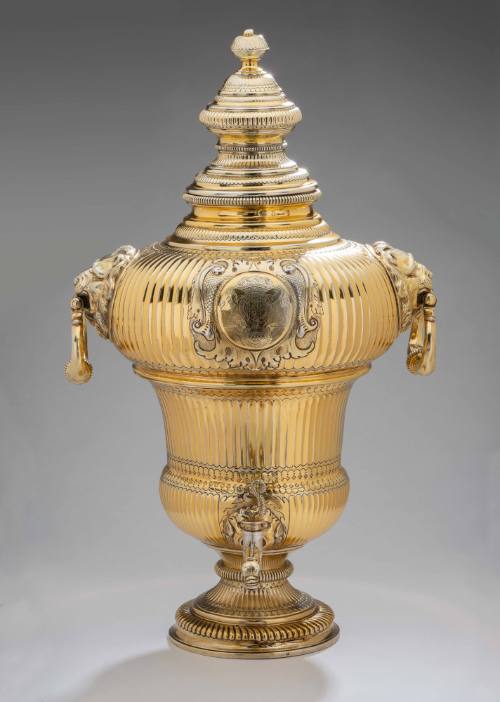
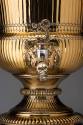
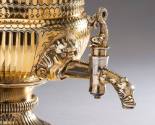
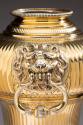
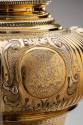
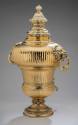
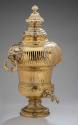
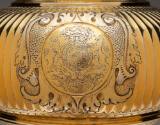
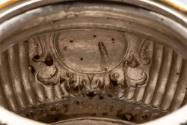
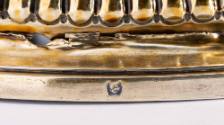
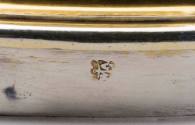
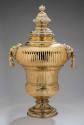
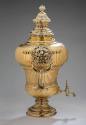
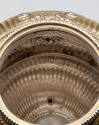
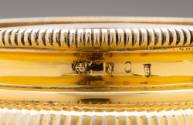
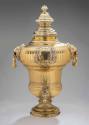
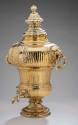
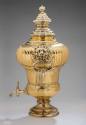
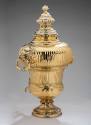
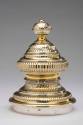
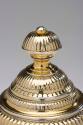
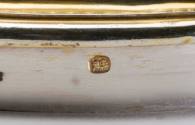
DescriptionSilver-gilt Britannia standard fountain or wine fountain: Circular stepped foot with molded edge and bands of gadroons, flutes, and reeds supports an inverted bell-shaped body in three sections, all ornamented with flutes. A cast spigot with dolphin’s head spout and stop cock in the form of a coiled dolphin issues from a grotesque mask on the lowest section of body. Uppermost section of body with an oval reserve for armorial engraving is flanked by chased scroll and scale mantling, all positioned above spigot. Two cast lion’s head masks with bail handles flank central oval reserve. Tall circular stepped lid ornamented with plain bands alternating with gadroons, flutes, and reeds, all surmounted by a compressed spherical finial with fluted upper half topped by a small plain orb. Label TextBy the late 1600s, grand arrangements of precious metal dominated the banqueting halls of British palaces and country houses, proclaiming the status and taste of their owners. During the baroque period, a wine fountain served as the focal point of the sideboard or buffet’s dazzling display of wealth. Despite the name commonly given to this form the fountain held water rather than wine; it was part of a trio of massive silver or gilded silver vessels. Water from the fountain was used to rinse glasses; the contents were discarded in a large tub or cistern and the glasses would then be refilled as needed from wine bottles held in an even larger cooler filled with ice. The coat of arms of John Holles (1662–1711), the Duke of Newcastle-upon-Tyne, ornaments this monumental silver-gilt fountain with lion-mask handles.Inscription(s)Engraved in oval reserved on face of body with the coat of arms of John Holles (1662-1711), Duke of Newcastle (1694) and Earl of Clare (1624), extinct 1711: Holles impaling Eastley, Scopham, Hanham, Denzell, Gilbert, Clare, Sergeaux, Bulbeck, Vere, Sandford, and Baldesmere, enclosed within a collar with the Garter motto "HONI SOIT QVI MAL Y PENSE", flanked by supporters, and surmounted by a ducal coronet. Banner beneath with motto "SPES AUDACES ADJUVAT".Mark(s)Struck in relief on neck of body below gadrooned rim to proper left of spigot: 1) sponsor’s mark “W A” flanking an anchor in a shaped shield for Joseph Ward [Grimwade 1990, #2989]; 2) Britannia seated; 3) a lion’s head erased; and 4) a Greek date letter “g” for 1702/03. Also struck on edge of foot to proper left of spigot with mark 3) and on bezel of lid with marks 1) and 3). Note: all marks very worn except those on bezel of lid ProvenanceThe dukes of Newcastle (sold at Christie, Manson &Woods, London, 1921)
H. H. Mulliner (sold at Christie, Manson & Woods, London, 1924)
Ex Coll: William Randolph Hearst (sold by Parish-Watson & Co., New
York, 1938)
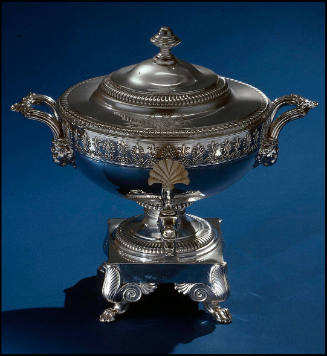
ca. 1815
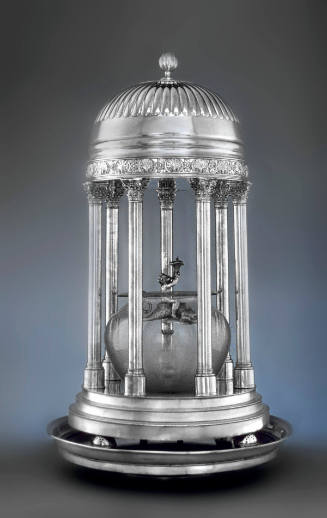
ca. 1780