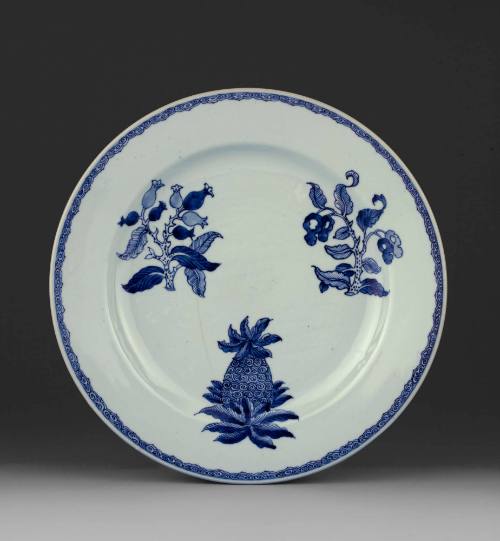
Dish
Dateca. 1755
OriginAsia, China, Jingdezhen
MediumHard-paste porcelain
DimensionsD: 14in. (35.6cm)
Credit LineMuseum Purchase, Wesley and Elise H. Wright in memory of Mr. and Mrs. Henry Clay Hofheimer II and in honor of John C. Austin
Object number2012-79
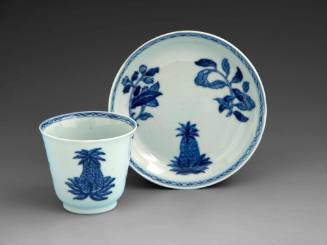
DescriptionDish: circular hard-paste porcelain dish painted in underglaze blue with a branch of cloves and one of nutmeg above a large leafy pineapple, all within a narrow band of stylized clouds or conjoined Ruyi symbols at the rim.Label TextThe unusual design found on this dish is taken from Pierre Pomet's A Compleat History of Drugs, London, 1712, after the original drawings from the French version Histoire Generale des Drogues published in Paris in 1694. Botanical prints were rarely depicted on Chinese export porcelain and very few examples of this pattern survive today. Saucers from a tea service decorated in this manner were recovered archaeologically from the wreck of the British East India ship, the Griffin, which sank off the coast of the Philippines on January 20, 1761. On its return voyage from China, the Griffin was laden with tea, spices, and porcelain.
Additionally, three plates from a dinner service were excavated from a privy in Philadelphia. The privy was associated with an early house at 13 Gray's (Morris) Alley. The privy was closed in 1750 therefore indicating that these plates were deposited prior to 1750, over ten years before the Griffin shipwreck. At the time of their disposal, the house was occupied by William and Patience Annis who were well connected in Philadelphia society including to James Logan. Annis was a Sea Captain who traveled regularly around the Atlantic world so he could have purchases the plates during one of his trips to England.
A fragment of a plate decorated with this motif was also found archaeologically in Williamsburg, Virginia, at the site of the Raleigh Tavern.
While the intact dish in Colonial Williamsburg's collection does not retain its 18th-century history of ownership, it is clear this pattern was in use in early America and was part of the larger British trade in Chinese porcelain.ProvenancePurchased at auction from Christie's New York, January 23, 2012, Lot 411.
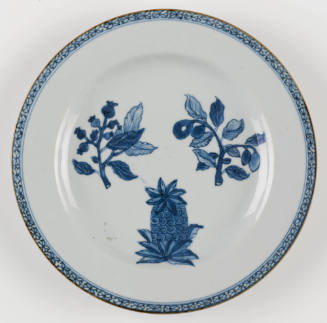
ca. 1755
ca. 1750
ca. 1823
ca. 1728
ca. 1750

ca. 1730

ca. 1730
ca. 1775
ca. 1790
ca. 1770