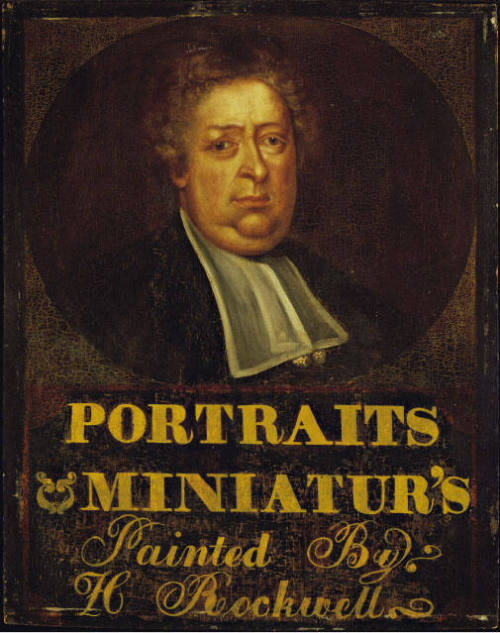
Horace Rockwell Trade Sign
Date1750-1770 (portrait); signage additions probably 1830-1835
Artist
Horace Rockwell
1808 - 1877
OriginAmerica
MediumOil on tulip poplar panel
DimensionsUnframed: 30 x 23 3/4in. (76.2 x 60.3cm) and Framed: 31 1/16 x 24 15/16in.
Credit LineGift of William E. Wiltshire III
Object number1979.707.2
DescriptionThe upper part of this sign is of a bust- sized portrait of a man within a horizontal shaped oval. The man is pudgy-faced and rosy-cheeked, with curly blonde hair. He is wearing a black coat with a white clergyman's neckpiece. Below the neckpiece are two bright brass-colored buttons. Below the oval shaped portait is large lettering in yellow paint advertising the painters' trade.Artist unidentified.Label TextThis sign is not only a rare survival of a portrait painter's advertisement. It is also an example of creative adaptation. Horace Rockwell secured an eighteenth-century likeness of a cleric by a now-unidentified artist and recycled it. By adding an oval reserve around the top half of the figure, painting over the lower half of the figure, and lettering the bottom of the panel, Rockwell transformed a conventional, pre-existing portrait into a testimonial of his own skills.
Rockwell was born in New York State but spent his early life in Connecticut, where he acquired basic painting skills. In 1835, he exhibited a portrait in Philadelphia, but the eastern metropolis seemingly held little appeal for him. By 1836, he had settled in the comparative frontier town of Fort Wayne, Indiana. Rockwell created several ambitious biblical scenes during his career in the midwest, but portraiture paid his bills. Two large group portraits done in the mid-1840s, one incorporating nine figures and the other ten, illustrate the apogee of his compositional skills. Soon after 1850, he moved to Roanoke, Indiana, where his creativity expressed itself in the invention of a flying machine.Inscription(s)"PORTRAITS/& MINIATUR'S/Painted By/H Rockwell" is painted in block letters (first two lines) and script (last two lines) at the bottom of the obverse.ProvenanceNorman White, Montgomery, NY; Vose Galleries, Boston, Mass; Nimmo & Hart, Middletown Springs, VT.; Kenneth & Stephen Snow, Newburyport, Mass.: gift of William E. Wiltshire, III.
1850-1910
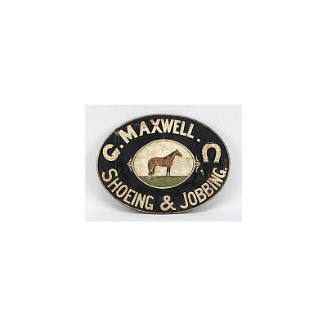
Probably 1880-1900