
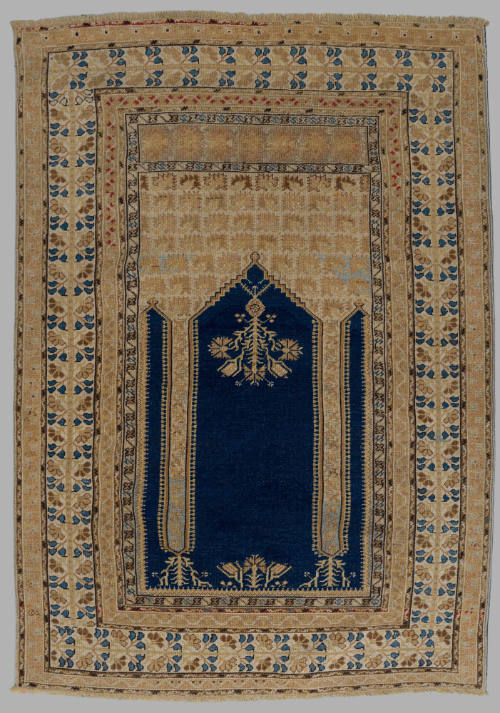
Prayer Rug
DateSecond half of 18th century
MediumWool
DimensionsOH: 74 " x OW: 50 1/2"
Credit LineGift of Mrs. John D. Rockefeller, Jr.
Object number1979-218
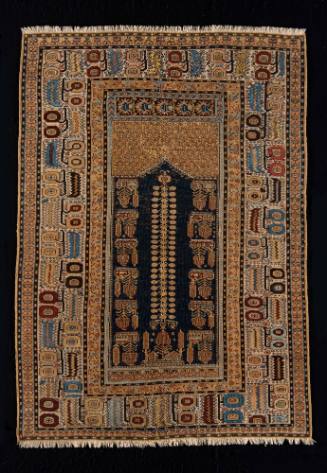
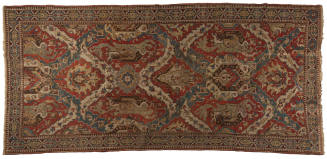
DescriptionThe central mihrab of this prayer rug has a blue ground, two columns, and a stepped roof culminating in a clover or flower. Plants grow from the bottom of the columns, and a carnation and tulip plant grows at the center bottom. A large carnation and tulip plant hangs from the top center of the mihrab, likely as a reference to the lamp that is symbolically significant in mihrabs and present in many prayer rugs. Small flowers grown from the sides of the columns and the sides and bottom of the mihrab. The central rectangle has a white ground patterned with yellow or beige spiky leaves. The upper rectangular insert has a floral pattern in faded yellow, beige, and white.
As is typical in Kula rugs, the central panel is surrounded by several borders, in this case eight. The first border is thin, with clovers or flowers outlined in black and added blue elements. The next border is also thin and has a white and black curvilinear design, reminiscent of Arabic lettering, over a brown ground with some red and blue elements present by not regular. A slight wider border follows with a white twisting ribbon over a beige ground. The thin brown border repeats again before the widest border of blue and brown flowers on a straight central stem over a white ground. The thin brown ground is again repeated, then a slightly wider beige border with florals on the sides and top and the twisted ribbon motif on the top of the rug. The final border is another repeat of the thin brown border.
The top and bottom have warp fringe, and the rug averages 95 knots per inch.
Construction History
18th century: Initial construction
1975: Repaired and cleaned by Karekin Beshir (New York, NY)
June 26, 2002: Vacuumed
Nov. 2012: Surface vacuumed and padding cleaned
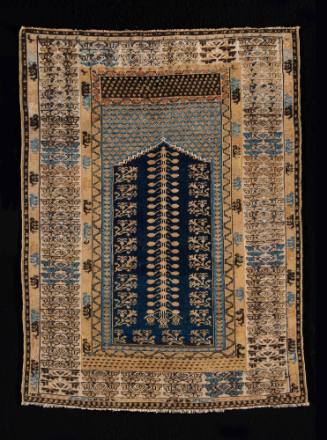
Nov. 2014: Tears sewn and surface vacuumedLabel TextThe central panel of this prayer rug is in the shape of a mihrab, or the niche in mosques that orients toward Mecca so worshipers can face Mecca while they pray. Similar in use, the mihrabs on prayer rugs would be pointed toward Mecca when used for prayer. The shape of the mihrabs in prayer rugs is often indicative of their place of origin.Inscription(s)None foundMark(s)None foundProvenance1927-dates unknown, purchased by Abby Aldrich Rockefeller (1874-1948); 1979-present, given to The Colonial Williamsburg Foundation (Williamsburg, VA)
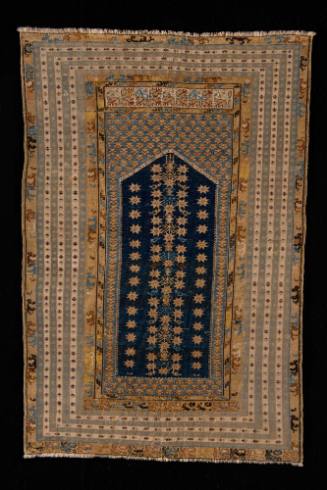
Second half of 18th century
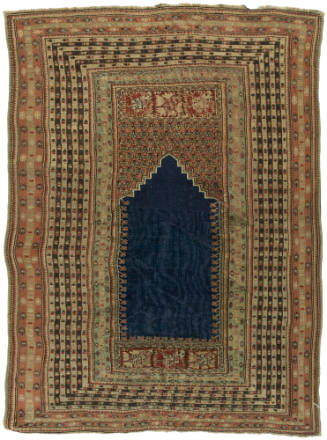
Likely Eighteenth Century
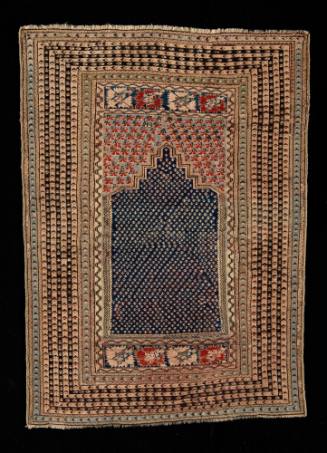
Second half of 18th century
Second half of 18th century
Second half of 18th century
Late 19th-early 20th century
ca. 1820-1830
Late 19th or early 20th century
Probably 17th century (original parts)
18th century