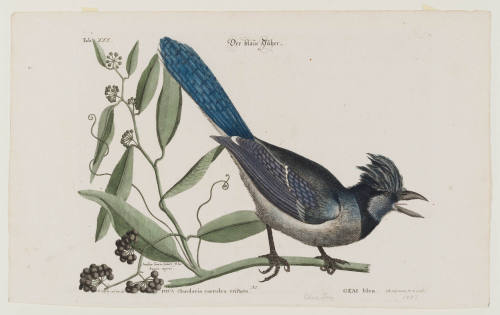
Der blaüe Häher (The Blue Jay)
Date1749-1770
Engraver
Johann Michael Seligmann
1720-1762
After work by
Mark Catesby
1683 - 1749
MediumEtching and line engraving with hand coloring
DimensionsFramed (overall): 16 5/16 × 19 5/16 × 1 1/4 in (41.4 × 49 × 3.17cm)
Platemark: 8 7/16 × 11 1/2 in (21.43 × 29.21cm)
Platemark: 8 7/16 × 11 1/2 in (21.43 × 29.21cm)
Credit LineMuseum Purchase
Object number1996-93
DescriptionTop margin: "Tab. XXX./ Der blaüe Hae.her."Text reads: "Smilax laevis Lauri folio/baccis nigris."
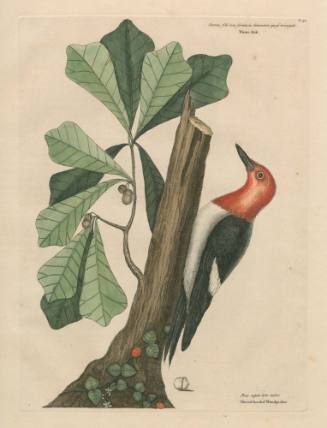
Lower margin reads: "M. Catesby ad viv. del./ PICA Glandaria caerulea cristata./30./ GEAI bleu./I.M. seligmann fec it excud."Label TextMark Catesby's The Natural History of Carolina, Florida and the Bahama Islands was the first illustrated publication devoted to the natural history of that region and groundbreaking for showing animals and birds with plants and trees from their natural habitats. These new scientific observations were so valuable, a separate German translation by Georg Leonhard Huth was published in Nuremberg, Germany between 1749-1776. It included detailed, scaled-down engravings, like this one, based on Catesby’s engravings by Johann Michael Sieligmann.This print was copied by Sieligmann from Catesby's print "The Crested Jay" or blue jay.
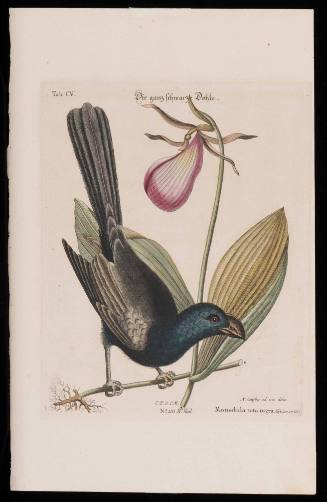
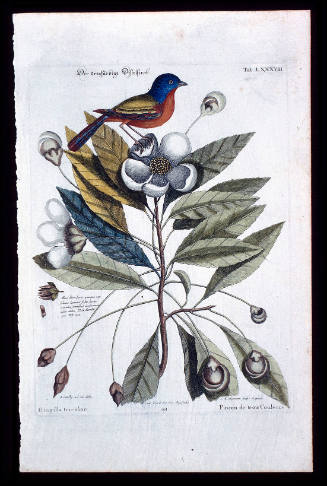
The complete work consited of 9 volumes, published in installments over 30 years entitled "Sammlung verschiedener ausländischer und seltener Vögel” which combined Huth's German translation of George Edwards's “A Natural History of Birds” (1743-51) and “Gleanings of Natural History” (1758-64), and Mark Catesby's ‘The Natural History of Carolina, Florida and the Bahama Islands' with illustrations copied and sometimes with additions by Sieligmann.
The southern colonies, in particular, provided a vast, boundless field of study for those interested in natural history. One of the most important works on the subject was The Natural History of Carolina, Florida and the Bahama Islands by Mark Catesby. He first came to Virginia in 1712 and spent seven years with his sister Elizabeth and her husband, Dr. William Cocke of Williamsburg. Catesby returned to the colonies in 1722 to gather information and specimens for a natural history that was sponsored by a group of Englishmen. Most of the four years of his second visit was spent in South Carolina, Georgia, and the Bahamas.
Upon his return to England, Catesby discovered that the cost of commissioning etchings after his drawings was prohibitively expensive; therefore he learned the process of etching himself, commencing production in 1732. By 1743, the publication was completed. Of the 220 plates, Catesby etched all but two. So important was this publication that it was revised and republished by George Edwards in 1754, and again in 1771.Mark(s)In pencil, lower right margin: Blue Jay 1783ProvenanceBefore 1996, William G. Hodges (Richmond, VA); 1996-present, purchased by the Colonial Williamsburg Foundation (Williamsburg, VA).
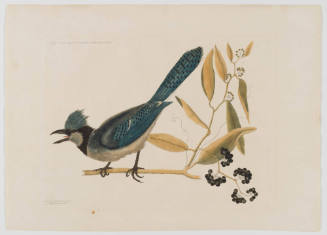
ca. 1760