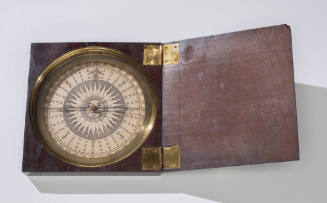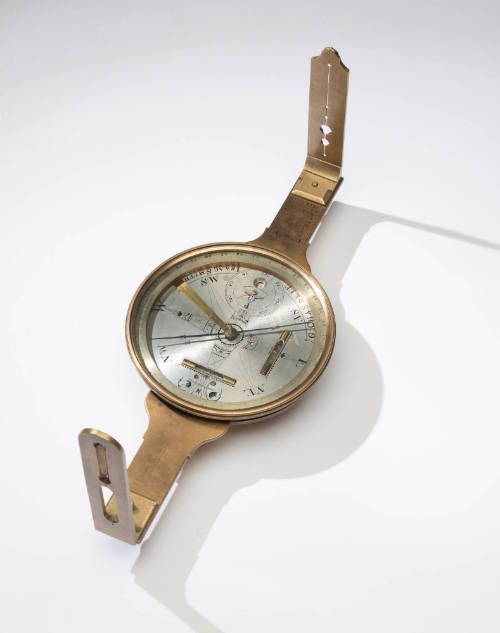
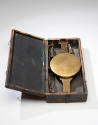
Surveying Compass and Box
Dateca. 1800
Artist/Maker
Goldsmith Chandlee
MediumBrass, silvered brass, steel, glass, liquid; and lacquer
DimensionsLength: 14 1/4"; Width: 6 1/4", Height with vanes: 7 5/16"; Height without vanes: 2 5/8"
Credit LineMuseum Purchase
Object number1986-133,1A-D
DescriptionPlain surveying compass (brass), with outkeeper, two detachable sight vanes, two inset bubble levels, needle, and needle lifter. Compass dial is silver plated. The compass has a protective cover and came with a pine field case (see 1986-133,2). The parts of the compass are as follows: 1A: compass and base, 1B: cover, 1C & 1D: detachable sight vanes.Label TextThe surveyor’s compass was a pivotal tool in the mapping and settlement of the southern Backcountry. By the beginning of the 19th century, compasses made by Goldsmith Chandlee of Winchester, Virginia, were renowned for both their quality and beauty. Goldsmith was the son and grandson of scientific instrument makers. Ironically, it was a surveyor’s compass in the hands of mapmakers Mason and Dixon that changed the designation of Nottingham, his hometown, from Pennsylvania to Maryland in the late 1760s.Mark(s)Engraved on face is "G. CHANDLEE" (maker) and "ISAAC SMITH" (the first user/owner). Chandlee apparently customarily marked the intended user's name on the face.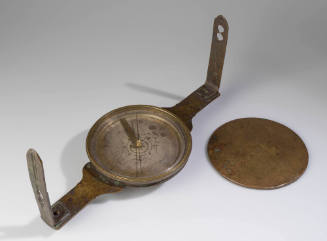


1750-1765