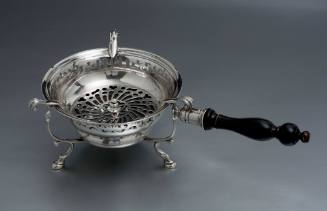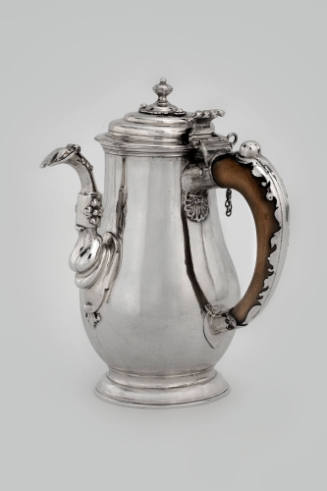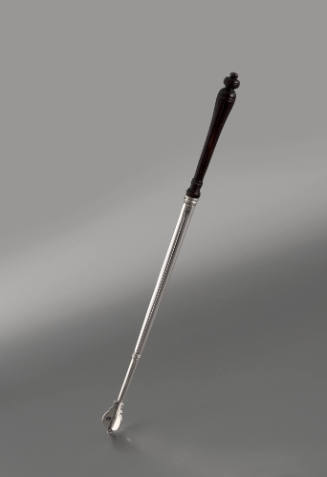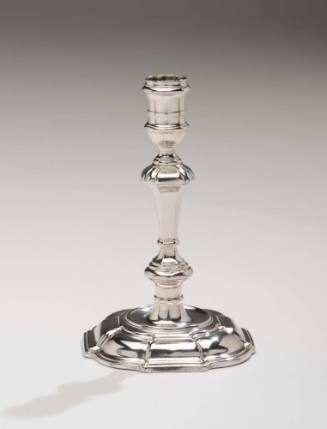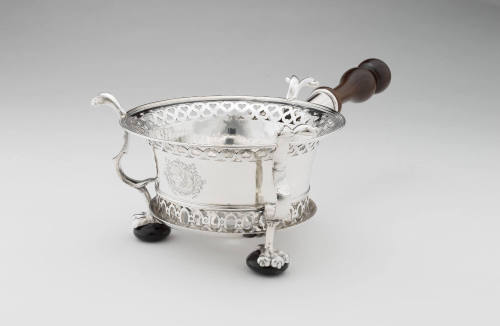
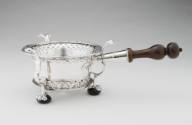
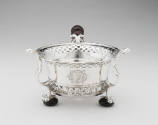
Chafing dish
Date1708-1709
Maker
Robert Cooper
OriginEngland, London
MediumSilver (Britannia standard); wood
DimensionsH: 4 1/8" ; Diam (rim): 6 3/16"
Credit LineMuseum Purchase
Object number1967-418
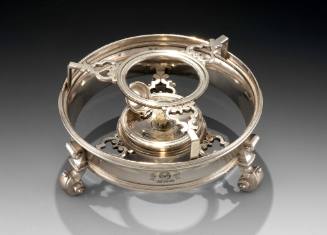
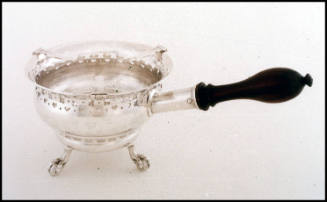
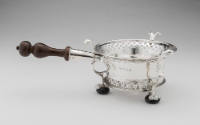
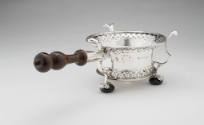
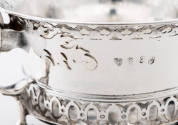
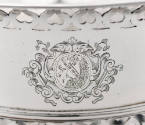
DescriptionChafing DishLabel TextChafing dishes in a variety of materials were more generally used in the seventeenth and eighteenth centuries than surviving examples indicate. English silver chafing dishes are comparatively rare. This example is of conventional form. Its circular body is pierced below the rim and at the base to facilitate the burning of the charcoal fuel. The charcoal was placed on a pierced circular plate (now missing), which rested on an applied molding above the lower band of piercing on the interior. The projecting edge of the base plate curves upward to retain the ashes. Voluted brackets at the rim supported a plate, dish, or pan. The insulating wooden pads of the feet are replacements. The turned fruitwood handle is original, and its inner end is bound in brass with a bolt attachment to a plate within the socket. The socket is attached to the body with foliate cut-card work. William Fitzhugh of Stafford County, Virginia, wrote in the spring of 1697 to Nicholas Hayward, his London agent, for, among other silver articles, "2 silver chafing dishes." The 1719 inventory of the estate of Edmund Berkeley of Middlesex County, Virginia, also listed "2 silver chafing dishes." "Four Chaffing Dishes" appear in the 1769 list of silver mortgaged by William Byrd III of Westover, Charles City County, Virginia. In 1780 Betty Randolph of Williamsburg willed "the Silver Chafing Dishes" to Edmund Randolph, her nephew.Inscription(s)Unidentifed arms engraved on face of body opposite handle.Mark(s)Fully marked on face of body to right of handle; lion's head erased on handle socketProvenanceRonald A. Lee, London
Acquired by CWF in 1967.