
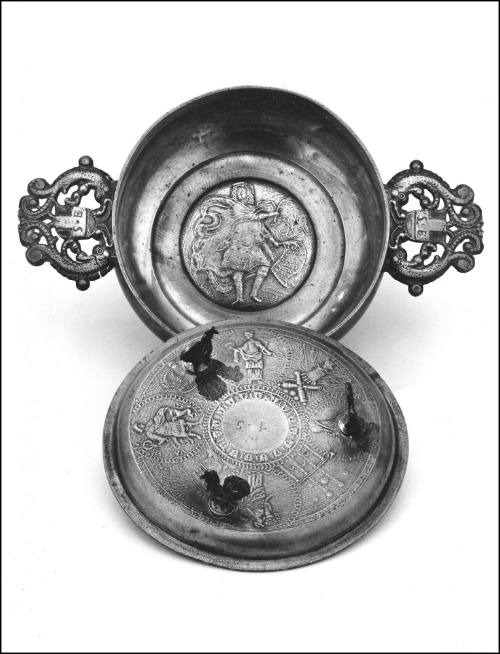
Commemorative porringer and cover
Date1719-1730
Artist/Maker
John Langford I
OriginEngland, London
MediumPewter
DimensionsOH: 3 3/4"; H (rim of porringer): 2 3/16"; OL: 10 1/16"; Diam (cover): 6 1/4"; Diam (rim of porringer): 6"
Credit LineMuseum Purchase
Object number1965-96,A&B
DescriptionPorringer and coverLabel TextOne of the most remarkable bodies of work in English pewter is the group of approximately twenty known commemorative porringers from the late seventeenth and early eighteenth centuries. These have a distinctly un-English look to them. They exhibit strong Continental influence in the use of double handles and covers, not to mention the degree of elaborate relief-cast decoration. That they are noticeably larger than English porringers lends them an added sense of difference and importance. This porringer is one of three known examples that commemorates the signing of the Treaty of Ryswick in 1697. The cover bears the royal initials WR with crown above for King William III, military trophies, celebratory scenes, and four circular medallions with allegorical figures labeled VALOVR, CONDUCT, CONCORDIA, and PEACE. The center is left vacant for stamped owner's initials. Three standing cockerels are burned onto the cover so that the lid may be inverted to serve as a stand for the bowl. John Churchill, first Duke of Marlborough (1650-1722) prominently appears in heroic dress and pose on the boss in the interior center-bottom of the bowl. He holds in his right hand a flail with its tangled thongs spelling Ryswick in intertwined script and in his left, a banner inscribed "To Europe Peace I Give Let Nations Happy Unite." Small circular eyelets with beaded surrounds have broken off the tips of both handles.
This porringer is marked by Langford, who did not commence work until 1719. Author Ronald Michaelis in his article on English commemorative pewter porringers speculated that this example was probably sold in 1722 to commemorate Marlborough's death. Either earlier castings were still available or new castings from the molds were produced at this time.
Even though the earlier history of this porringer is not known, one of the other two Treaty of Ryswick examples has a long tradition of New England ownership. Believed to have been owned by the Richards family of Boston in the eighteenth century, it was exhibited at the Centennial exhibition in Philadelphia in 1876. Three other commemorative porringers have traditions of American ownership.
Inscription(s)Owner's initials "S E" stamped on the upper face of both handles and on top of cover in center.Mark(s)Touch mark a sleeved arm holding a hammer over a tun with "I" to the left and "L" to the right within an outlined circle on underside of left handle. Cover unmarked.ProvenanceVendor: Henry J. Kauffman, Lancaster, Pennslvania.
1660-1680
1620-1640
1685-1700
1700-1715