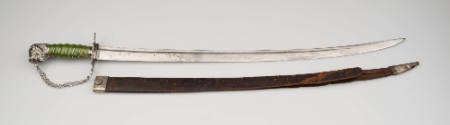
Silver Hilted Cuttoe and Scabbard
Date1775-1780
OriginAmerica, Northeast
MediumSWORD; Silver alloy, iron/steel, and walrus ivory
SCABBARD: Leather, wood, and silver alloy
DimensionsSWORD - Overall: 31"; Hilt: 5 5/16"; Blade: 25 1/2" x 1 3/16"
SCABBARD - Overall: 26"
SCABBARD - Overall: 26"
Credit LineMuseum Purchase, The Friends of Colonial Williamsburg Collections Fund
Object number2025-93,A&B
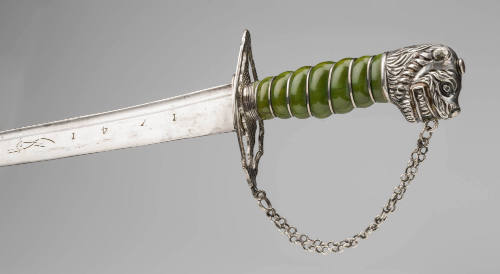
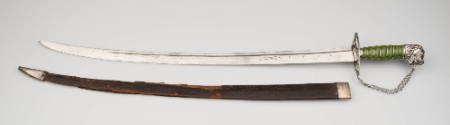
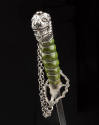
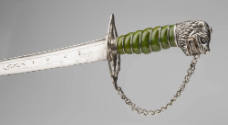
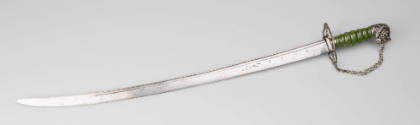
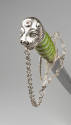
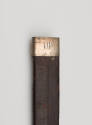
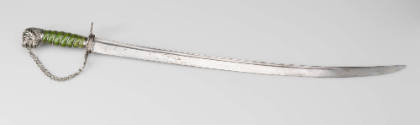
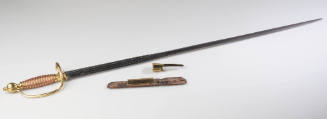
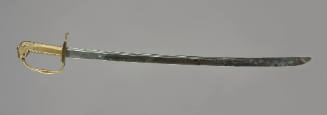
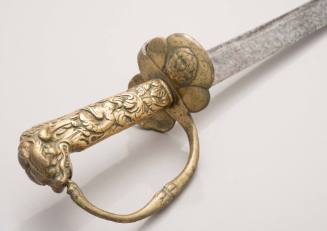
DescriptionSWORD: Silver-hilted cuttoe with a large, hollow lion's head pommel topped by a low capstan and a spiraling green-stained walrus ivory grip set with a narrow silver band tracing the groove, and a ribbed ferrule at its base. The engraved and chased counterguard is ovoid with four large apertures, a smooth inboard edge, and a serrated outboard edge. A double chain of twisted "figure-of-eight" links connects a swiveling ring at one end of the guard to a ring soldered to the teeth of the lion. Between the guard and the blade is a ribbed scabbard cap. It's slightly curved, single-edged blade has a narrow fuller running along the spine and a false edge.SCABBARD: Dark brown or black leather, stitched down the center of the back, covering a wooden carcass. The top mount is a period-of-use replacement, consisting of a simple sheet silver band and a plain circular stud. The chape is original and has a bulbous, molded tip, and a reeded band near its opening, which has a decoratively filed edge.Label TextDerived from the French couteau de chasse, meaning “hunting sword,” the simple-hilted British cuttoe appeared sometime in the early 1760s. Almost immediately it became "a thing" with gentlemen, and by extension military officers, being a fashionable, light, and easy-to-wear cutting sword. Since the cuttoe’s form was not subject to the rigid architectural norms of the smallsword, a broad spectrum of striking variants proliferated.
Pommels often took the form of a grimacing lion, symbol of Britain's strength, or occasionally the head of an eagle. While gilt or plain silver was the choice metal for hilt and scabbard mounts, grips were invariably spiraled or gadrooned, usually of ivory, either left natural or stained to a beautiful green. Other attractive grip materials found on British cuttoes include ebony, horn, or shagreen over a wood core and bound in twisted wire. Blades could be whatever the customer wanted, but were typically shorter than those found on smallswords or hangers.
The cuttoe craze reached the American colonies quickly, where it was so enthusiastically received that by 1770, silversmiths and cutlers were both importing and making them to satisfy a burgeoning demand. By the time of the Revolution, five years later, cuttoes were being wrought in cities like Philadelphia, New York, Providence, Newburyport, Boston, Exeter, and even some of the smaller towns in from the coast.
During the war, the cuttoe was the go-to sword of officers fighting for American independence. Even George Washington is documented as having carried two different examples during the war, both of which were American-made.
Other senior Continental Army officers carried them too, as evidenced by General Israel Putnam's cuttoe now in the collection of the Connecticut Historical Society. Putnam's sword was almost certainly made by the same anonymous maker of this example, as both have the idiosyncratic, oversized lion's head pommel.
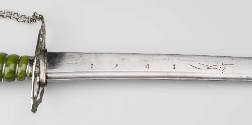
Colonial Williamsburg's cuttoe survives in superb condition, complete with its original scabbard and double knuckle chain. Additionally, its spiraling green grip offers an opportunity for further research; our Conservators have determined it's made of ivory from a walrus tusk!Inscription(s)The back of the scabbard's top mount is engraved with "MA" conjoined, in sprigged script.Mark(s)Both faces of the blade are punched with the date "1 7 4 1" and a crude engraving of a "running wolf."ProvenanceEstate in Acton/Concord area of Massachusetts; [Bonhams Skinner, Marlborough, MA, August 13, 2025 Auction ARM30917MRL2 - 30917, Lot 1126]; 2025 - present, purchased by The Colonial Williamsburg Foundation (Williamsburg, VA).
1765-1775
1690-1710
ca. 1765-1770
1690-1720
ca. 1690