
Scottish Broadsword
Dateca.1690-1730, with later additions
OriginScotland
MediumIron, steel, wood, and brass
DimensionsOverall: 37 3/4"; Blade: 32 1/8" x 1 9/16"; Hilt: 5 9/16"
Credit LineGift of Robert and Sally Ware
Object number2024-210
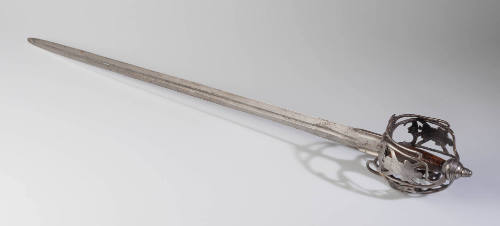
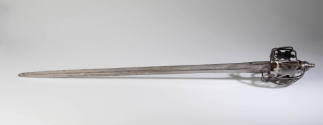
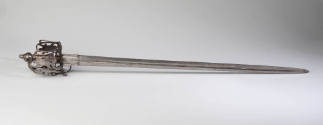
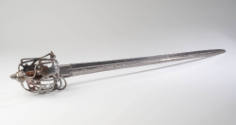
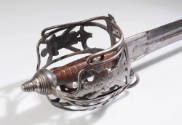
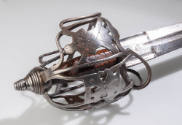
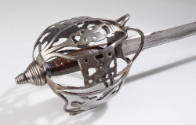
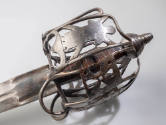
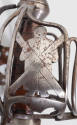
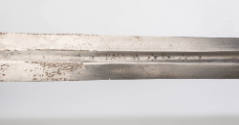
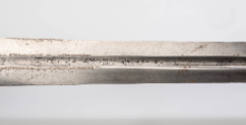
DescriptionIron hilt of classic British/Scottish form, with a basket composed of two later panels shaped like St. Andrew & the Cross, three panels pierced with circles and hearts, and thin bars. Its later turned pommel is cut with bands of rings and knurling, and is topped by a tall capstan, decorated en suite, and likely screwed onto the tang of the blade. The base of a quillon, added during the sword's working life, is still riveted to the wrist guard. Forged with two fullers running along the edges of a long ricasso, the center of its double-edged blade carries a broad fuller. Its octagonal wooden grip, cut with a spiraling wire channel, is a period of use replacement.Label TextThe basket-hilted broadsword has been emblematic of Scotland for centuries. Treasured by their owners, swords were passed down through generations and often updated and altered, like this unusual example. Possibly made as early as the last part of the 17th century, it received some innovative embellishments over the course of its first one hundred years. In place of the usual panels flanking the hilt opening, two new ones were added, in the shape of Saint Andrew, patron saint of Scotland, with his cross. What may be the sword's original pommel was embellished with decorative turnings and a band of milled reeding at the same time it received a matching capstan.Broadswords of this general form are also associated with the Jacobite Rebellions of the 1689 to 1746 era, where the deposed King James II, and his descendants, unsuccessfully sought to regain the throne of Great Britain. Similar broadsword blades, taken from the battlefield at Culloden in April 1746 were formed into a garden fence once installed at Twickenham House in Twickenham, near London. Though the house was demolished in 1888, some of the Culloden blades, since freed from the fence, survive in museum collections in Scotland and England.
This unique sword was brought to New York City in 1927 by John Reid, a native of Glasgow. When he died in the late 1980s, the sword passed to Sally Ware, his goddaughter. Mrs. Ware believes this sword was brought to America when Reid emigrated as a family heirloom.Mark(s)The blade struck with ANDREA on one side and FERARA on the other, within the central fuller. Each name is flanked with geometrically arranged cross and crescent punches.Provenance1927, brought to America by John Reid (Glasgow, Scotland); thought to be a family heirloom; by decent to his goddaughter, Sally Ware (Lynchburg, VA)
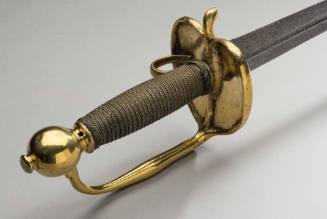
ca. 1700-1720
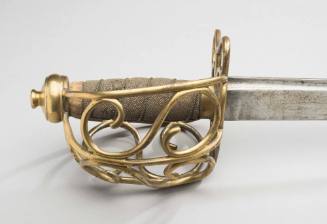
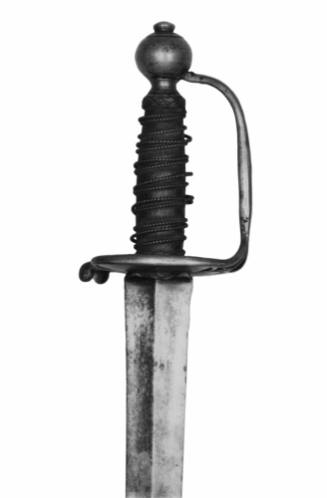
ca.1690-1710
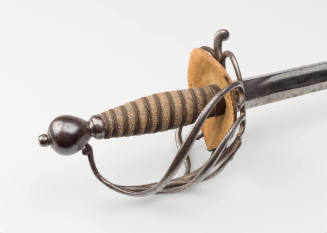
1765-1775
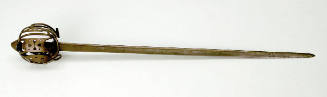
c. 1740-1750
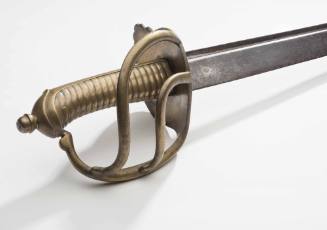
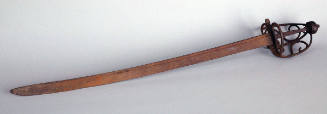
1775-1780

1750-1770
ca. 1770