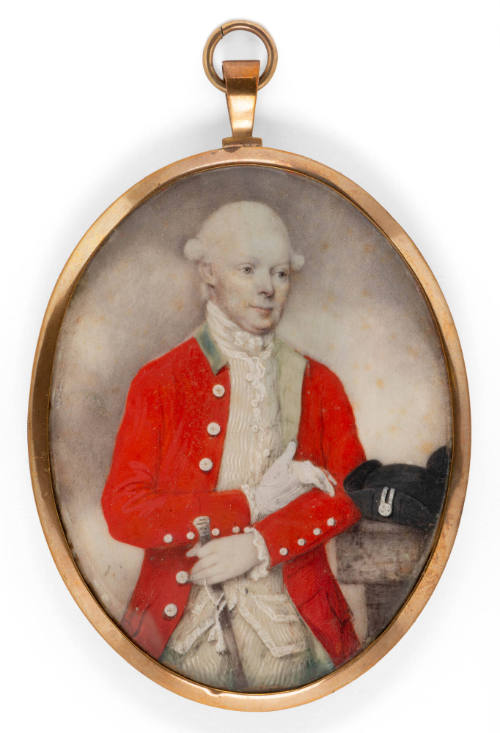
Portrait Miniature of Richard Cox (1718-1803)
Date1777
Artist
The Artist "V" (probably Francois-Xavier Vispre)
1730 - 1792
OriginEngland
MediumWatercolor on ivory
DimensionsOverall: 2 7/8 in (7.3cm)
Credit LineMuseum Purchase, The Friends of Colonial Williamsburg Collections Fund
Object number2025-56
DescriptionMiniature 3/4 length portrait of a man wearing a scarlet civilian coat with green velvet collar over a neck stock and ruffled shirt and a striped or corduroy waistcoat and breeches. His proper left elbow is resting on a pillar next to a cocked hat with silver button and loop, probably made of mother-of-pearl. The subject's arms are crossed, his left hand holds a walking stick with a silver head; the right hand is gloved and is holding the left glove. The oval miniature is signed lower left and set in the original gilt metal pendant frame. The frame is engraved on the reverse.Label TextThe subject of this portrait miniature is Richard Cox, a clerk and secretary who served for General Sir John Ligonier in the late 1740s. When Ligonier became Commander-in-Chief of the British Forces in 1757, Cox was promoted to military agent of the 1st Foot Guards, an important role responsible for the payment of officers and soldiers, ordering of regimental clothing and supplies, and fulfillment of any special requests. While there were about a dozen main agents working for the army at this time, Cox was awarded oversight of the prestigious 63rd Regiment of Foot, the British Army unit that served in Colonial America throughout most of the Revolutionary War.
In 1765, Cox went into partnership with a prominent London banker, first offering loans to officers and soldiers and later expanding into the private sector. By 1795, Cox & Co. was one of the largest military contractors for the army, holding the agencies of nearly 100 regiments, and an advisor to the Prince of Wales and the Duke of York. Cox’s daughter Caroline married Sir Thomas Champneys, of England and Jamaica, paving the way for the business to open worldwide. Cox’s thriving company continued through World War I, until it was acquired by Lloyds Bank.
Colonial Williamsburg’s portrait miniature of Cox portrays him in civilian clothes, complete with a scarlet coat, hat, and gloves. The likeness was taken in 1777, by an elusive artist whose rare surviving work is marked by the letter “V.” This probably stands for Francois-Xavier Vispré, a French artist who moved to England in the 1750s and exhibited at the Society of Artists.
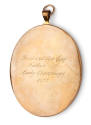
Inscription(s)The oval miniature is signed lower left with a cursive "V," thought to be the distinctive signature of French artist Francois-Xavier Vispre (1730-1792).Mark(s)The reverse of the gilt metal pendant frame is engraved: "Richard Cox Esq/ Father of/ Lady Champneys/ 1777."Provenance[Elle Shushan, Philadelphia, PA]; 2025, purchased by The Colonial Williamsburg Foundation (Williamsburg, VA)
José Francisco Xavier de Salazar y Mendoza
1800-1801