
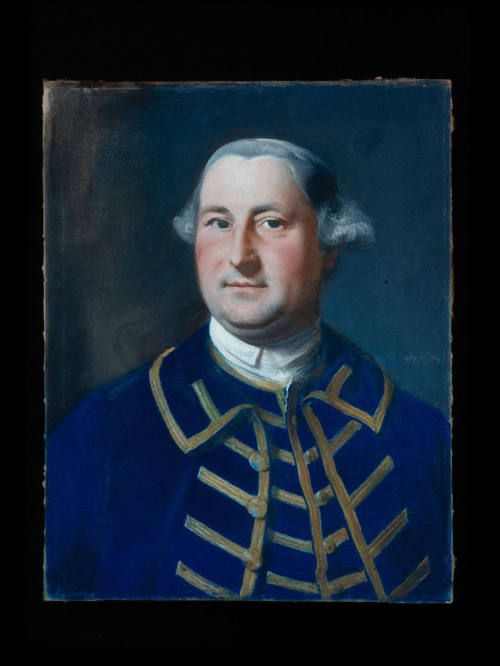
Portrait of Gregory Townsend (1718-1798)
Date1756
Artist
John Singleton Copley
1738 - 1815
MaterialsPastel on paper adhered to canvas, the canvas supported by wooden strainers. Remnants of 18th (?) century newspaper are glued to the backs of the strainers.
DimensionsUnframed: 23 7/16 x 18 1/4in. (59.5 x 46.3cm); Primary paper support: 22 3/8 x 18 1/4in. (56.8 x 46.4cm); and Framed: 25 1/2 x 20 11/16 x 1 3/16in.
Credit LineAcquisition funded by Alma and Lewis Steadman
Object number1992-221,A&C
DescriptionA bust-length portrait of a man, his body turned slightly sinister, his head turned dexter, brown eyes to viewer. His hair is powdered, with upturned curls over the ears. He wears a white neck cloth, over which the collar tips of his white shirt are turned down. A suggestion of a shirt ruffle appears beneath his waistcoat. His waistcoat and coat are vivid blue with gold trim and buttons. The background is a plain gray.The gilded frame on the portrait at the time of acquisition was not original to it; CWF replaced it with a modern, 18th-century-style, reproduction frame of black-painted wood molding with gilded ornamentation made by Black Dog Gallery and accessioned as 1992-221,C. The replaced frame (1992-221,B) was retained and stored separately.Label TextThere is controversy over the date of this portrait. While the inscription on it appears to read "1756," the sitter's attire is typical of the 1760s. Regardless, the picture is one of Copley's earliest pastels. Despite certain naive qualities and considering his lack of experience in the difficult medium, the likeness reveals surprising proficiency.
Gregory Townsend was the son of Solomon Townsend (b. 1676) and his second wife, Esther Sugars, of Boston. He remained a Loyalist during the Revolutionary War and served in the British army as Assistant Commissary General in New York.
Via the Banishment Act of 1778, Townsend and many other Loyalists were sent to Halifax, Nova Scotia. His letter of July 8, 1783, written at Halifax and sent to his wife's brother and sister-in-law, Daniel and Mary Hubbard of Boston, gives a glowing report of the place. However, a letter addressed to the same couple on April 20, 1784, focuses on the political bickering then current: "Nothing going forward but ins & outs of Violent Contests between the two Houses of Parliamint and their unhappy Sovereign." Townsend died in Halifax in 1798.
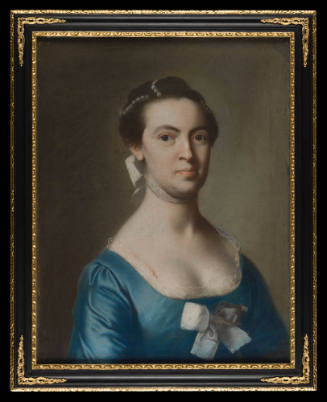
Colonial Williamsburg's companion portrait of the sitter's wife, Lucretia Hubbard, appears to have been done later, after the couple's marriage. The two pastels may have been left behind in America when the Townsends were forced to emigrate.Inscription(s)Handwritten in script in white pastel or chalk in the mid right background: "J.S. Copley fecit 1756".ProvenanceThis portrait and its companion were left behind when the Townsends went to Nova Scotia. It is believed that the portraits were left with Horatio Townsend (b. 1763), Gregory Townsend’s first cousin, through their shared grandfather Johnathan Townsend (b. 1697). Horatio married Sarah Green and the portrait likely passed from Horatio to their daughter, Mary Townsend (b. 1796). She married John B. Derby of Salem, Massachusetts and the portrait descended to their son, George Horatio Derby (1823-1861). He married Mary Ann Coons of St. Louis in 1854 in San Francisco and the portrait was passed to their son George McClellan Derby (b. 1856). The portrait then passed to one of his children, presumably George Townsend Derby (1905-1992), who either sold the portraits to (or placed them with) Ginsberg & Levy, New York, NY. In 1972, the pair were purchased by Thomas A. Gray of Winston-Salem, NC. In 1974, Gray sold the pair to his mother, Anne Pepper Gray (1921-2003). In 1976, Mrs. Gray gave the pair to Old Salem, Inc., Winston-Salem, NC. In 1985, Old Salem placed the pair with dealers Bernard & S. Dean Levy, New York, NY but it seems that they did not sell them until 1992, when, on behalf of Old Salem, the pair sold at Sotheby's and were purchased by the Colonial Williamsburg Foundation
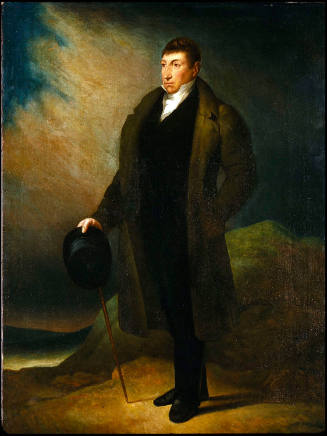
Ary Scheffer
Probably 1824-1850
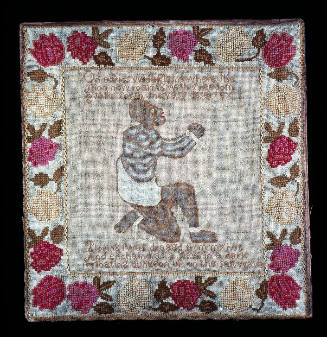
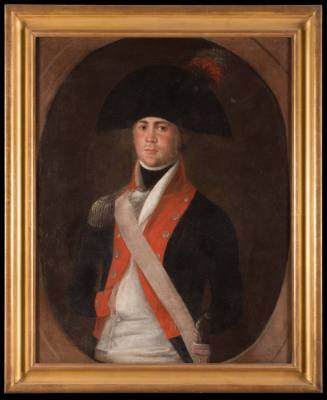
José Francisco Xavier de Salazar y Mendoza
1800-1801