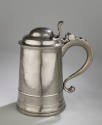
William Will Tankard
Date1770-1780
Maker
William Will
MediumPewter
DimensionsHeight: 7 7/8"; Width across handle and body: 6 15/16"; Diameter at foot: 4 9/16"
Credit LineMuseum Purchase, The Friends of Colonial Williamsburg Collections Fund
Object number2025-28
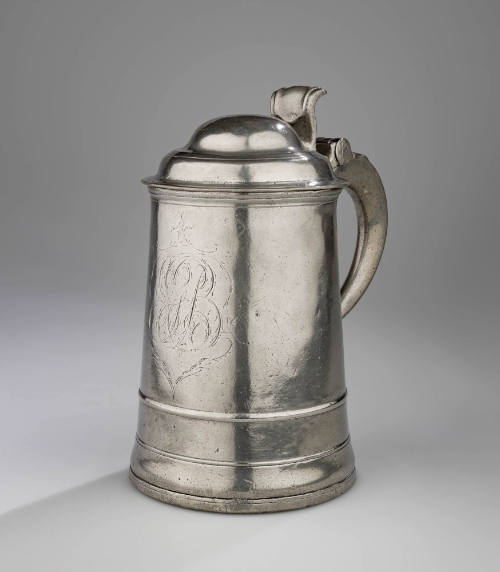
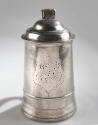
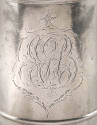
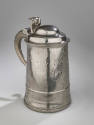
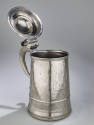
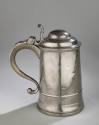
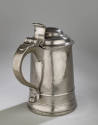
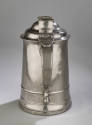
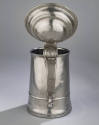
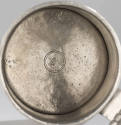
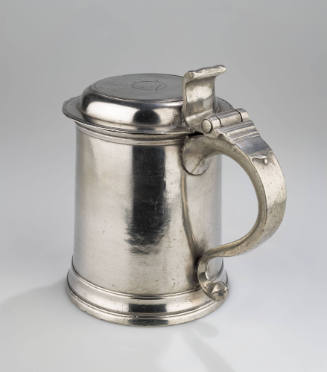
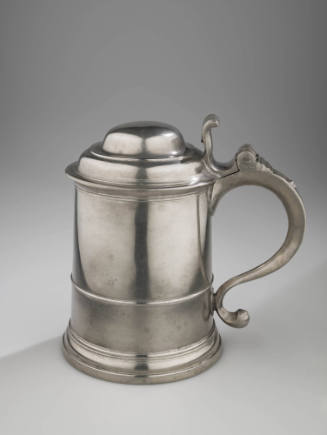
DescriptionQuart tankard of tall, tapering cylindrical form with a molded base, a molded lip, and a band at the lower junction of the handle. A hollow scrolled handle with a bud terminal (replaced) connects to an integral hinge which connects it to a double-domed lid with a projecting lip. The lid is opened by a chair-back thumb piece.Label TextWilliam Will, the fourth son of the pewterer John Will, learned his trade from his father and brother Henry in New York City before moving to Philadelphia with his brother in the early 1760s. Will served as an officer in the Revolution, in the General Assembly, and even signed some of Pennsylvania's paper money of the April 10, 1777 issue. Will produced an impressive array of high-quality pewter vessels in the last decades of the 18th century. Colonial Williamsburg's holdings of his holloware products include a very rare drum-shaped teapot and three tankards. This tankard is the only straight-sided one by Will in the collection, its body cast in the same mold as a mug also owned by the Foundation (2022-196). Distinguishing this tankard as something extraordinary are the owner's initials "GEB," engraved in cypher at its center.
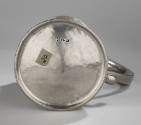
This tankard has long been on the radar of early American pewter collectors and students. It was illustrated in J.B. Kerfoot's "American Pewter" in 1924, the first major work to tackle the subject. Two years later it appeared in Louis G. Myer's "Some Notes on American Pewterers," which advanced scholarship even further. Graham Hood recognized its importance and plated it in his 1965 study of American pewter in the collection of the Yale University Art Gallery. It is hoped that one day the original owner of this tankard, with the initials "GEB," will be finally identified.Inscription(s)Front of the body engraved with an owner's "GEB" cypher within a sprigged surround.Mark(s)Bottom interior struck with "W W," a sprig above and below, within a saw-toothed circular reserve, all within a pair of incised concentric circles (Laughlin-541).ProvenanceIn the collection of John Barrett Kerfoot (1866-1927) and plated in Fig.72 of his book "American Pewter," published in 1924. From Kerfoot to Louis G. Myers and plated in his 1926 book "Some Notes on American Pewterers," facing p. 72. From Myers to Mabel Brady Garvan, to Yale University Art Gallery, 1931 (Acc. No. 1931.163). Deaccessioned by Yale on April 27, 1973 (see file), likely to Tom Williams (Litchfield, CT). Sold by Williams to Alexander L. "Sandy" Weiner (1908-2004) later in 1973. Purchased by Colonial Williamsburg from Sandy Weiner's son in 2025.
1650-1675
1700-1720