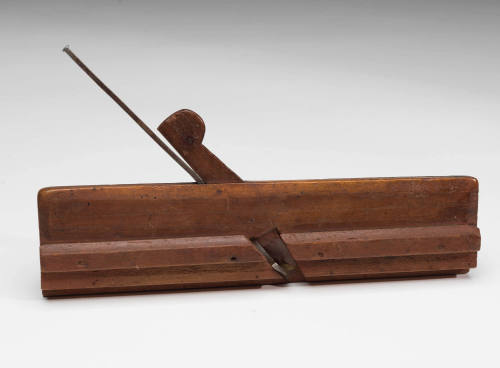
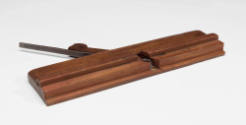
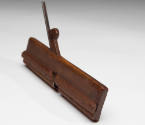
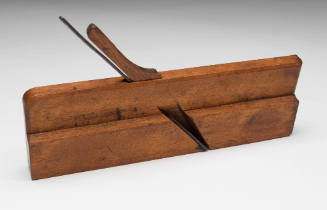
Shiplap Rabbet Plane
Dateca. 1780-1800
Maker
Thomas Hayden
1745 - 1817
MediumChestnut, iron, and steel
DimensionsLength: 9 3/8"; thickness: 13/16"
Credit LineGift of Thomas Elliott
Object number2024-287
DescriptionShiplap rabbet plane with shallow, flat chamfers (mostly on the sides) which end with a turn-out. Its wedge is flat-backed, and its applied secondary molded shoulder is held in place by nails.Label TextA carpenter, housewright, and architect, Thomas Hayden is known for his work on the 1788 addition to the Oliver Ellsworth house in Windsor, Connecticut, the 1794 addition put on to the Phelps-Hatheway House in Suffield, CT, and the 1788-1789 John Watson House in East Windsor, CT, amongst others.Before achieving a reputation for creating fine woodwork and beautiful structures, Hayden had an honorable career in the military of the fledgling United States. First answering the Lexington Alarm of April, 1775 as a serjeant, Haydon served as the 8th Connecticut Regiment's Serjeant-Major until late December of that year. Receiving an officer's commission from Congress, he became 2nd. Lieutenant in the 17th Continental Infantry in New Year's Day, 1776, and served as the unit's Adjutant for much of that year. On New Year's Day next, Haydon received a 1st. Lieutenant's commission in the 3rd Connecticut Regiment of the Continental Army, where he also served as Adjutant for some time. Though he resigned on April 15, 1778, he returned to service as a Lieutenant in the Connecticut militia in 1781 and 1782.
Living well into his seventy-third year, Thomas Hayden died on November 28, 1817, and was buried in Windsor's Palisado Cemetery. He left an estate worth about $1850, and his inventory, proved early the next year listed "Joiners and Carpenters tools amount - $69.81," in addition to lots of lumber.
Hayden's shiplap plane, made by him for his own use, was needed to shape the long edges of boards so they'd fit together tightly. Judging from its wear, it had a very long working life, and may have been used to help create some of the abovementioned houses.Mark(s)T , HAYDEN in relief within a rectangle, struck into the toe (Elliott, GAWP 5th ed., p.173). I, A, and T (upside-down), incuse, are also struck into the toe.ProvenanceJanuary 2000, purchased by Thomas Elliott (Westbrook, CT); 2024, given to The Colonial Williamsburg Foundation (Williamsburg, VA)
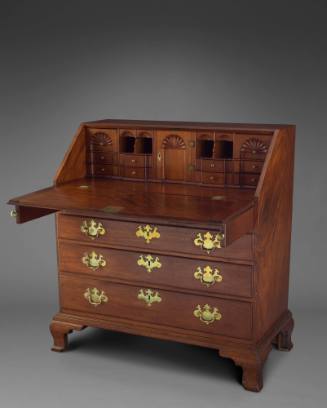
1760-1790
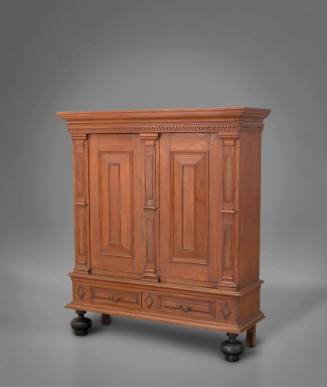
ca. 1798
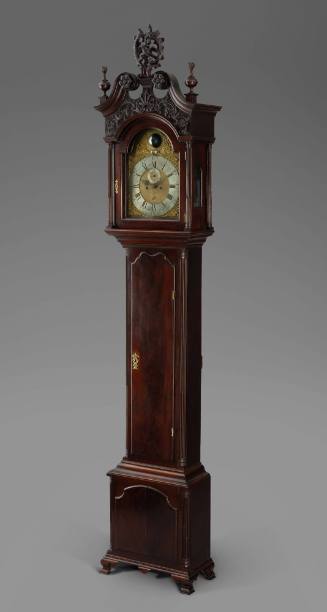
ca. 1775
1760-1780