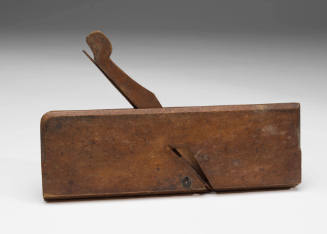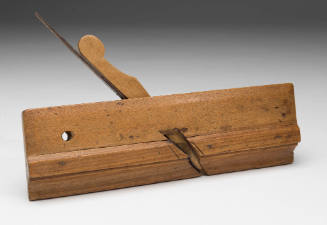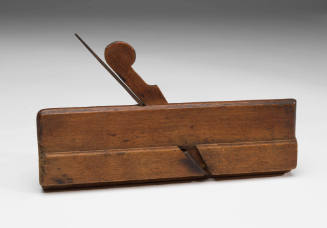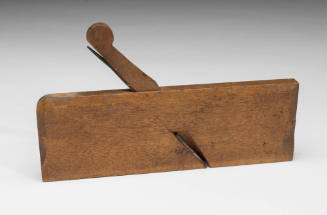
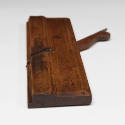
Small Bead Plane
Dateca. 1751-1770
Maker
Joseph Gould
1730 - 1810
MediumBirch, iron, and steel
DimensionsLength: 10"; width: 11/16"
Credit LineGift of Thomas Elliott
Object number2024-284
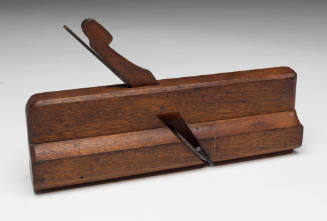
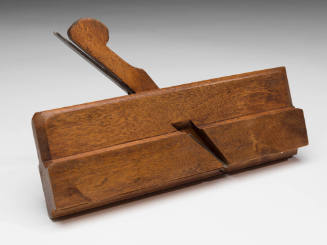
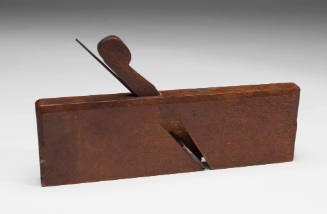
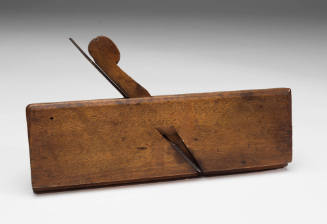
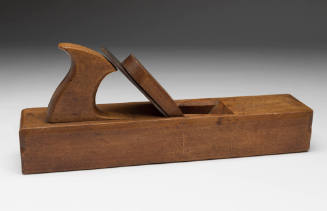
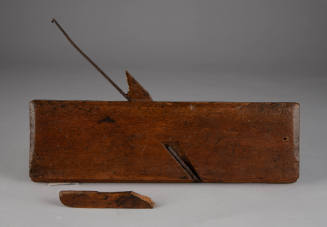
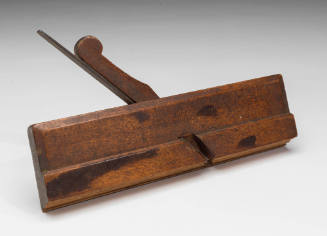
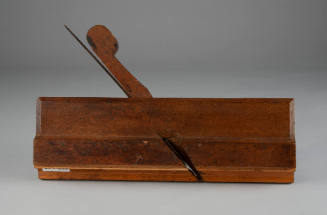
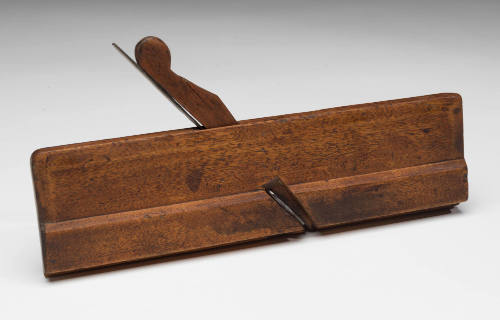
DescriptionSmall bead plane with flat chamfers, mostly on the sides, and ending with lamb's tongues. It has a molded shoulder, and the wedge is of the "John Walton" style with a small round finial.Label TextJoseph Gould is a rare bird indeed. Not only is he an American planemaker from the middle of the eighteenth century, but his ledger, covering 1752-1760, survives in the collection of Historic New England (GUSN: 194026, Ref. Code: MS002.015). Detailed within are indexed accounts of joiner's work, prices, and tools, amongst other activities like gun-lock work, wheelwrighting, and shoemaking.Apprenticed to carpenter, housewright, and planemaker John Walton, Jr. of Reading, Massachusetts, Gould was free at the age of twenty-one, on December 30, 1751. Two days later and out on his own, he began his day book on January 2, 1752, though he continued to work for Walton.
In 1770, when the burgeoning town of Reading, Massachusetts formed four companies of militia, Gould found himself attached to Col. David Green's South Reading command as the unit's joiner and wheelwright. As a Private in Capt. John Walton's Company of Col. Green's regiment, he responded to the alarm of April 19, 1775 and participated in the battles of Lexington and Concord. Gould's service record shows that he spend four days in the field afterwards, helping kick off the Siege of Boston.
In his fifty-sixth year, Joseph Gould was again with the Reading Militia when they were called upon to put down the riot at Springfield Arsenal in 1786.
Insight into the into the personal, professional, and civic communities of rural Massachusetts can be gained through the study of everyday tools like this woodworking plane and those who made them. Not only did Joseph Gould learn his woodworking trade under John Walton, Jr., but he served in his command during the opening salvo of the American Revolutionary War. Surely, they must have been friends.
Unsurprisingly, the planes carrying Gould's mark look very much like those of his former master. Even his marks look like John Ealton, Jr.'s marks, down to the use of a four-petaled "x" shape between the initial and last name, and the large initials in relief within a serrated heart. Both Gould's and Walton's planes resemble those of Francis Nicholson, and though slightly cruder, were surely patterned off the latter's products.
Passing away on August 5, 1810 at the age of 79, Gould died intestate. His son John was appointed administrator to the estate, and in the notice he ran in the Independent Chronicle (Boston) on October 15, 1810, his father was described as a wheelwright. Considering the style of his planes and the preponderance of evidence that he leaned heavily into wheelwrighting after about 1770, it seems they likely date from the third quarter of the eighteenth century.Mark(s)I x GOULD in relief within a serrated rectangle is struck into the toe (Elliott, GAWP 5th ed., p.153, imprint A). An owner's mark of I•S in relief within a square is also struck into the toe twice, and possibly a thrid time over Gould's mark. Heel struck with later owner's initials F.M.P., incuse.ProvenanceSeptember 2006, purchased by Thomas Elliott (Westbrook, CT); 2024, given to The Colonial Williamsburg Foundation (Williamsburg, VA)