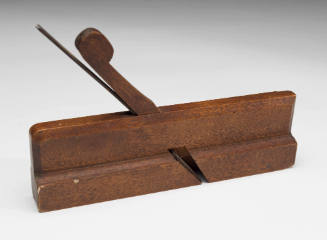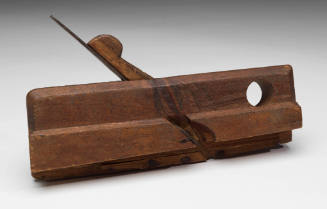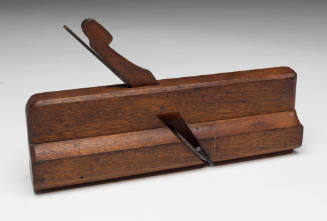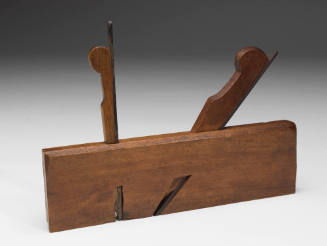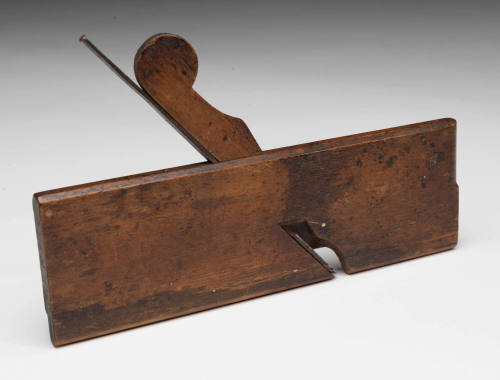
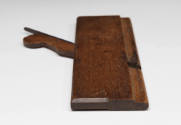
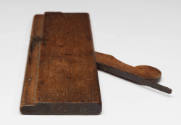
Coping Plane
Dateca. 1770-1800
Maker
Ebenezer Clifford
1746-1821
MediumBirch, iron, and steel
DimensionsOverall: 9 3/4"; Width; 1/2"
Credit LineGift of Thomas Elliott
Object number2024-266
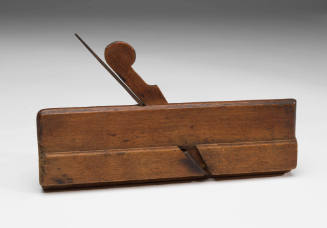
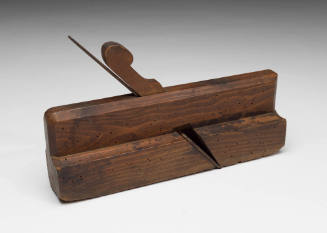
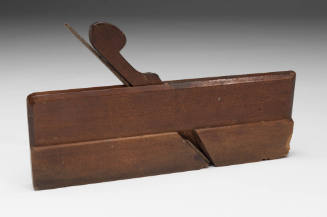
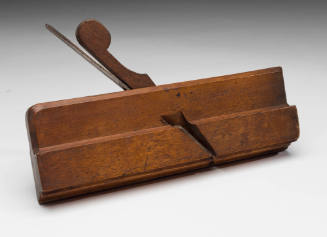
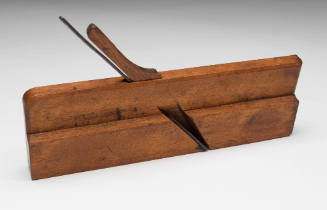
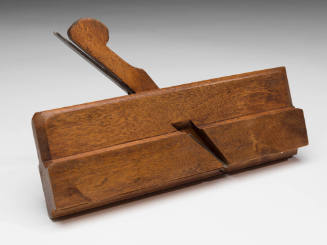
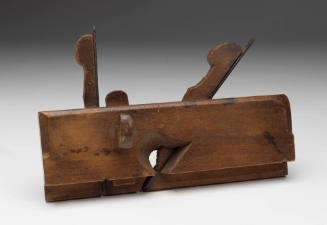
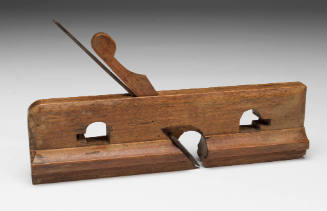
DescriptionCopping plane with flat chamfers that end with a turn-out. Heel has been reduced.Label TextWhen one thinks of early American mechanical geniuses, names like Paul Revere, Benjamin Franklin, David Bushnell, and David Rittenhouse may pop to mind. To that distinguished list should be added the name of this humble plane's maker, Ebenezer Clifford.Variously described as a joiner, cabinetmaker, carpenter, master builder, architect, mechanic, inventor, under-water treasure hunter, justice of the peace, legislator, and mill operator, it seems Clifford could do it all. In some parts of coastal New England, where his larger works can be experienced, his name is still renowned.
Born into a family of woodworkers in Kensington, New Hampshire, Clifford was working on his own before the Revolution. Spurred to action following the Battles of Lexington and Concord, Sergeant Ebenezer Clifford, aged 28 appears on a June 3, 1775 muster list of Capt. Winthrop Rowe's company of the 2nd New Hampshire Regiment as a joiner. As a soldier in the 2nd NH, he participated in the Siege of Boston. Clifford's talents were recognized, and he was given the job of Regimental Quartermaster Serjeant, a post he held until 1777.
Once back home in Kensington, Clifford returned to his tools and bench with vigor, building an intricate staircase for the Deerfield, NH home of Stephen Batchelder, a local farmer. He was also continually expanding his tool kit, and is recorded as having purchased over 200 new plane irons from a local blacksmith between 1772 and 1794. This is an important fact since it shows Clifford was making his own woodworking tools, like this beading plane, only needing to go to others for specialized metal components.
Attributed to Clifford's early career is a remarkable paneled room, once part of the Moses Shaw house, built in Kensington around 1774. Long since demolished, the wall and ceiling panels were purchased by the Metropolitan Museum of Art in New York in 1911, and installed in their American Wing in 1924. Once uninstalled, the entire room was given by The Met to the New Hampshire Historical Society (Accession no. 2006.036). Tools like this plane would have been used by Clifford to create such beautiful woodwork.
After the war, Clifford relocated to Exeter, New Hampshire, between 1788 and 1790. He purchased the early 18th c. Brigadier Gilman house and lived out the rest of his life there. Today it is known as the Gilman Garrison House, operated as a museum by Historic New England.
His work as a cabinetmaker is shown in records dating from the time of his move. In the late 1780s Clifford purchased “1,600 board feet of cherry, 900 feet of maple, and 900 feet of birch,” while selling a “Cherrytree” clock case, a “Mahogany Stand Table,” six chairs, and an 18-inch “Mahogany Teaboard.”
Surviving structures attributed to Ebenezer Clifford include the Congregational Church in Exeter, some of the interior woodwork of the ca.1784 John Langdon House in Portsmouth, the ca.1803 Academy in Atkinson, the ca.1800 Samuel Tenney House in Exeter, and the ca.1807 staircase and joinery in the Samuel and Jabez Lane Homestead in Stratham. All are in New Hampshire and built in conjunction with others, excepting the Atkinson Academy, which was Clifford's execution alone.
Though not the inventor of the submersible, Clifford showed his ingenuity in designing and building a diving bell used to salvage underwater valuables, along with Samuel Palmer, a partner. Appearing in the February 8, 1810 issue of The United States Gazette, published in Philadelphia, is this account of an 1809 recovery expedition;
"DIVING BELL. We understand that Ebenezer Clifford, of Portsmouth, N.H. has invented an improved and ingenious Diving Bell, of a new construction; in which labourers can descend with great ease and safety, to almost any depth, and work with convenience. During the last summer he has been industriously employed in weighing the ordnance in Penobscot river, from the wrecks of the vessels lost and destroyed in the unfortunate expedition in the time of the American revolution, against Hagaduce, on that river. He has already weighed thirty-six pieces of artillery, and one brass howitzer, together with several tons of cannon ball; all of which, it is said, were more than sixty feet below the surface of the water. We hope such ingenuity and enterprise will be suitably rewarded."
Clifford and Palmer were paid $2,078.84 by New Hampshire for the value of the metal.
Sunken treasure, in the form of silver coin, was also within Clifford's technological grasp. According to Charles Henry Bell's, "Exeter In 1776: Sketches of an Old New Hampshire Town As it Was a Hundred Years Ago," published in 1876, Clifford was remembered as an;
"an ingenious mechanic, and constructed a diving bell, with the aid of which he is said to have recovered a quantity of silver money from the wreck of a Spanish or other foreign vessel, at the Isles of Shoals. The coin had suffered, during its long submersion, a wondrous sea change, and was found to be covered with some kind of marine incrustation. A portion of it was placed for safe keeping in the old Exeter Bank, and when the vault of that institution was entered and robbed of its valuable contents, about the year 1828, some of Mr. Clifford's silver pieces were among the spoils. The story goes, that the peculiar appearance of the money afforded the clew by which the guilty persons were detected."
At the age of seventy four, Clifford died on October 21, 1810, and now lies in Exeter's Winter Street Burial Ground below a neat, but weathered, white marble tombstone.
In 1864, Clifford's descendants, remembered as the "last of the fourth generation of cabinetmakers" sold the family homestead. Also crossing the auction block were the family's accumulation of tools. Writing to Joseph Down at The Met in 1946, the Reverend Mr. Roland Sawyer recounted one of his father's stories;
“A farmer bought their old planes and tools for firewood, many of them then over 100 years old — he had to go twice with a two horse wagon to haul them home.”Mark(s)E.CLIFFORD in relief within a serrated rectangle, is struck into the toe (Elliott, GAWP 5th ed., p.76, imprint A). Owner's initials of a large F•E are struck into heel.ProvenanceOctober 1998, purchased by Thomas Elliott (Westbrook, CT); 2024, given to The Colonial Williamsburg Foundation (Williamsburg, VA)