

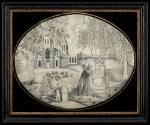
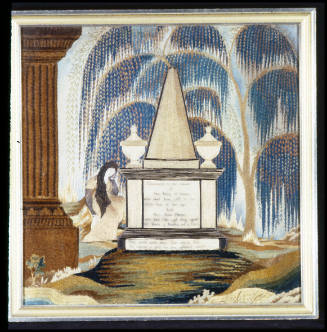
Memorial to Philo Day and Julia Ann Gilbert
Dateca. 1830
MediumGouache and ink on a plain-weave silk ground
DimensionsUnframed: 18 5/8 x 23 3/8in. (47.3 x 59.4cm) and Framed: 22 1/2 x 27 1/4 in.
Credit LineGift of the Museum of Modern Art
Object number1935.404.1
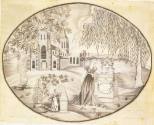
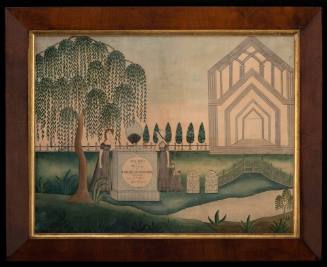
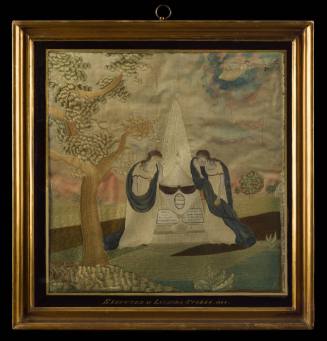
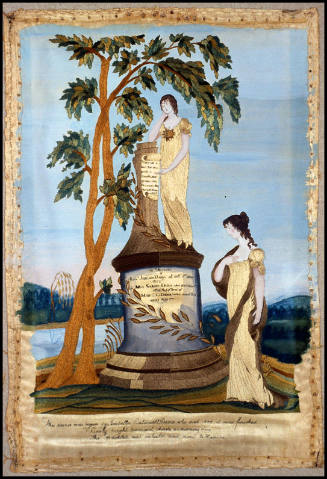
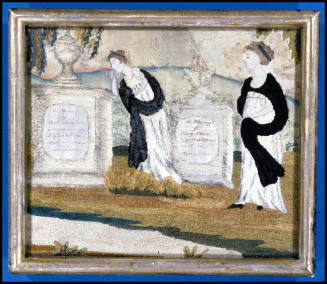
DescriptionA grisaille mourning picture within an oval format on silk. In the right foreground, a female figure leans on an urn-topped, inscribed tombstone while, to the left, a smaller female figure with an anchor stands beside a smaller, obelisk-topped tombstone. In the left background stands a Gothic church. Trees to left and right frame the composition, while various plants sprout from the ground, the smaller ones blatantly drooping and wilting.The 2-inch, cove-molded, black-painted frame with a carved, gold-painted liner, is a nineteenth-century replacement.Label TextAs is typical of mourning pictures, this double memorial to Philo Day and Julia Ann Gilbert uses various popular symbols to convey mourning. The most prominent Christian symbol is the impressive Gothic church, a type that appears in other memorials from New York and Massachusetts, suggesting it was copied from a published source. The tomb, grieving mourner, drooping plants, withering oak, and weeping willow are all reminders of the transitory nature of earthly life. The urn suggests the spirit of the departed.
The phrase “There is Rest in Heaven” inscribed on the face of the smaller monument expresses an attitude toward life and the hereafter shared by many Americans throughout the first quarter of the nineteenth century. The foreground figure of Hope, identified by the anchor, points skyward, a gesture symbolizing confidence in the soul’s immortality. An 1801 published engraving by Thomas Clark inspired the figure of Hope and the adjacent tomb.
Sometimes referred to as “print-work,” this beautifully designed composition is executed in shades of white and gray to simulate an uncolored engraving. Similar works in silk embroidery are attributed to artists in Albany, New York. The memorial probably pays tribute to one or both sons, both named Philo Day, who were born to Erastus and Amelia Day of Durham, New York. It was not unusual for grieving parents to name a child after a deceased sibling. Julia Ann Gilbert may be the daughter of Timothy and Hannah Gilbert, who died at age twenty-five on June 18, 1826, and is interred at the Burying Ground at Coleman Station, New York. The Day and Gilbert families were related by marriage, although the exact relationship between Julia and Philo has not been established.
Inscription(s)Ink inscriptions on the tomb at left read: "Julia Ann/Gilbert" and "There is/Rest in/HEAVEN"; an ink inscription on the tomb at right states: "Sacred/to the MEMORY of/PHILO DAY."ProvenanceFound in New Jersey by Edith Gregor Halpert, Downtown Gallery, New York, NY; purchased from Halpert by Mrs. John D. Rockefeller, Jr.; given by the latter to the Museum of Modern Art, New York, NY in 1939; given by the MoMA to CWF in June 1954.
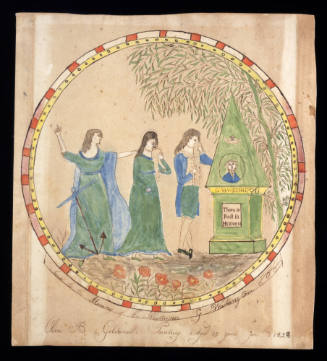
ca. 1815
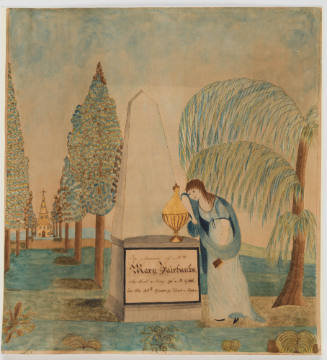
Probably 1815-1825

ca. 1820 (possibly)