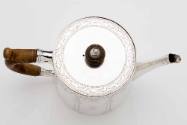
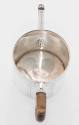
Teapot
Date1771-1772
Marked by
Andrew Fogelberg
Swedish / English, working ca. 1767 - deceased ca.1815
OriginEngland, London
MediumSilver (sterling); wood (cherry?)
DimensionsOH (w lid): 4 ½”; H (w/o lid, to top of spout): 3 ¾”; H (w/o lid, to top of handle): 3 7/8”; OW (including spout and handle): 8”; O Diam. (at base of teapot): 3 3/8”; O Diam. of lid: 3 11/16”
Credit LineGift of Angus Sladen of Hampshire, England, a descendent of the 4th earl of Dunmore
Object number2018-128,A&B
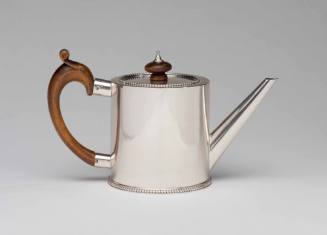
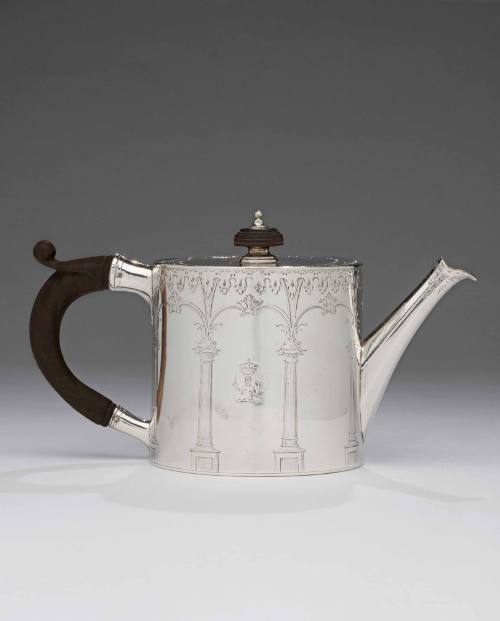
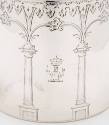
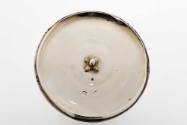
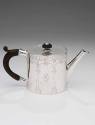
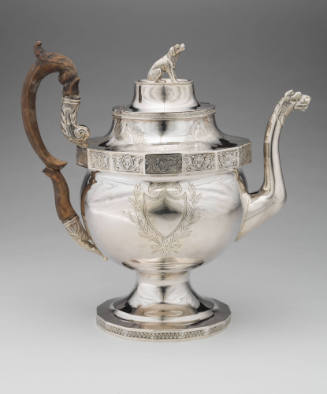
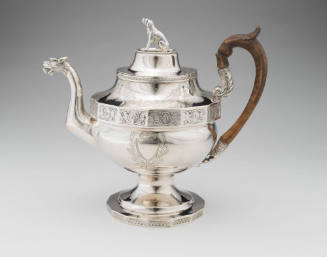
DescriptionSmall cylindrical silver teapot, seamed under spout, with flat circular base, tapered paneled straight spout with slightly everted tip, and shaped tubular handle sockets. Later C-shaped wooden (cherry?) handle with scrolled thumb grip and ring turnings at sockets. Loose flat circular lid with narrow bezel and with finial composed of cast and turned stepped silver reel section below a ring-ornamented turned wooden disk, all on a threaded silver post with bell-shaped silver knop and quatrefoil-shaped silver fastening nut. Sides of teapot engraved with eight arcaded columns with shell and acanthus border at top. Lid with narrow engraved border of scrolling vine and leaves. Tip of spout engraved with leafy tendrils. Proper right side of teapot engraved with the Murray family crest beneath an earl’s coronet.
Label TextThis small teapot belonged to John Murray (ca. 1730–1809), fourth earl of Dunmore, a Scottish peer and colonial governor in America and The Bahamas. Engraved with the Murray family armorial crest beneath an earl’s coronet, it was made in London in 1771-1772 under the sponsorship of the Swedish-born silversmith Andrew Fogelberg. Lord Dunmore likely acquired the teapot during the earliest years of his residency in the American colonies, while serving initially as the royal governor of New York and subsequently as royal governor of Virginia.
Continual strife with the Virginia Assembly marked Lord Dunmore’s tenure in Williamsburg from 1771 to 1776 as the representative of King George III. All semblance of peaceful governance ended in April 1775, when he seized the colony’s store of gunpowder. In June an armed rebellion forced Dunmore to flee to an English warship anchored in the Chesapeake Bay. Having sent his wife and children home ahead of the uprising, Lord Dunmore abandoned much of his household furnishings and personal property in Williamsburg. As a small yet valuable item, the Fogelberg teapot probably returned to Great Britain with Lord Dunmore’s family, as it passed down among his descendants until its presentation to Colonial Williamsburg in 2018.
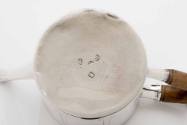
Inscription(s)Engraved with the Murray family crest beneath an earl's coronetMark(s)Struck in relief on base of body: 1) lion passant; 2) leopard's head crowned; 3) date letter "Q" for 1771-1772; and 4) sponsor's mark of "A•F" in a rectangle for Andrew Fogelberg [see Grimwade 1990 # 32]. Struck in relief on underside of lid with marks 1 and 4 as described aboveProvenanceThe teapot descended to the donor via Lady Evelyn Cobbold, née Murray (1867 – 1963), daughter of the 7th earl of Dunmore and Lady Gertrude Coke, daughter of the 2nd earl of Leicester
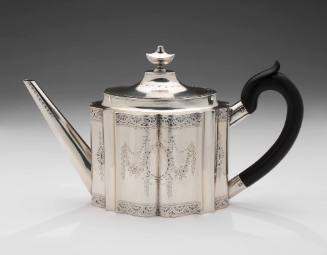
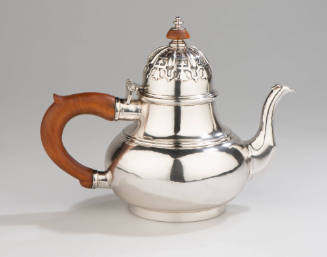
1740-1760