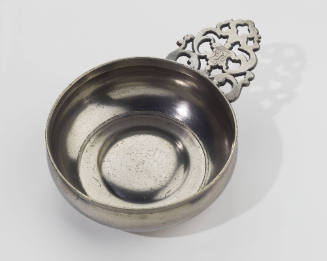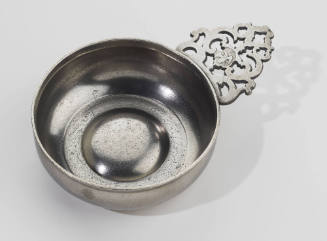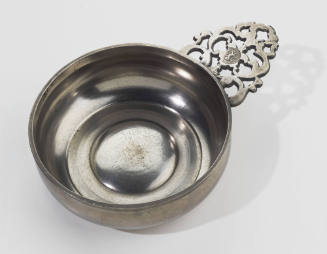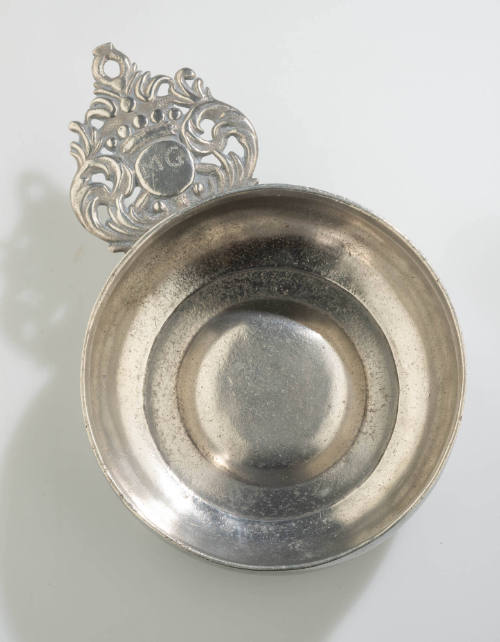
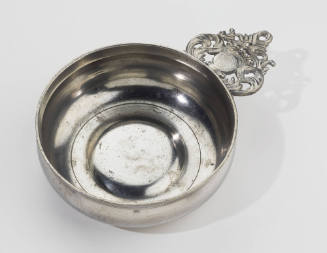
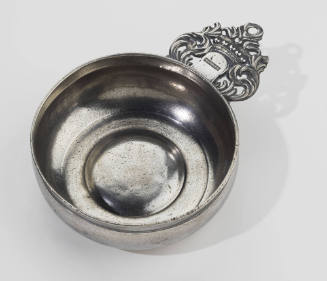
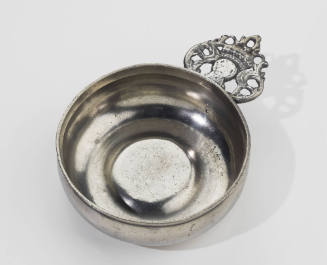
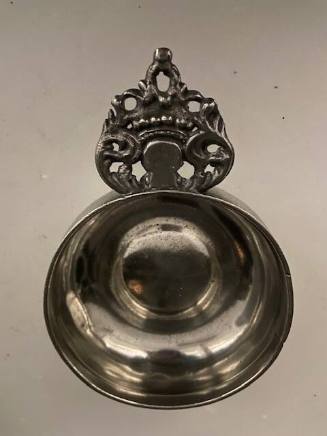
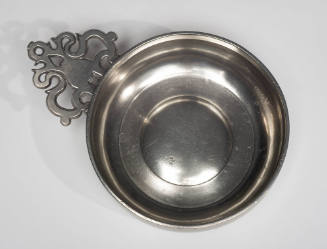
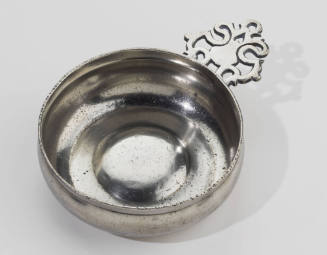
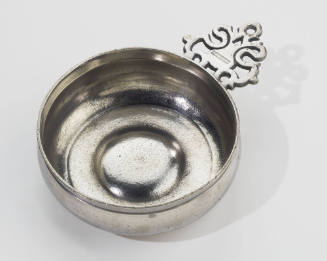
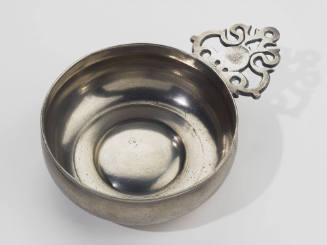
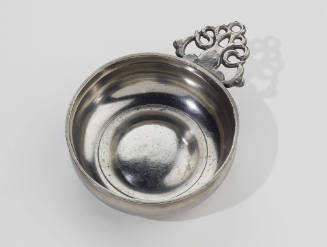
Coronet Handle Porringer
Date1711-1753
Possibly by
Joseph Leddel Sr.
ca. 1690 - 1754
Possibly by
Joseph Leddel Jr.
1718 - 1754
MediumPewter
DimensionsOverall: 7 1/2"; Diameter of bowl:4 7/8"; Height: 1 3/8"
Credit LineMuseum Purchase, The Friends of Colonial Williamsburg Collections Fund
Object number2025-4
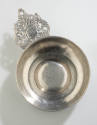
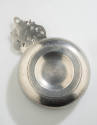
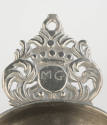
DescriptionPewter porringer with a handle centered around a ducal coronet over a circle, surrounded by foliage and embellished by ten apertures, all below a crested suspension ring at the top. Its bellied bowl has an everted rim with incised lines on the exterior, and a raised boss surrounded by a recess at the bottom. The handle, supported by a triangular bracket, was cast directly onto the vessel leaving a small, deep linen mark inside the bowl.Label TextThe father and son team of Joseph Leddell, Sr. and Joseph Leddell, Jr. created fine quality pewter wares in New York City from the early 18th century through early 1754, when both passed away. Born in Hampshire, England before 1690, the elder Leddell plied his trade at "The Sign of the Platter" in Dock Street before moving to the lower end of Wall Street in 1744. In his will, proved January 22, 1754, he left "all my brass moulds for pewter work and all my working tools" to his namesake.Joseph Jr. (b.1718) was offering his engraving services and selling wares from his house on Smith Street. His ads ran in the New York Gazette and announced that he made "any uncommon Thing in Pewter, in any Shape or Form as shall be ordered." Joseph the younger died on May 10, 1754, at the age of about 36, only outliving his father by six months.
First appearing in England around 1715, coronet-handled porringers became immensely popular in New England after the Revolutionary War. This example is an extremely rare outlier because it was made in New York City, and during the years before the French & Indian War.
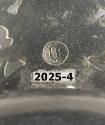
Colonial Williamsburg's porringer by Leddell Sr. or Jr. is amongst the earliest pieces of American pewter in the Foundation's collection. Perhaps one of only two known, an identical example struck with the same touch mark is in the collection of the Brooklyn Museum (Accession # 45.10.150).Inscription(s)The circle below the coronet is dot-punched with the owner's initials MG."Mark(s)Struck on the center back of the handle with "I•L" above a sprig(?), in relief within a beaded border, all within a circular reserve (Jacobs-196). A photograph of the mark on this porringer is plated as Laughlin-579.ProvenanceThomas D. & Constance R. Williams (Litchfield, CT); sold to Mrs. Ralph Hanes (Winston Salem, NC) in 1959; Museum of Early Southern Decorative Arts (Winston Salem, NC); Dr. Melvyn and Bette Wolf (Flint, MI); (Pook & Pook, Inc., Downingtown, PA); 2025, purchased by The Colonial Williamsburg Foundation (Williamsburg, VA).
ca. 1800-1820