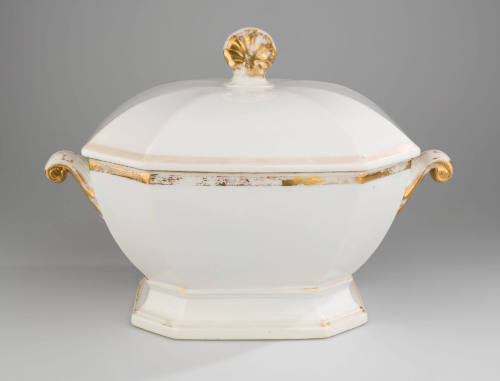
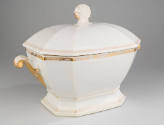
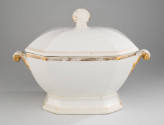
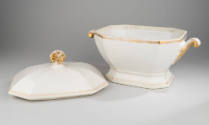
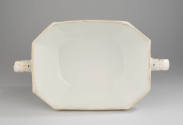
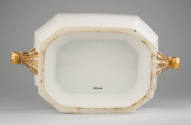
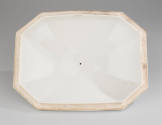
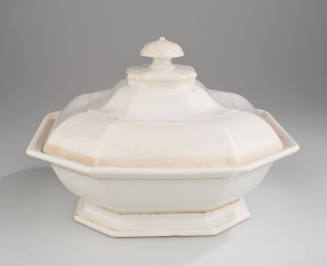
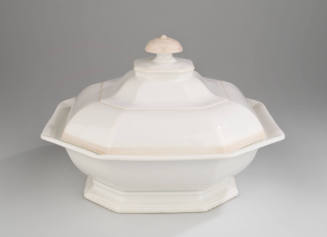
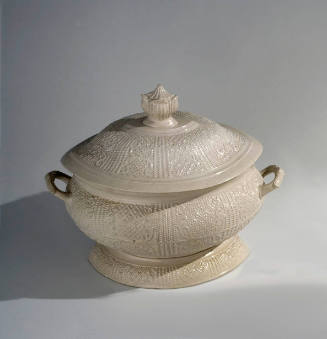
Soup Tureen
Date1827-1838
Maker
Tucker Porcelain Manufactory
1826-1838
MediumHard-paste porcelain
DimensionsOH: 10 3/8" (with cover); OL: 14 3/4" (with handles); OW: 8 3/4".
Credit LineGift of Mrs. Edna and Ms. Wendy Tucker in memory of their husband and father, Edward Bolton “Teddy” Tucker, M.B.E.
Object number2020-454,a&b
DescriptionSoup tureen: stepped octagonal foot rises to the tapered oblong octagonal body composed of slightly convex panels. Two opposing horizontal scrolled shell handles flank the short ends of the tureen just below the rim; there is a single hole on the top of each handle. The domed cover is of a conforming paneled octagonal shape; the cover is surrmounted by a scallop shell-shaped finial supported by a squat pedestal rising vertically from a twelve-petal juncture in the center of the cover. There is a vent hole on the underside of the center of the lid where the finial connects. Traces of gilt bands may be seen around the foot, the stepped juncture between the foot and the body of the tureen, the exterior of the body just below the rim, and the rim on the exterior of the cover. The scroll handles and shell finial show signs of being completely gilt. The glaze wiped on the underside of the foot and on the interior a half inch below the rim, and from the bezel under the lid.Label TextWhen William Ellis Tucker (1800-1832) opened his porcelain factory in 1826, he hoped to establish a domestic industry that could compete with European imports dominating the American market. The factory allowed customers to choose the style and decoration, as well as custom order inscriptions or monograms on their porcelain. The custom order that this soup tureen comes from was likely placed by members of Tucker’s extended family as a gesture of financial support and pride in his business. The surviving receipt requests the porcelain “To be White and Gold,” and the Neoclassical form of the tureen accompanied by remnants of gilt bands show that Tucker’s manufactory fulfilled this request by imitating the most fashionable trends in imported French and English porcelain. The Tucker family cherished the costly set and passed it down through the generations.
The Virginia Tuckers are one branch of the family that owned pieces from William’s factory. Ann Evelina Tucker (1789-1855), wife of Henry St. George Tucker (1780-1848) and daughter-in-law to St. George Tucker of Williamsburg, documents the “Tucker china” in her will.
Mark(s)The underside of the body with two incised slashes within an incised upside down “U”. Incised script “Gu?” on the inside of the foot.ProvenanceDescended through the Tucker family, gift of Edna G. Tucker and Wendy S. Tucker.
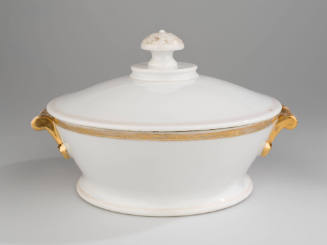
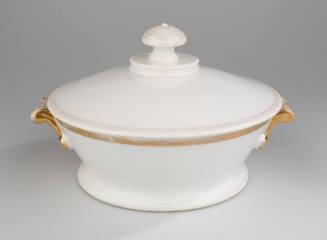
1755-1770