
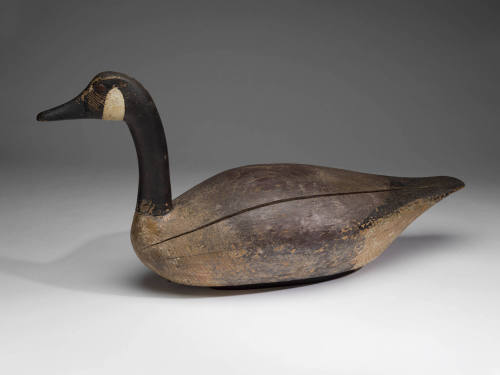
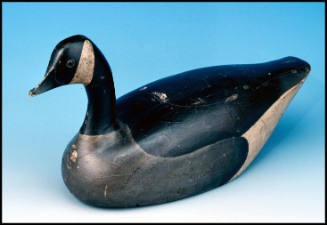
Canada Goose Decoy
Date1920-1925
Artist/Maker
Edward James Phillips
1901 - 1964
MediumPainted wood, lead, and iron
DimensionsOverall: 13 1/2 x 28 3/4 x 10in. (34.3 x 73 x 25.4cm)
Credit LinePartial gift of the Sterling Fund and Fellowship Foundation and Merle H. Glick
Object number1981.702.2
DescriptionHand-carved and painted wooden decoy of a goose that retains much of its original paint. The tail, wing tips, beak, neck, and head are black; it has a white chinstrap, breast, and rump; and its wings and back are brown. The eyes are rusted and may be oxidized upholstery tacks. An original, hand-battened lead weight is attached to the underside with small, wire nails, and a wire cleat is fastened to the base of its breast in order to attach a weight line or anchor to the decoy.Label TextEdward James Phillips was born and lived his whole life on Maryland's Eastern Shore. He began waterfowling around Tar Bay as a young boy, started making his own decoys in 1920, and quickly earned a wide reputation for his quality craftsmanship in both the woodworking and the painting of his birds.The striking design of this Canada goose demonstrates Phillips' keen ability to capture the salient features of a bird while simultaneously adapting them to his personal aesthetic. In addition to Canada geese, he fashioned canvasbacks, redheads, blackheads, black ducks, pintails, and widgeons, all for his own use as a waterfowler.ProvenanceThe Colonial Williamsburg Foundation acquired the object in 1981 from Don Farlow c/o Charles Spiron (Currituck, NC).
ca. 1900
probably 1900-1920
Early 20th century
ca. 1880-1910
Late 19th century
Possibly 1900-1930