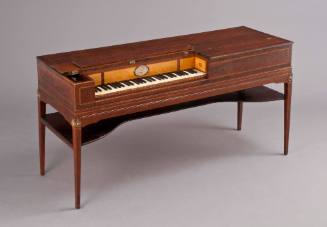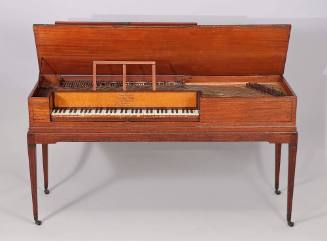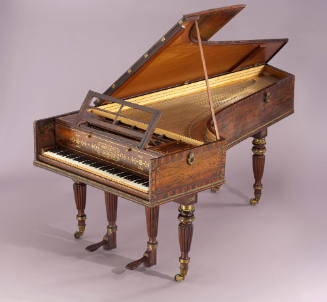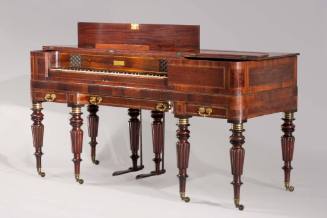
Square piano
Date1800-1808
Maker
Charles Albrecht
1759 - 1848
MediumMahogany: case, stand, hammer-rail cover, overdampers, damper overrail;
White pine: key levers;
Softwoods: soundboard, nameboard substrate, bottom, belly rail, spine;
Oak: key-frame balance and front rails;
Plain light hardwoods: keywell veneer, case inlay, hammers, key fronts;
Maple: pin block, bridge, hitch-pin plank;
Striped dark wood: crossbanding veneer on keywell;
Ivory: natural key tops, lockboard keyhole surround;
Ebony: sharps;
Leather: hammer covers;
Iron: stop lever, tuning pins;
Brass: bolt covers, casters, lid hinges, stop-lever knob, hitch pins, balance pins;
Tinned brass: bridge pins, nut pins
DimensionsNet dimensions exclude lid, stand and projecting moldings. All dimensions in mm except where noted.
Length: 1,601 mm (net 1,583 mm); Width: 567 mm (net 558 mm); Height: 799 mm (net 234 mm)
Length: 1,601 mm (net 1,583 mm); Width: 567 mm (net 558 mm); Height: 799 mm (net 234 mm)
Credit LineGift of Mrs. Jeannette S. Hamner
Object number2004-20,A
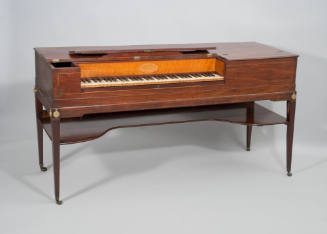
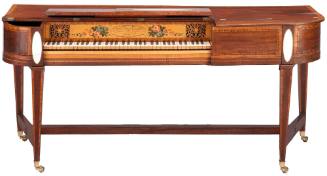
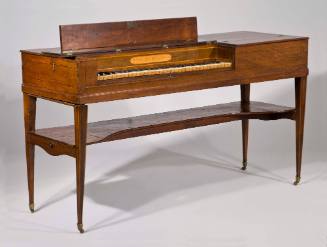
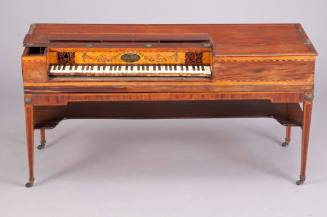
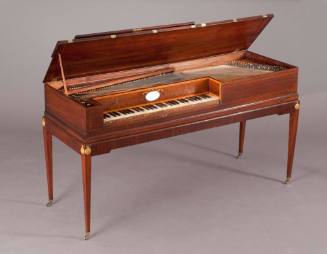
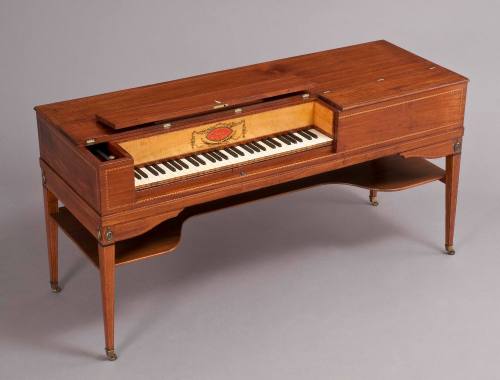
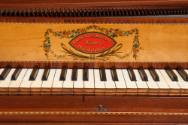
DescriptionCASE DECORATION: The piano has a solid mahogany case with inlayed diamond-pattern string banding.KEYWELL: The nameboard is made of pine with curly maple veneer and rosewood cross banding above and below and composite string inlay. There is an inscription of gold letters on a red cartouche outlined with green and black and surrounded by a floral swag. Below the inscription is gold ribbon on a grass sheaf. There is also a tear-drop-shaped key escutcheon-inlay of ivory.
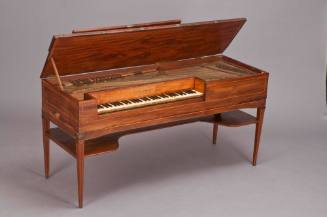
LID: The lid is thumb-molded, with a double row of string banding.
STAND AND PEDALS: The French frame stand has simple white line stringing; its front apron extends only about twelve inches in from each front leg. A music shelf once probably rested on the leg stretchers, but is lost. Bolt covers are at the top of each leg. The castors and six brass bolt covers may be original.
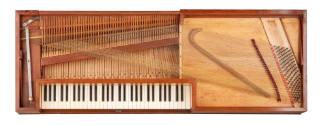
INTERNAL NOTES: There is no provision for an internal folding music desk.
COMPASS: FF–f3
OCTAVES: 5 oct.
STOPS: There is one hand stop for dampers.Label TextThe American piano industry began at the hands of German immigrants in southeast Pennsylvania around the turn of the nineteenth century. Charles Albrecht was the first American to manufacture pianos of a workmanship and design on par with London piano makers of the period.Inscription(s)"CHARLES ALBRECHT / Maker / Philadelphia." in gold lettering on nameboard on a red vesica piscis (pointed oval) cartouche [small caps on maker's name]Mark(s)• "Joshua Baker Maker" in pencil on key bed • "Restoration 1983–84 / Osborne Piano Shop, Carlisle PA. / Technicians: / Mark Showers/ Keith Bowman" in pencil on bottom under key frame • Other inscriptions are penned on the soundboard but these are not easily readable with normal light. Infra-red or ultra-violet light may make them readable. • Note names are stamped on the pin block.ProvenanceDescended in family of Jeanette Hamner, who gave it to CWF in 2004