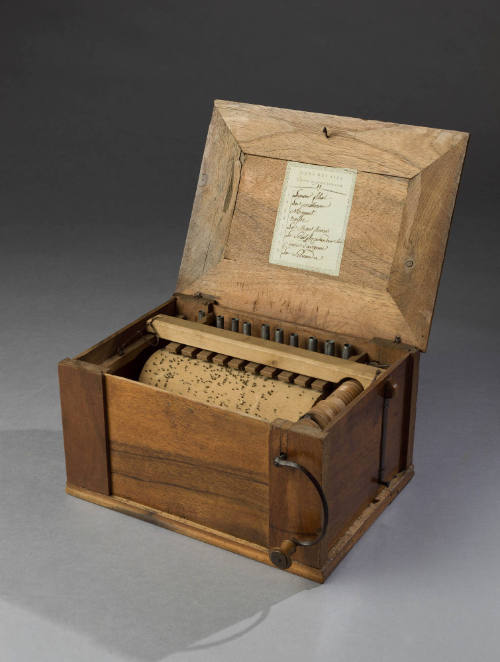
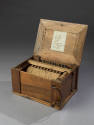
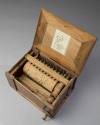
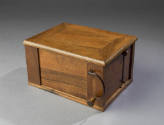
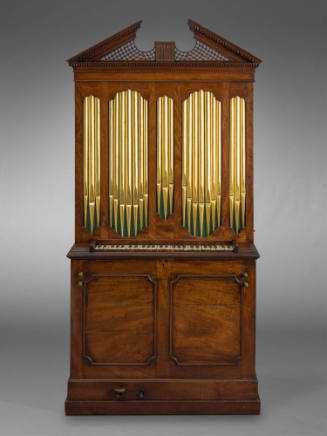
Organ, for teaching birds to sing
Date1780-1820
Artist/Maker
Benoit
MediumWalnut, English sycamore, boxwood, poplar, iron/steel, brass, lead, paper
DimensionsH: 5 3/4"; W: 10 1/2"; D: 7 1/2"
Credit LineMuseum Purchase
Object number1988-19,A&B
DescriptionOrgan for teaching birds to sing.Rectangular walnut case with removable panels on three sides (fourth panel is removable if mechanism is disassembled). Exterior right panel has wood and metal lever used to raise interior mechanism, allowing organ barrel to be moved horizontally in order to choose the desired tune. Exterior front panel has circular opening for end of barrel crank shaft to which detachable handle attaches for turning the organ barrel and producing the tunes. Handle is C-shaped iron/steel with boxwood knob, which has brass mount on which are embossed fourteen stars.
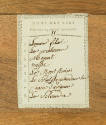
Interior of case contains ten vertical lead organ pipes approximately 3 3/4 inches in length which are glued into the top of a wooden wind chest. Each pipe sounds one of ten different pitches. Brass pins and bridges of varying sizes protrude from the poplar barrel so that as the barrel is rotated, the keys, which are attached to the key frame by means of wire staples, are lifted by the pins and bridges, thus causing the stickers to fall, depressing the pallets, which allows the wind from the bellows resevoir to flow into the windchest and causes the organ pipes to speak. Various springs regulate the expansion of the bellows and the tracking of the English sycamore screw mechanism. Inside top of lid has list of eight songs which the organ plays. Organ roll can be removed if the mechanism is disassembled.Label TextA serinette is a type of mechanical musical instrument consisting of a small barrel organ. It appeared in the first half of the 18th century in eastern France, and was used to teach tunes to canaries. Its name is derived from the French serin, meaning “canary.” Appreciated for their beauty and melodic song, birds were valued as pets and were kept indoors in decorative cages during the 18th century. They were taught to sing popular songs of the day. Surviving books explain how instruments like the serinette, a small organ instrument, or small flutes were used to teach birds to mimic a specific pitch. An organ similar to this one was recorded in Governor Dunmore’s losses after he left Virginia and filed his schedule of losses in 1784, and it is known that his predecessor, Lord Botetourt, had up to twelve birdcages during his tenure in the Palace.Mark(s)Paper label on organ roll: "BENOIT, facteur de serinettes/ a Mirecourt, Dapartment/des Voges"; D11 in red chalk or crayon on three removable panels; pencil "11" on organ roll and support Paper label on inside of case lide lists eight songs: 1) [ ] filial 2) La porcheron 3) Menuet 4) Valsse 5) La Mout ferme 6) Le Soleil 7) Chasse d'avignon 8) La SilvandreProvenanceWurlitzer-Bruck, New York
1782