Spinet
Date1726 (dated)
Artist/Maker
Cawton Aston
OriginEngland, London
MediumWalnut: case sides (solid) , moldings, lid, box guide, rim veneer, pin block veneer, nameboard veneer, end blocks, right jackrail, bracket, stand;
Softwoods: spine, bottom, nameboard, keys, jack-rail rim veneer substrate, key frame, belly and other framing, ribs, horizontals of stand;
Oak: keyboard rack and overrail, key-frame balance rail;
Sycamore (?): pin block;
Beech: nut;
Boxwood: string inlay on case and around inscription, inscription inlay;
Ebony: sharp sides, string inlay around inscription;
Ivory: natural key tops;
Brass: nut pins, bridge pins , hinges and escutcheons, lid hook, balance-rail pins, rack pins
DimensionsNet dimensions exclude lid, stand and projecting moldings. All dimensions in mm except where noted.
Length: 1,785 mm (net 1,758 mm); Width: 680 mm (net 670 mm); Height: 780 mm (net 175 mm)
Length: 1,785 mm (net 1,758 mm); Width: 680 mm (net 670 mm); Height: 780 mm (net 175 mm)
Credit LineMuseum Purchase
Object number1960-321,A
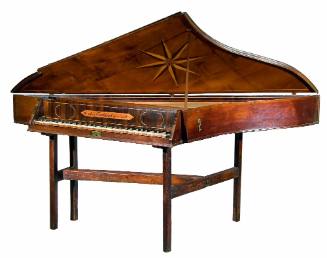
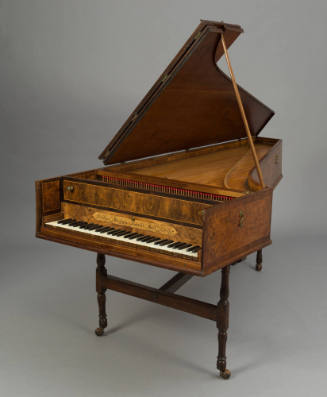
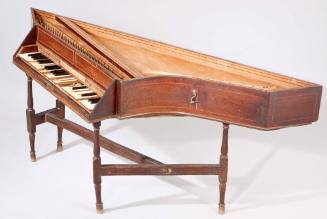
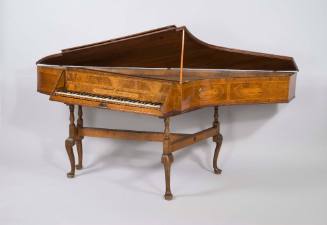
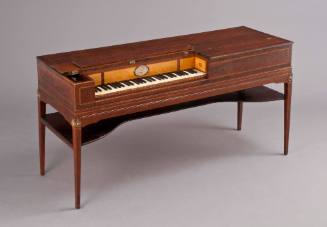
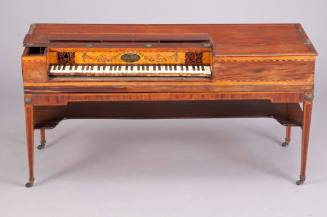
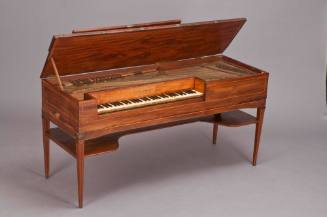
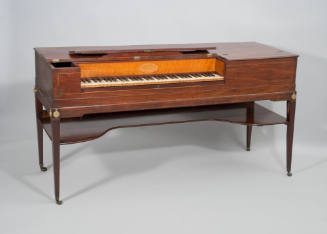
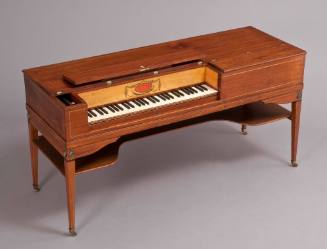
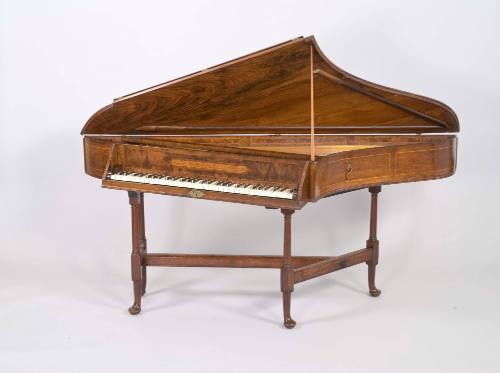
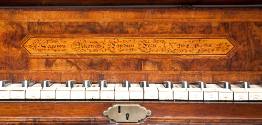
DescriptionCASE DECORATION: The solid walnut case is decorated with white line stringing forming large rectangular panels. The case sides on both ends are bent rather than mitered; the main bent side being double bent. The inner rim is veneered in the same scheme as the nameboard. A molding surrounds the base and ends.KEYWELL: The keywell is veneered with stump walnut, walnut herringbone stringing, and walnut crossbanding. The white inscription inlay is surrounded by white/black stringing.
LID: The lid has rounded edges and drip molding. Three brass strap hinges attach the main lid section and three shorter hinges attach the slanted keyboard cover. A lock is fitted to the front of the case. The hinges are brass and probably replaced; the lid hook is also likely to be a replacement.
STAND AND PEDALS: The trestle stand has turned legs with pad feet and molded stretchers.
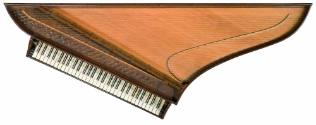
COMPASS: GG–g3
OCTAVES: 5 oct.
STOPS: noneLabel TextThis spinet is one of three surviving instruments made by Aston and the only one in the United States. The double bent-side of the case, "skunk tail" sharps (called this because of their black and white striping) and the arcaded key fronts are typical of the instrument's early eighteenth-century date, but its 5-octave range is an early example more typical of spinets made later in the century. Based on the dates and serial numbers of the three spinets, it appears that Aston was able to finish an instrument every six to seven weeks, a fairly rapid rate of production. The spinet was restored in 1898 by the celebrated early champion of the early music revival, Arnold Dolmetsch, who signed the underside of the soundboard.Inscription(s)“Cawton Aston Londini Fecit No 268 AD 1726” in ink on nameboardMark(s)• "Restored at Bayley St. Bedfore Sq. / Oct. 1898 by Arnold Dolmetsch / [illegible]” in pencil on underside of soundboard • On the back of the nameboard, "G.M.L. / 1900" ProvenanceOriginally from collection of J. Highfield Jones, Esq.; sold at Sotheby’s on Dec. 20, 1954, to Leonard Knight Ltd.; sold on Feb. 18, 1955, to Herbert Rothbarth; sold on May 26, 1960, at Christie’s (Lot 87) to Leonard Knight Ltd.; sold in 1960 to CWF