Quilt, Raised Wool Work
Date1904
Maker
Catherine DuVal Coleman Kemp
1828 - 1905
MediumWool and Cotton
DimensionsOverall: OH 81 x OW 50 1/4in. (205.7 x 127.6cm)
Credit LineGift of the North Carolina Museum of History
Object number2015.609.2
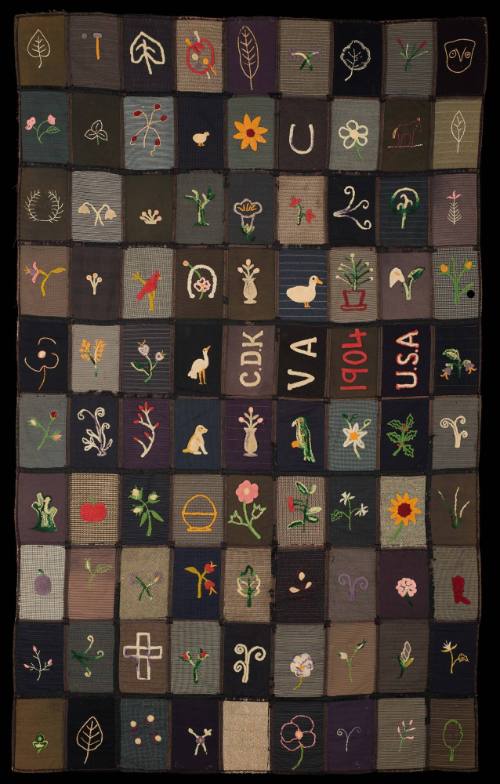
DescriptionThis rectangular quilt is constructed from 90 rectangular pieces of machine-bound wool in blues and greys. Each square bears a different motif in raised woolwork. Many of the motifs are floral, but other typical Victorian designs are also present, such as a dog, a parrot, a cowboy boot, a cardinal, and a paint pallet. Each square was originally outlined with red feather stitch, but has since been covered with black acetate hem tape. The quilt is initial “C.D.K” in the central square, with “VA”, “1904”, and “U.S.A” in adjacent squares. The initialed squares are oriented differently than the rest of the motifs. Label TextArt of the Quilter:
The initials "CDK" stitched into this quilt refer to two Virginia women named Catherine Kemp. Catherine DuVal Coleman (ca. 1832-1905), wife of John Jefferson Kemp, stitched this raised wool work quilt in Norfolk in 1904. Raised work, known for its 3D, textured look, saw a resurgence in popularity in the 1840s, when Catherine would have first learned needlework. Here, this earlier practice blends with a turn-of-the-20th-century trend for wool blocks.
Family history states that Catherine worked this older style as a gift for a second "CDK" - her granddaughter and namesake, Catherine DuVal Kemp (1903-1977). Their lives briefly overlapped, as the older Catherine died only a year after this quilt was completed. Her granddaughter went on to work as a science teacher at Granby High School in Norfolk.Mark(s)Initialed "C.D.K" in central square. "VA", "1904", and "U.S.A" in subsequent lower squares.Provenance1904, made by Catherine DuVal Coleman Kemp (Gloucester, VA); passed by descent to Catherine DuVal Kemp (Norfolk, VA); given to Mary Arthur Billups Stoudemire (Chapel Hill, NC); 1980, given to the North Carolina Museum of History (Raleigh, NC); 2015, given to The Colonial Williamsburg Foundation (Williamsburg, VA)

ca. 1830
ca. 1860
1900-1920
1840-1880