
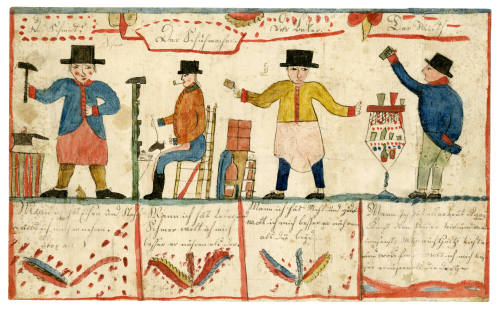
Fraktur: Four Tradesmen
Dateca. 1815
MediumWatercolor and ink on laid paper
DimensionsPrimary Support: 7 3/4 x 12 9/16in. (19.7 x 31.9cm) and Framed: 14 15/16 x 17 13/16 x 13/16in.
Credit LineGift of Juli Grainger
Object number2008.305.3
DescriptionA depiction of four men lined up, cartoon-fashion, across the sheet, with a horizontal dividing line near vertical center, the lower space being sub-divided into four parts, one below each man and each containing text relevant to the figure above it. Reading from left to right, the men practice blacksmithing, shoe-making, baking, and inn-keeping.Artist unidentified.
The 1 7/8-inch frame is flat and painted red with black-painted corners and black-painted inner and outer edge striping and is a replacement possibly dating from the 2nd quarter of the nineteenth century.Label TextThe commonest form of Fraktur in America was the geburts-und-taufschein, or birth and baptismal certificate, a formal document of one of the recipient's qualifications for eternal, heavenly life. In contrast, pieces that capture the appearances and sayings of ordinary men and women are rare. In cartoon-like fashion reading from left to right, this work shows four distinctive tradesmen pursuing their livelihoods: a blacksmith, a shoemaker, a baker, and an innkeeper. The wording consists of lively banter suggesting that each man thinks he has the best, most lucrative profession.Inscription(s)Alan Keyser's transcription and translation made 10/28/2009 are as follows:
[Top of left hand panel:]
Der Schmidt
[To the right of the title:]
Scheia
[Below drawing]
Wann ich hätt Eisen und Stahl/
Wolt ich mich er nähren/ über all
[Top of second panel:]
Der Schuhmacher
[Below drawing:]
Wann ich hät Leder und/ Schmer
wolt ich mich/ besser er nähren als der.
[Bottom left of second panel:]
[??]sa [This word is illegible]
[Top of third panel:]
Der Beker
[Below drawing:]
Wann ich hät Mehl und gedrid/
Wolt ich mich besser er nähren/ als die beÿd
[Top of right hand panel:]
Der Wirth
[Below drawing]
Wann Ich hät aller Leut Gnad und/ Gunst
Rom Seider Bier und wein/ Umsonst,
Mär auch Holtz Lichter/ und accis freÿ
Wolt ich mich bes/ser er nähren als die dreÿ
[Translations:]
The Blacksmith
[??]
If I had iron and steel,
I would support myself everywhere
The Shoemaker
If I had leather and grease,
I would support myself better than he.
The Baker
If I had flour and yeast,
I would support myself better than these two.
The Tavernkeeper
If I had the grace and favor of all people,
Free rum, cider, beer and wine,
In addition free firewood, candles and accis[?]
I would support myself better than all three.
ProvenanceEdgar William and Bernice Chrysler Garbisch; sold at auction at Sotheby Parke Bernet, New York, NY, January 23-24, 1974, whence bought by M/M William E. Wiltshire III, Richmond, Va.; sold at Sotheby Parke Bernet, New York, NY, April 30, 1981, whence bid in by the Washburn Gallery acting as agent for Juli Grainger, CWF's donor.

1750-1770
August 1762
Probably 1838-1842
1830-1840