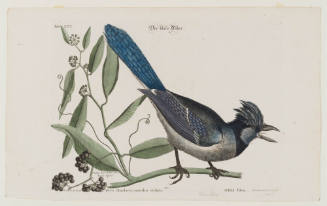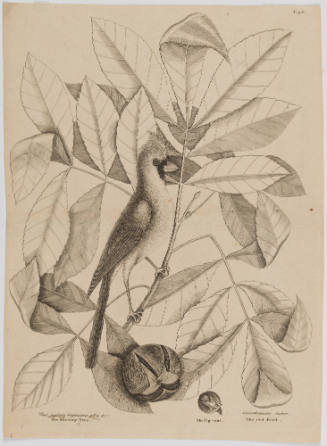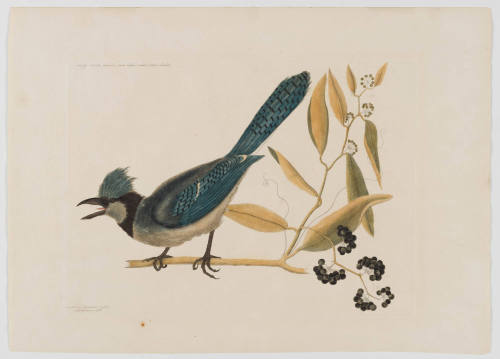
The Crested Jay (Counterproof)
Dateca. 1731
Designed and engraved by
Mark Catesby
1683 - 1749
OriginEngland, London
MediumEtching and line engraving on laid paper with hand coloring
DimensionsFramed (overall): 18 × 24 × 1 in (2.54cm)
Platemark (inverse): 10 × 13 3/4 in (25.4 × 34.92cm)
Platemark (inverse): 10 × 13 3/4 in (25.4 × 34.92cm)
Credit LineMuseum Purchase
Object number1992-6
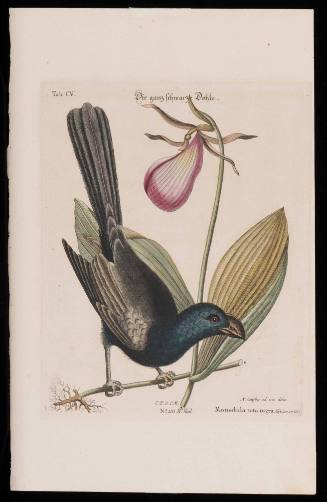
DescriptionCounterproof of "The Crested Jay" by Mark CatesbyUpper right corner reads (in reverse): Smilax laevis Lauri folio non ferreto, baccis nigris.
Lower right corner reads (in reverse): Pica cristata caerulea/The crested Jay./T. 15Label TextEnglish naturalist and artist Mark Catesby’s engravings of birds, plants, and other wildlife were based on years of study and travels through the southeastern part of England's American colonies, including time spent in Williamsburg. The Natural History of Carolina, Florida and the Bahama Islands was the first illustrated publication devoted to the natural history of the that region and groundbreaking for showing animals and birds with plants and trees from their natural habitats. Catesby compared the "Blew Jay" to jays found in England, writing: "They have the [same] jetting motion of our Jay; [but] their Cry is more tuneful." The jay perches on a branch of the smilax laurifolia or laurel greenbrier, which "is food for some sorts of Birds, particularly this Jay."
This print appears in reverse from the plate in The Natural History of Carolina, Florida, and the Bahama Islands because it is a counterproof. In engraving, a counterproof is a print taken directly from another that has just been printed. While the ink is still fresh, the printer can pass the print and another piece of paper through the press to get a second copy. This copy is, however, in the reverse, mimicking the position and details of the plate itself. The object of creating a counterproof is to be able to inspect the state of the plate. The image produced is more subtle, consisting of delicate lines that lack the beveled impressions of the original.
ProvenanceBefore 1992, St. Luke's Gallery (Washington, D.C.); 1992-present, purchased by the Colonial Williamsburg Foundation (Williamsburg, VA).