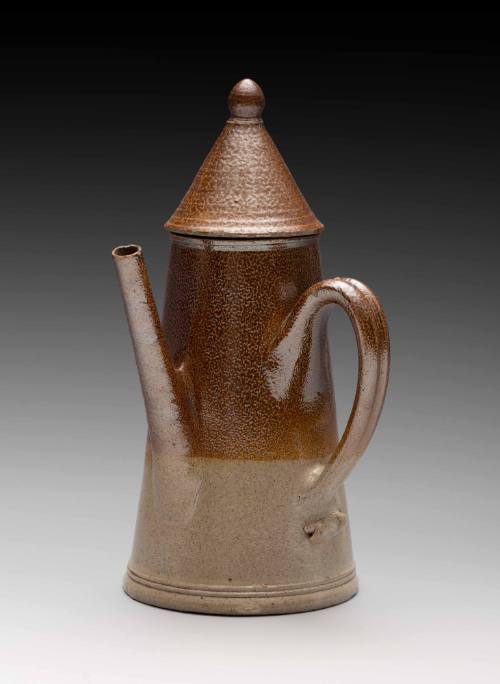
Coffeepot
Dateca. 1710
Maker
John Dwight's Fulham Pottery
1668-?
OriginEngland, Fulham
MediumGray salt-glazed stoneware with white slip and brown (metallic brown wash)
DimensionsOH: 7 9/16 x; OW: 4 15/16in. (19.2 x 12.5cm)
Credit LineMuseum Purchase
Object number1998-167,A&B
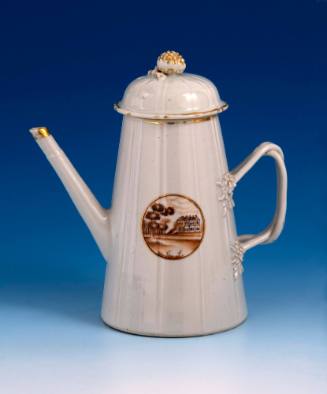
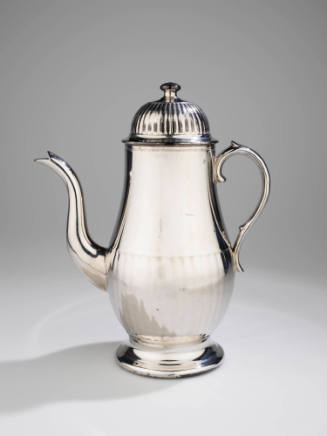
DescriptionConical or lighthouse-shaped coffeepot with double reed above flat circular base and double reed at lip. Molded C-shaped handle terminating in rolled and pinched juncture is at 90-degree angle to simple tapered tubular spout. Conical lid has straight bezel and plain ovoid knop. Entire lid and upper two- thirds of body havewhite slip and rich metallic brown glaze with characteristic orange-peel texture over a gray stoneware body.Label TextThis coffeepot is one of the earliest English ceramic examples of the form to survive.Conical coffeepots, like this example, are often described as lighthouse shaped. By the time this object was made, coffeepots were typically tall or vertical. In comparison, teapots were more squat or horizontal. This was true for all types of ceramic and metal coffee and teapots. While there is no need for such variations in form—hot beverages can be served equally well from either type of vessel—these shapes persist even today.
Shards of a rare circa 1710 white- and iron-dipped lead-glazed stoneware coffeepot attributed to John Dwight’s Fulham factory were recovered from the cellar of the Rumney/West Tavern. In shape and details of execution, the Rumney/West Tavern coffeepot greatly resembles
a salt-glazed lighthouse-shaped example, also credited to the Fulham pottery about 1710, now in the collections of Colonial Williamsburg (1998-167). Approximately a half-dozen early ceramic
coffeepots of this distinctive conical form have survived. The Williamsburg example is made of pale gray clay, and the upper two-thirds of the body, as well as the spout, handle, and lid, were enhanced with a rich ferruginous brown wash. The bottom third of the vessel was coated with a thin, watery white slip that is most evident where it has pooled around the lower handle junction. In lieu of Fulham's usual double-
diamond motif below the handle, a folded and pinched piece of clay has been attached. Fragments of an engobe-decorated bowl were also found among the fill of the Rumney/West Tavern cellar. Dated to circa 1720, it is 2½ inches high and 4 ¾ inches in diameter and features the brown rim common on slip-coated white stonewares. It has been identified as perhaps being a coffee bowl and is tentatively attributed to the Fulham factory.
Inscription(s)NoneMark(s)NoneProvenancePurchased from Jonathan Horne (Antiques), Ltd., London