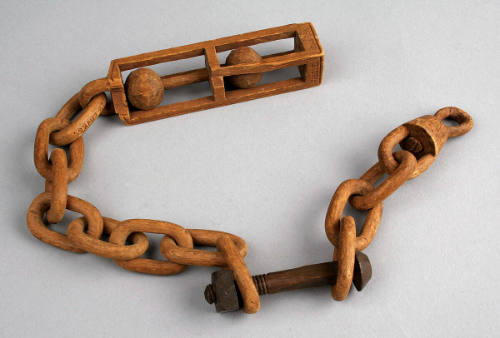
Caged Balls on a Chain with a Swivel and a Bolt
DateProbably 1867-1869
Artist
Frederick E. Parker
(b. 1848, fl. 1867-1874)
MediumThe chain links and swivel are estimated by eye to be white pine, the bolt as walnut
DimensionsOverall: 1 x 1 3/4 x 17 1/2in.
Credit LineGift of Eunice G. Smith in memory of her great-uncle Frederick E. Parker
Object number2002.701.1
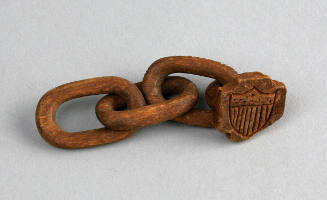
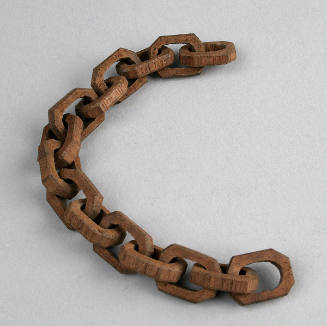
DescriptionTwo lengths of carved wooden chain joined by a bolt carved from a different wood; a carved wooden swivel appears at the end of the shorter (3-link) section, a carved wooden cage enclosing two balls at the end of the other (8-link) section.Label TextWoodcarvers are seldom bored. Their moments of leisure may be snatched between chores or stretched into endless winter nights, but as long as pocket knives and spare blocks of wood are handy, they have the ingredients for relaxation, contentment, and amusement.
Frederick Parker readily mastered caged balls and lengths of chain, traditional show pieces meant to test a whittler's deftness and patience. The swivel at one end of this piece is more unusual, as is the bolt joining the separate sections of the chain. An inscription indicates that the chain once consisted of twenty-two links. Presumably the original chain broke, some links were lost, and Parker re-joined the two shorter lengths by using another carving of his, the bolt.
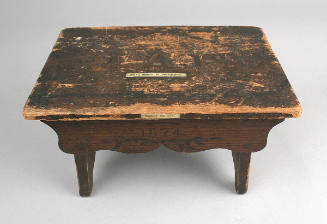
The bolt may have been carved slightly earlier than the rest of the assemblage. It is walnut rather than white pine and probably belongs with a larger group of Parker's whimiscal, carved walnut tools and implements, one of which is dated 1867.
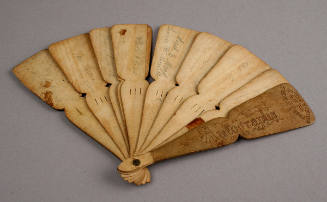
Inscription(s)The link closest to the cage is engraved in block letters "22 LINKS". The Swivel is engraved in block letters "1868" and (over a shield) "IN GOD WE TRUST". The cage is engraved in block letters "MADE BY/FRED. E./PARKER/NOV 1869 [or 1868?]". The bottom of the cage is engraved in block letters "F E P".ProvenanceThe group of carvings eventually passed through the line of Frederick’s youngest sister, Harriet (b. 1858), who married one of the fan signers, Purdy Cornell (b. 1851). Their daughter, Mary Cornell (b. 1879), married John Homer Smith (b. 1875) of Putnam, New York. The donor of the carvings, Eunice G. Smith, was their daughter, and was a lifelong resident of Washington, D.C.
The piece descended in the maker's family to his great-niece, Eunice G. Smith, who was AARFAM's donor.