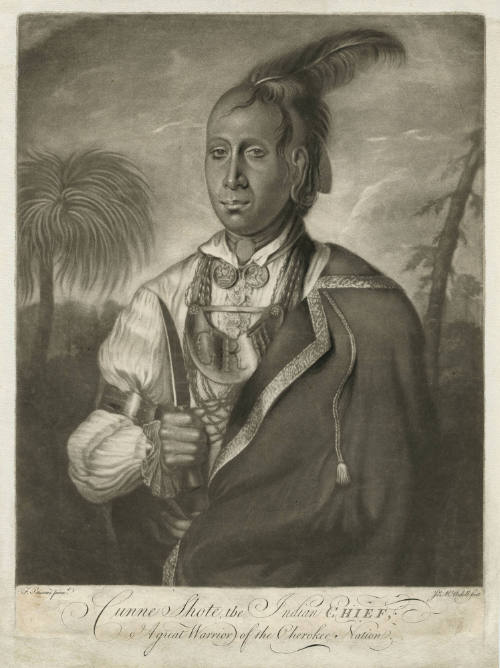
Cunne Shote, the Indian CHIEF, A great Warrior of the Cherokee Nation.
Dateca. 1763
Engraver
James McArdell
1728 - 1765
After work by
Francis Parsons
OriginEngland, London
MediumMezzotint on laid paper
DimensionsOH: 14 1/4" x OW: 10 5/8"; Plate H: 14" x W: 10"
Credit LineMuseum Purchase
Object number2002-10
DescriptionThe lower margin reads: "Cunne Shote, the Indian CHIEF,/ A great Warrior of the Cherokee Nation./ F. Parsons pinx.t/ J.s M.cArdell fecit."Label TextCunne Shote, or Conocotocko II (Standing Turkey), was a Cherokee leader who fought against the British in the Carolinas and Virginia in the 1760s. The conflict was sparked by British officials' executing Cherokee leaders imprisoned at Fort Prince George (today Lake Keowee, South Carolina). Intensifying into the Anglo-Cherokee War, the British enacted a scorched-earth policy to starve the Cherokee into submission, resulting in a Cherokee surrender in 1761. Later that year, Cunne Shote, along with four other town headmen and a group of seventy Cherokees, traveled to Williamsburg, Virginia to negotiate a peace treaty with the Governor, Fancis Fauquier. After signing that treaty, Lieutenant Henry Timberlake escorted Cunne Shote and two other Cherokee leaders to London in 1762 to meet with the King and colonial adminstrators. Cunne Shote was the center figure pictured in the print of the three Cherokees. While they were in London, he also sat for an individual portrait that was subsequently engraved in mezzotint. The Cherokee and the British would continue their alliance into and during the American Revolution.The combination of English and Indigenous clothing items and accoutrements were meant to suggest the harmonious unity between cultures. The medals that he wore around his neck were both struck in 1761 to commemorate the marriage of George III and Charlotte. He also wears a silver gorget with the initials "GR III." The most striking aspect of the portrait however is the forceful grip that he has on the scalping knife - a clear visual reminder of the tenuous relationship between the Cherokees and the English and Europeans living in the South.ProvenanceBefore 2002, W. Graham Arader, III (New York, NY); 2002-present, purchased by the Colonial Williamsburg Foundation (Williamsburg, VA).