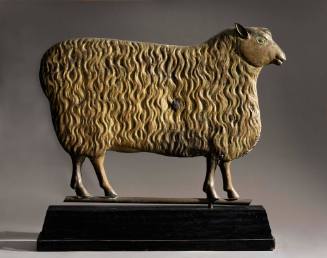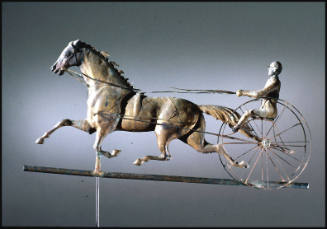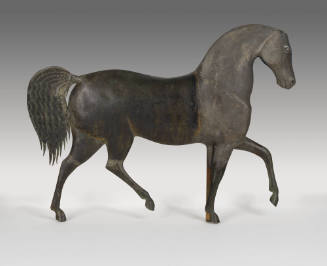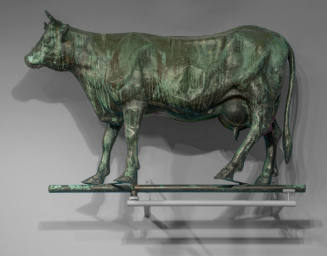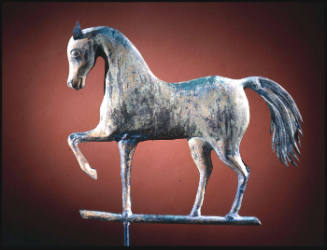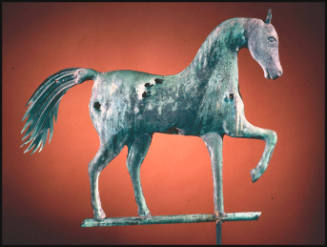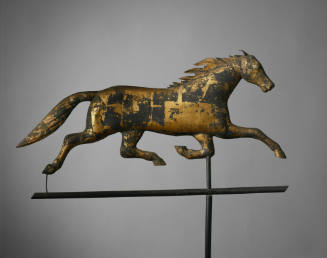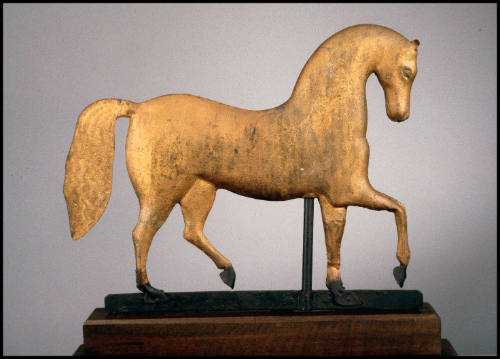
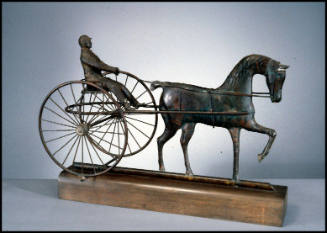
Horse Weathervane
Date1875-1900
OriginAmerica
MediumMolded copper, gilded and painted.
DimensionsOH. 14 1/4" (36.2 cm.) OW. 18 1/2" (47.0 cm.) Base: 20" x 4 1/4" x 4".
Credit LineGift of the John D. Rockefeller, 3rd, Fund, Inc., through the generosity and interest of Mrs. John D. Rockefeller, 3rd, and members of the family
Object number1979.800.8
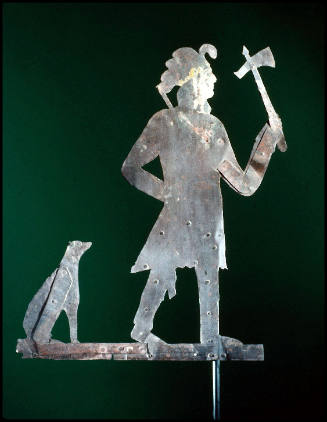
Label TextIn the seventeenth century the colonial weathervanes were of iron cut in silhouette or of wood carved in profile, often painted in non-realistic designs. But, although the cut-out banneret remained fashionable in the South for many years, and the early silhouette form was not discarded, its popularity waned considerably with the general introduction of copper. By the nineteenth, thousands of bright copper weathervanes, modeled in the round and half-round, turned on their direction rods about churches, public buildings and barns. A large assortment of designs exists, including feathers, tulips, ships, birds, animals, fish and figures. Either fashioned on a template, or hammered up and chiselled on a plain block of wood or lead, each copper sheet would take on the desired form in high relief or low. The two sides were joined with solder, and sometimes a cast head or other detail was applied to increase the weight. A later variation reversed the process, applying sheet copper details to a body cast in iron or zinc. Extraordinary stylizations appear in methods followed to simulate wool, feathers, scales or mane. Whatever the subject, whether fashioned on a template or without a guide, the individual interpretation is apparent. Even vanes from the identical cast bear the personal impret in the treatment of applied parts.ProvenanceAcquired by Cahill from M. B. Brown, Hanover Four Corners, June 1935. Given to C.W.F. in 1979.
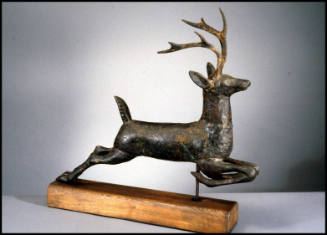
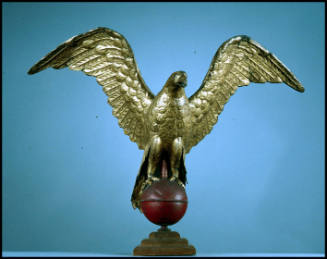
Probably 1870-1900
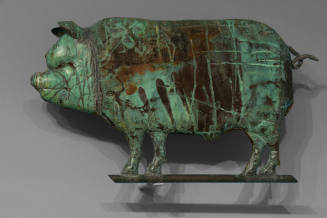
1875-1900
1860-1880 (probably)