
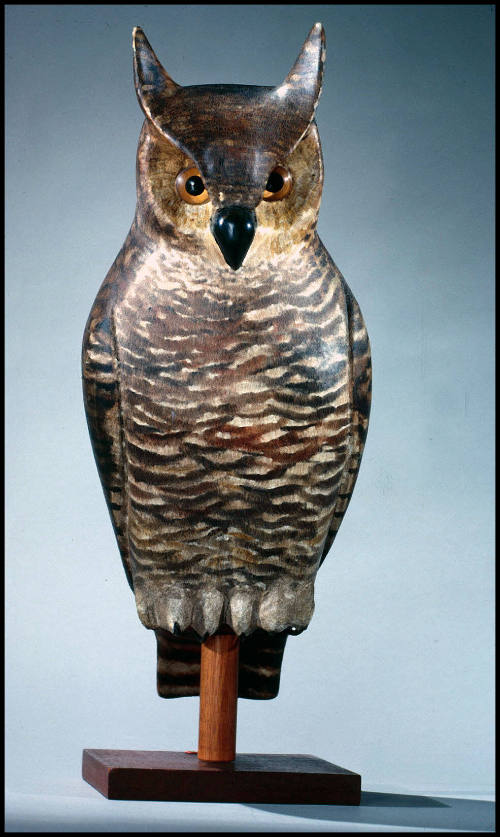
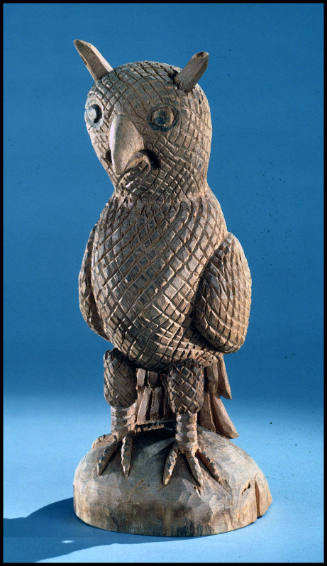
Great Horned Owl
Date1905-1907
Artist
Rex Smith
1886 - 1982
MediumPine, maple, glass, iron, paint, sawdust, and glue
DimensionsFigure alone: 18 3/4" x 7" x 6 1/4" (47.6 cm x 17.8 cm. 9/16" x 7" x 9 3/16" (49.7 cm. x 17.8 cm. x 23.3 cm.)
Credit LineMuseum Purchase
Object number1981.701.2
DescriptionCarved and painted wood carving of a great horned owl. The body is formed of 3/4" slabs of pine, glued together to form a chunk, which was then carved. The black-painted beak is a separate piece, set into the body, and identified as maple by the carver. The eyes are plastic taxidermist eyes, the claws tenpenny nails bent backwards, and the lower legs are glued sawdust, painted. The bird is naturalistically painted in irregular wavy lines of buff, brown, cinnamon, etc., to suggest feathers. The lower wings are defined by carving, and the tail is carved. The bird is free-standing, and it has a hole in the bottom, into which a peg fits, the other peg end going into a square modern base. Label TextRex Smith was an avid outdoorsman as a youth, and this interest is reflected in his Great Horned Owl, which he sculpted when he was about twenty years old. Smith's goal was to use common, everyday materials to create as faithful a representation of the bird as possible.
Smith's model was a live owl that he caught, caged, and kept for a time as a pet, feeding it sparrows. Laminated pine planks salvaged from a shipping crate provided the block from which he carved the owl's body, and the glass eyes were purchased from a taxidermist. Needing a close-grained hardwood for the beak, Smith carved the sawed off end of a maple broomstick. The feet were molded from a mixture of sawdust and glue, and the hooked talons are ten penny nails that Smith bent, then inserted into the feet before the sawdust and glue mixture had dried. After the figure was carved, Smith painted it, carefully reproducing the subtle tonalities and patterns created by the overlapping feathers that he had observed on his model.ProvenanceFrom the artist and his wife directly to AARFAC.
ca. 1735
ca. 1735
Possibly 1910-1930